


At the time of writing this I was sitting here reading 2 Chronicles 22 during my prayer time when my brain stops me in my visions. I joke and call them the That’s So Raven visions:

This is how I imagine I look when I start connecting patterns. I’m sitting here reflecting how awfully familiar some of the dynamic depicted in this book feels. I start thinking of modern societies today. Ahaziah becomes king after the older sons are killed, his mother Athaliah is influencing him toward the ways of Ahab’s house, the people around him are advising him into decisions that ultimately contribute to his destruction (this part, save this part for later), and the whole thing reads like one of those families where you can tell nobody woke up one morning and decided, you know what would be fun? Generational dysfunction.
All the behavior was learned from some where. It was inherited. Normalized. Reinforced. Protected. Everybody was learning how to survive inside something that already existed long before they had enough awareness to question whether it should continue.
Sound familiar?
Verse 3 reads “walked in the ways of the house of Ahab, for his mother advised him.” That sentence holds two truths at the same time when I look at. Now, for those who may cringe at the discussion of biblical topics. Hang tight there is a reason for this.
We as a society have become increasingly bad at building the muscle to hold multiple truths at once. Which is interesting, because most of the gridlocks we get into—unless the gridlock is entirely within the self—involves other people. Partners, family members, co-workers, whoever. The second another person enters the equation, another perspective enters with them. You know what that means Ding Ding Ding there are multiple versions of what feels true inside the same system.
I use the word “truth” lightly here, because none of us have access to the full truth of an entire relational system—unless you're God. I mean think about all the secrets the trees and the birds are holding onto about us humans. If only they could speak…
Anyways,
We know what is true from where we are standing. We know what we felt, what we noticed, what we intended, and what we experienced. The other person is standing somewhere else, having their own experience of the exact same interaction. The work is learning how to hold both without immediately deciding that one person’s reality has to erase the other’s. When I get to this stage of the work with my clients, it is the most hardest to navigate even as the professional. That’s why trying to Costco style the work by arriving at it only when the fire has already started spreading. That is like calling the fire departement only after the house burned down.
This sounds about American if you ask me. Let’s not tend to anything until it is already dying. Then try and throw skills at it.
No, that will not work here.
Holding multiple truths while screaming for someone to hold yours takes focus. Think of it like training for some sort of marathon or sport. You have to clock in multiple training hours in order to get the body prepped for race or game day. Same concept but for the need to have something outside yourself validate you.
In the book 2 Chronicles
Ahab was influenced by the system he came from and he was still responsible for what he chose to participate in. Understanding somebody’s childhood does not require pretending adulthood has no consequences. In our society of Dopamine Nation, we spend so much time talking about what feels good, what regulates us, what soothes us, what gives us relief, but developmental growing pains somehow keep getting left out of the conversation. We can learn everything there is to know about maladaptive and dysfunctional behavior, but compassion does not require the removal of responsibility.
As I kept reading, the chapter got darker. I don’t want to be dramatic here because the Bible has this hilarious way of describing absolute family chaos, but after Ahaziah dies it is basically: well, all family hell broke loose. Athaliah attempts to destroy the royal heirs and seize power and I’m sorry—are you kidding me? My brain immediately went to so many family systems I have worked with or witnessed where one person is trying to dominate the entire system through force, coercion, intimidation, manipulation, abuse, control, whatever flavor of dysfunction is on special that week. Sometimes the implosion gets so big that it genuinely looks like the dysfunction has swallowed the whole family line.
Just like here, when Athaliah comes for the royal heirs, you almost want to lean back and go, welp. That’s it. Pack it up. The generational trauma won.
Except…
One child remains.
Joash.
One little boy is taken and hidden away.
This part had me like:

Sometimes one person remaining is enough to create another possible future. A shift in how the family operated. Thing breaking generational trauma here, Joash surviving meant that the dysfunction of the family he came from does not have to continue any longer because he is the one who sets the tone for that—possibility. This is not about guaranteeing something or gaining certainty. I know I know. We all want certainty. Trust me, the more I dig deep in this work, the more I realize how much my nervous system is a fiend for certainty. However, the more I sit with this work, the more I have to face my own realizations about how deeply I crave certainty. In the book however he does start to see how fallen the temple was and works to restore it. In modern words this looks like someone in the insight stage of behavioral change. Gathering information and doing that is necessary to create the change. Joash is preparing what the generations before him allowed to deteriorate. Take a moment and compare this to your own life and family system.
I think about a lecture I watched with Bruce Lipton speaking about his work in The Biology of Belief and the role hope can play in healing and rewiring. In 2 Chronicles, the meaning and impact of one child remaining demonstrates hope in such a powerful way. If you keep reading his story, Joash is still complicated because human beings are complicated. Hope in Scripture is rarely the promise that somebody becomes perfect, especially overnight. What his survival represents is that the destructive system did not become the only possible ending. There was still another road and that is the hope Bruce Lipton highlights as a driving force for change.
When I bring that story into our modern world, I can’t help thinking about the person in a family who starts noticing things nobody else wants to name. Maybe it is the scapegoat or the one who finally goes to therapy. It could be the one who starts asking why everybody is terrified of one particular family member, or the person who realizes that anxiety has been passed down like a family heirloom and everybody has simply been calling it “being responsible” or “being cautious” but you are the one who wants to get out and stretch out farther than where your family has gone. You may be the daughter who learns that love and enmeshment are not the same thing. The son who realizes that respecting his mother does not require allowing her to govern his marriage. The parent who decides their children are not going to grow up carrying emotional assignments they were never supposed to receive.
Sometimes you are the child who remained. Not in a Harry Potter-survived kind of way, unfortunately you do not get a cool scar with this one. I truly believe it is because something in you survived long enough to start asking whether the system gets to keep deciding who you become.
That is hope.
Beautiful, right?
Try it on for a moment.
Go on…
I think we desperately need to talk about hope again because so much of modern psychology has become very good at naming the inheritance and strangely bad at reminding people that an inheritance is not necessarily a destiny. We are learning all about our attachment styles, our diagnosis, our trauma response. We learn our neurotype. We learn that our mother did this, our father did that, our nervous system adapted this way, our genetics may make us more vulnerable to that. All of this can be useful. Some of it can be life-changing because naming something can finally give language to an experience we have been living inside for decades. Eventually the information has to become something other than an identity card though and that is where humanity has sort of stalled.
At some point the work is not just saying:
I have ADHD. I am anxious. I am avoidant. I have trauma. This is my attachment style. This is what my family did.
The work becomes: What am I going to do with what I now know?
I think this is where I have started becoming increasingly irritated with the way we collectively regurgitate therapy language while somehow avoiding therapy’s actual invitation inward.
We villainize avoidance while participating in a massive cultural version of it.
I mean let’s zoom out and see…
We keep pointing at avoidant people yet do not see the very parasite of avoidance that lives deep within us.
Every time the analysis ends exclusively with what somebody else is doing to us, we may be avoiding.
Every time we can perfectly describe our partner’s attachment style but have no vocabulary for what happens inside our own body when we feel rejected, we may be avoiding.
Every time we collect another diagnostic label and use it primarily to explain why the behavior cannot change, we may have turned insight into another hiding place. Insight is not integration.
Knowing why the room caught on fire is useful trust me I get it.
But Eventually somebody still has to stop standing inside it explaining and grab the f*cking extinguisher!!!
For the people in the back.
Yes:
Genetics matter.
Trauma matters.
Neurobiology matters.
Environment matters.
YES YES YES YES YES!! We hear you!!!! Your trauma matters!!!
Epigenetics has made it increasingly difficult to pretend that biology and environment exist in separate little boxes. People like Daniel Amen have spent years talking publicly about the brain as something influenced by lifestyle rather than a fixed moral identity, and Bruce Lipton—whose work I have found personally thought-provoking even where people debate his broader interpretations—has consistently emphasized the relationship between environment, perception, and biology. I am not interested in using any of that to say somebody can positive-think themselves out of every psychiatric condition. That would be ridiculous. I am interested in the deeper philosophical question underneath it: What if the diagnosis tells us something about the terrain without sentencing us to one path through it?
This is the terrain you are having to drive on, but you can switch the car if you need to in order to drive on it better.
That is what Joash represents to me. Another path exists because somebody remained.
I have been developing something in my own work that I keep coming back to, which is almost like my own hierarchy for this kind of relational and internal growth. The first level is willingness. Then insight, Awareness, ending with consciousness. The goal is not consciousness in some airy crunchy spiritual sense. I mean the ability to become consciously aware of what lives within you, including the shit you do not particularly enjoy seeing about yourself, and then use intentional effort to create another behavioral pathway.
Willingness says, I am willing to look. Insight says, I am beginning to understand why. Awareness says, Oh shit, I am actually doing it right now. Consciousness says, I can see what is happening while it is happening and increasingly choose what I want to do with it. That last level is close to what self-actualization has always meant to me. Not perfection or trying to eliminate the shadow. I also don’t want us all to absorb a belief that the last level means you are reaching some imaginary graduation where you never become defensive, anxious, controlling, jealous, avoidant, insecure, arrogant, resentful, or afraid again. It is becoming increasingly capable of meeting those parts of yourself without immediately handing surrendering to them as full stop evidence or declaration about yourself.
When you enter any meaningful union, whether it’s a marriage, friendship, family, workplace, community. We must as humans understand, class is going to be in session, honey!
You can completely ignore the assignment if you want to. People do it every day. Sometimes for decades. Understand thought, that not choosing is still choosing. A lot of us sit at the intersection complaining that we do not know which road to take while failing to realize we have already selected the road we are currently standing on. We keep looping in it because the alternatives require something from us that feels scarier than familiarity. Marriage makes this painfully obvious because two people can arrive at the same relationship with completely different assignments. One partner may need to learn how to speak up more. While the other may need to learn how to stop talking long enough to listen. You may be in season that may require something different of each of you, you may need to learn how to establish boundaries with each other, or even a parent or family member. Or you may need to soften a boundary that has actually become a wall. Differentiation could be something both parties must learn and it will look differently for each person. One may need to learn independence. The other may need to learn interdependence.
What about invisible lessons? Interpersonal lessons, such as learning how to stop abandoning yourself every time you are in relationship. That might look like expressing yourself more opening rather than harboring resentment or becoming passive aggressive. The other may need to discover that every uncomfortable feeling does not constitute an emergency requiring somebody else to fix it. You know, the mirror moment for me in all of this is the cruel understanding that you can’t take your partner’s exam for them. You can explain the material, send them the podcasts and the reels. Maybe even orchestrate the therapy sessions. At some point they have to sit in the chair and show up for their assignment and you have to focus on yours. That is their mission, and you have one too.
That is where many overfunctioniners get stuck. They want to help him, adjust, explain the directions. do all the things they were doing that contributed to this dynamic. What happens if you are in this role and you:
stop.
What happens?
What will you do in all that open space, how will you fill it?
Maybe that is what we overfunctioners are distracting ourselves from. Our mission is to sit in that realization and the discomfort that comes with it while exploring what comes up emotionally for you. I have my own version of the same mission I have to face, and am currently navigating myself. There are many women who are more anxious and tend to lean toward the pursuer role, and honestly, I want to ditch some of the anxious/avoidant language for a second and just talk about pursuers and withdrawers. When we lean in, they lean out, but sometimes once we lean out, that is where the magic happens. Now ladies, I am not her for the passive aggressive forms of communication through huffing, and puffing, and deep sighs, circulation, hovering, survalencing behavior. That screams like a nervous system that is unregulated and ready to instigate a discharge match of shitty tennis. This work is not about playing petty games or trying to manipulate somebody into coming closer. The goal here is for us in the pursuer roles to finally stop filling every inch of space with our fear, our questions, our urgency, our interpretation, our need to know.
no no no… We don not need you to explain the why at this time. I am asking for you to do the bigger challenge of sit in the discomfort that your explanation is freeing you from. You might be trying to gain clarity, trying to understand, resolve. What ever you want to name it the assignment is simply this.
Stop it, and go sit in the shit.
The shit of the discomfort that is radiating inside you. The shit that creates the urgency to get up and go explain, get defensive about, etc. That shit is the weight of discomfort that you are learning how to bench press.
So let’s get to it.
I am saying this with my entire chest because I am one of the anxious women who has had to learn this the hard way. Sometimes we keep touching the heat.
Did you do it yet? Did you talk to her? What did she say? What are you going to do? When are you going to do it? Do you understand why this matters? Let me explain it again in case you did not.
Then we are furious that the other person feels pressure?
Girl!
We are pressure!! 😂
I do not say that to shame us because usually underneath the pressure is fear. We are trying to create the outcome because creating the outcome temporarily makes us feel safe. But I have had to ask myself a brutal question: If I have to orchestrate being chosen, was I actually chosen?
If I have to manage every boundary, formulate every conversation, supervise every change, remind somebody why the marriage matters, explain what they need to do, and then make sure they do it on the timeline that keeps my nervous system calm, am I allowing another adult to choose the marriage or am I manufacturing the experience of being chosen because some part of me is terrified that I will not be? That one hurt my feelings. Which usually means I should keep looking at it.
Because my mission in certain seasons has been to back the F up. Not emotionally abandon or become cold, start weaponizing silence.
No.
Just Back up.
Go clean my own mental house.
Go move my body.
Go organize my business.
Go finish the things I have been avoiding. That may look like going and finding water to regulate next to even if it’s the bath.
Go return to the version of myself that existed before I decided my partner’s internal world needed to become my full-time research project. Let somebody think. Let them struggle. Let them be uncomfortable. Let them decide.
We have made discomfort into evidence that something has gone terribly wrong when sometimes discomfort is literally the classroom. The funny thing is that we criticize avoidant people for running from discomfort while anxious people have our own sophisticated form of avoidance: we try to solve discomfort before we have to feel it. The problem with that is through trying to solve it we generate discomfort internally, once it’s generated internally we start acting out as if that discomfort was a real threat.
One of the things I keep thinking about is the lake. The waves can be chaotic without the lake ceasing to be a lake. That image has become useful to me because I have spent a lot of my life reacting to waves as though they are announcements about the entire body of water. A bad day becomes, the marriage is bad. A disconnected week becomes, we do not love each other. A partner’s mood becomes, something is wrong. My anxiety becomes, I need to make a decision. A family conflict becomes, this will never change. I think one of the spiritual and psychological disciplines of adulthood is learning how to access the lake while the waves are still happening. Not pretending they are not there. Not spiritual-bypassing yourself into saying, everything is peaceful. No. Sometimes it is a fucking storm. But storms are events. They are not identities.
Marriage makes the unconscious visible in a way single life sometimes allows us to avoid. When you are alone, you can organize many things according to your preferred rhythm. You clean when you clean, rest when you want, work when you decide. You can arrange your house exactly how you want it. Nobody else’s mood becomes ambient weather that can dampen on yours.
Until, you marry somebody and suddenly there is an audience to your low seasons. They see you depressed, when you’re unproductive. They see you doubt yourself, and watch you self-sabotage your habits such as working out. They hear your irritation. They see the dishes and the clutter. They experience your stress, moods, irritability, snappiness. Sometimes what gets activated is not even your partner’s expectation. It is your own internalized expectation waking up because somebody is there to witness you. I have heard so many women describe hearing their husband pull into the driveway and immediately jumping up to look productive. Maybe sometimes the husband has created that environment. Maybe sometimes something much older has entered the room and created and urgency to “ look busy.” Either way we have to be willing to ask both.
That is the uncomfortable shit.
I mean any real relationship changes the terrain. A friendship will. Parenthood will. A workplace will. A spiritual community will. A marriage absolutely will. Which brings me back to the question I do not think enough people ask before getting married:
What do you think a husband is for? Seriously.
What is a wife?
What is marriage?
When you imagine it, where does your mind immediately go?
If your first images are the ring, the dress, the venue, the photos, and the honeymoon, I regret to inform you that you are describing a party. You can have a party right now. You do not need a marriage license.
Marriage asks much deeper questions. Can you love somebody when they inconvenience you? Can you serve without keeping a running invoice? Can you receive influence without experiencing it as domination? Can you disagree without immediately threatening the union? Can you tell your mother no? Can you let your husband be disappointed? Can you stop making your wife responsible for the emotion you refuse to name? Can you tolerate your partner becoming more successful without turning their growth into abandonment? Can you be alone without punishing the person who needs space? Can you be close without consuming them? Can you remain yourself while belonging to a “we”?
That last part especially as women. We look at men so graciously operating without what we often may belle is a care in the world. we look at them from our lens of contempt. Look at him over there relaxing while dinner has to be made.
Meanwhile you could have ordered in take it.
He never asked for hoe made meals.
He would be cool with whatever.
What if, it’s actually you that is complicating the role of wife?
That is marriage. The wedding is the orientation. Class starts afterward.
I think most struggling couples eventually arrive somewhere where three paths become visible. One road is continuing exactly as you are. One road is leaving. One road is rebuilding the relationship into something neither of you has actually lived inside before, that would be the ideal direction. Maybe for you leaving is the ideal direction.
No one can tell you that. Not even the “This video was meant for you” or “ God wants you to know this” videos are going to give you the answer.
People often think they are sitting at the intersection deciding between the second and third road. Meanwhile they have already chosen the first. They are still living the same marriage, having the same argument, defending the same positions, waiting for the other person to complete both assignments.
Not choosing is a choice.
You are simply choosing familiarity while avoiding the grief and risk attached to the alternatives. That third road, the rebuilding road, has prerequisites: willingness, insight, awareness, consciousness.
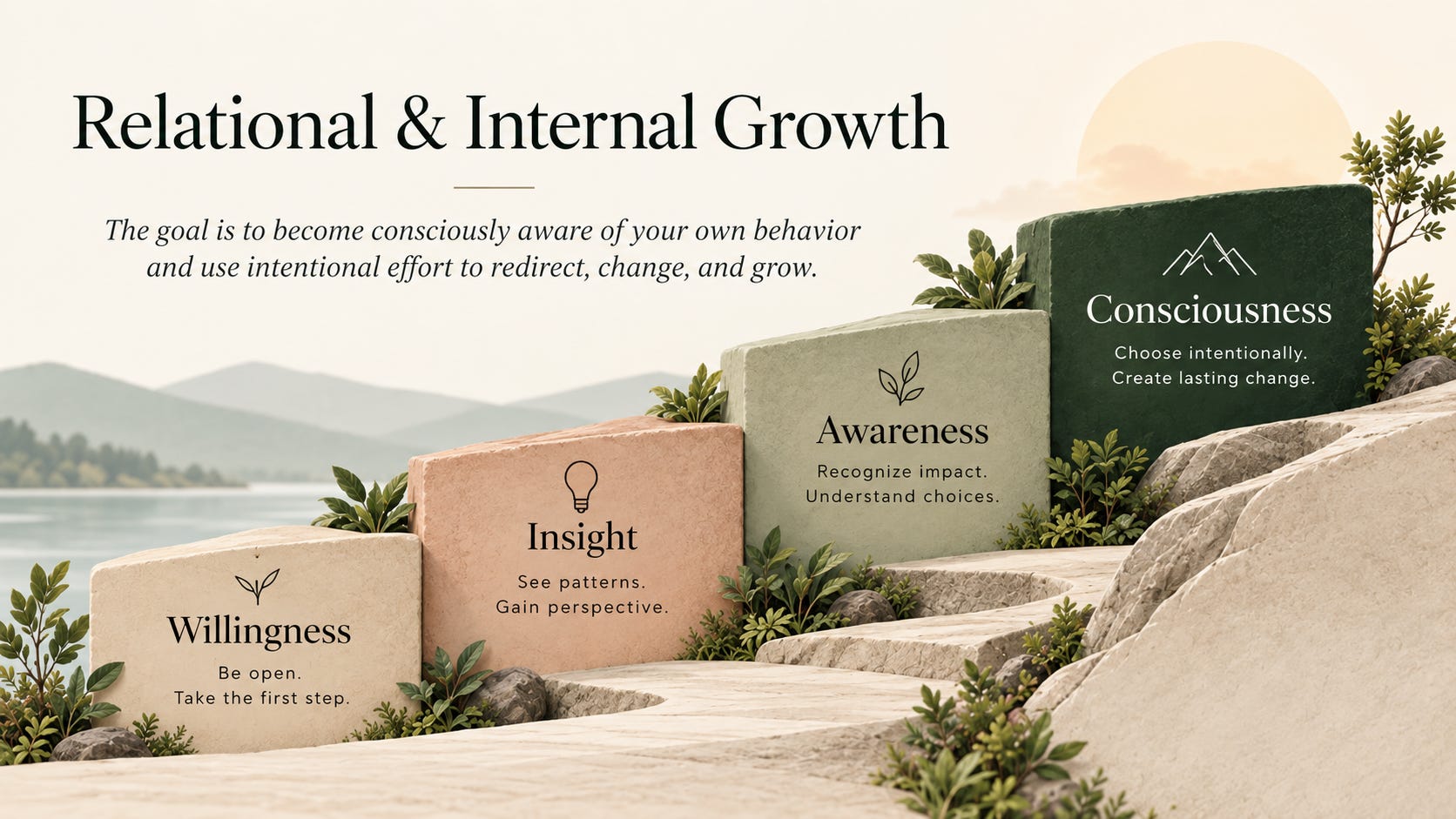
If one person has no willingness, there is nothing to build with. If both people have willingness but no insight, they may sincerely love each other while repeatedly recreating the same injury. If insight develops without awareness, they can explain the cycle beautifully after every fight and still enter it again tomorrow.
Awareness is where somebody starts noticing, oh shit, I am doing it.Consciousness is where another possibility becomes available: I know what I usually do here. I am going to try something else.
That is rewiring.
The goal is to never become activated.
We also are not weaponizing the therapy language and tools as a way to exaggerate your use of them either. This is something I see in session quite often.
This is why I can’t stop thinking about Joash.
Except there is something I haven’t told you yet.
Remember our little surviving child Joash? The one hidden away while Athaliah tried to wipe out the entire royal line? He grows up. He becomes king and for a while, it really does look like we got ourselves a biblical cycle-breaker. Joash does what is right. He decides to restore the temple that had been neglected and damaged. He organizes the work, raises the money, brings people in and starts repairing the house. I mean, come on. If I were trying to manufacture the perfect metaphor for healing generational dysfunction, I couldn’t make this shit up. The child who survived the dysfunctional house grows up and starts repairing the house.
Beautiful.
Except...
Keep reading.
Jehoiada, the priest who helped protect Joash, supported his rise to the throne and appears to have been an incredibly important stabilizing influence in his life, eventually dies. Then the officials of Judah come to Joash and something changes. Scripture simply tells us that “the king listened to them.” Joash abandons the house he worked so hard to restore and turns toward idolatry. Eventually Zechariah, Jehoiada’s own son, confronts what is happening and Joash orders him stoned to death.
Excuse me?!
The surviving child who looked like he was going to break the cycle becomes part of another destructive cycle of influence!?
This is where 2 Chronicles stopped being a cute little hope metaphor for me and became something that I see in modern relationships today without all the “off with their head” lingo.
Go back to Chapter 22. Ahaziah’s mother “was his counselor to do wickedly.” Afterward, the house of Ahab became his advisers “to his destruction.” Influence is woven through this family system. People gain somebody’s ear. Loyalty shifts. Destructive behavior becomes relationally reinforced. Then generations later, here is Joash, seemingly walking another road, and after the person who had been guiding him dies, another group gains his ear and he listens to them. What do I mean when I say “gains his ear.” Think about families and how people in them switch their stance simply because of who they are in company with.
Now, we have to be careful here because Scripture does not climb inside Joash’s nervous system and tell us the why behind how he was so easily influenced. Was Jehoiada functioning as an external moral compass Joash had never completely internalized? Was Joash deeply impressionable? Was belonging more powerful than conviction? Did losing Jehoiada destabilize something in him? Was power involved? Approval? Fear? We don’t know. The text does not give us enough information to diagnose the man from thousands of years away, and frankly, I don’t think we need to.
Look at what happened.
This is where I think our obsession with the why can sometimes become another hiding place. Understanding why we are susceptible to something matters. I built half my career around curiosity, so obviously I am not throwing the why in the trash. But eventually the question becomes:
What are you allowing to influence you now that you know better?
Joash had insight-level evidence all around him. He had lived another way. He had participated in restoration. He had seen what destructive leadership had done to his family. None of that made him immune to becoming susceptible to the very relational mechanism that had already helped destroy generations before him.
And holy shit, isn’t that us?
You can go to therapy, read the books, identify the family pattern. You can even go as far as restoring parts of the house. You can become the person everybody points to and says, she’s the one doing the work. None of that makes you exempt from influence. None of it means the old system can’t find another doorway back in. Sometimes it comes through a parent, a partner. Sometimes even a therapist, or a trusted friend group. Sometimes an algorithm feeding you the same interpretation until it starts sounding like you created that perspective from your own thought. Sometimes it is an entire online community rewarding the most wounded version of your worldview.
Cycle-breaking is not a credential you earn. It is a practice you have to keep participating in.
Joash’s story gets even darker. His own servants eventually conspire against him and kill him. The child who survived an attempted massacre of his family ultimately dies inside another web of betrayal, violence and relational consequence.
So maybe I need to amend what I said earlier.
One child remaining was never proof that the cycle would be broken.
It was proof that the cycle could be broken.
Joash was given another road. He still had to keep choosing it. Notice the behavioral responsibility he had?
Suddenly hope becomes much less passive. Hope is not, something different is guaranteed to happen to me. I think this is where manifesting language has become something that can easily delude ourselves to believing we don’t have any behavioral responsibility behind. Hope is the existence of another possibility alongside the responsibility of continuing to choose it. The story does not promise that the child who survives becomes flawless. That would actually ruin the metaphor. Hope does not mean nothing difficult will ever happen again, maybe that is why our human brains have beef with hope?
Hope means the pattern is no longer the only possibility.
One surviving possibility changes the whole architecture. You may come from a family where nobody apologized, but guess what—you can. Maybe you are a part of a family where everybody stayed fused. Well, you can differentiate. You may come from generations of anxiety, and fear of leaving the hometown, but, guess what? You can learn another relationship to develop with uncertainty. Maybe when you are in conflict you inherited emotional shutdown as your go to response, it’s something everyone in the family did. So overtime when things happen you don’t speak up about them you shut down. So instead you can practice naming what happens inside you, and expressing yourself. What if you are someone who learned to pursue people until they give you reassurance. Well, you can learn to stop touching the heat through over functioning. If you learned that love requires disappearing. You can remain and face it.
All those possibilities just from the revelation of one child remaining.
That is what I hear underneath 2 Chronicles 22. It’s not that your family and genetics determines you.
Something much more human: another path still exists if we choose it.
The family system can be ancient, and maybe to you unrepairable. The diagnosis can be real. The nervous-system pathway can be deeply rehearsed, and possibly rough terrain to unlearn. The attachment pattern can be obvious, while the marriage can have the history it has. All of it can be true and still, another response can exist.
I am in an arena right now where I am discovering this inside of my own marriage. Pursuer and withdrawer is not an end-all-be-all label. It is an invitation into learning more deeply about the why behind why you tend to pursue or withdraw. That is the exploration. I have learned a great deal about myself and about the way I lean in and pursue at the abandonment of self, and I am starting to understand that this work is less about our partners and more about why these responses become so automatic in certain situations.
What are we protecting ourselves from when we pursue?
What are we protecting ourselves from when we withdraw?
What do we believe will happen if we stop?
That is where I want us to get curious.
Sure, Joash’s story does not end exactly the way we would have hoped—pun intended. 😂 But maybe that is the point. Hope and faith can show us another road, but neither one can walk it for us.
Joash was young, vulnerable, impressionable, and living inside a family system that had already taught generations how powerful influence could be. We can extend compassion toward that, but it also makes me wonder about us now. We have therapy language, family-systems theory, trauma education, books, research, and access to more information than ever before.
So what keeps us from choosing differently?
One of my theories is belonging.
Belonging is currency, and people will pay an extraordinary price to keep it. Sometimes that price is their values. Sometimes it is their marriage, or even the family they chose, created, and participated in because disappointing the family they came from still feels too threatening.
Which brings me to another question: Do you know your values well enough to recognize when belonging is asking you to betray them?
The child who remained was never the guarantee of a better ending. He was the evidence that another ending was possible.
That is hope.
The question is what we do with it.