

Data Collectors,
What Are You Actually Bringing In With You?
You ever notice how your body starts reacting before anything even happens? You’re not even inside of the hard conversation yet. You’re not at the workplace. You haven’t even pulled into the driveway, but your stomach is already tight. Your breath is shallow. Your mind is running simulations—mind movies. Your nervous system is on edge, and nothing has technically gone wrong. That’s preemptive embodiment. It’s your body rehearsing what it expects. Key word here: because if we are expecting something, we anticipate it.
When we engage in this loop, our mind starts directing the movie and your nervous system is already acting it out. It looks like carrying a storm you haven’t even walked into yet. Maybe you hate your job, and on the drive to work the entire way, your mind automatically loops and loops into negative expectations of how the day is going to be because “the bitches” are in the office and we hate them. So then the mind locks in… on their face, their snarky little XYZ behavior that triggers us. Or maybe it’s the holidays and we are on our way to the families’. The mind loops into anticipation: “Oh boy, Mom is going to ___ and it’s going to get bad.” Here is another example: you are in conflict with your partner, you have to tell them something and express something, and you are already saying, “He/she will react, we will get in a fight, it’s going to get worse, omg we are going to divorce…” See the script? What this is describing here is the nervous system engaging in predictive threat modeling. The brain, specifically the amygdala and insula, begins scanning for danger based on memory, not present-moment data. This is how trauma works: the body prepares before the event because, historically, it had to.
From a neuroscience perspective, this is the sympathetic nervous system activating; and when that happens in advance, heart rate increases, digestion slows, and breath shortens, despite the absence of an immediate threat even being present. The body is not responding to reality; it is responding to expectation (this is when the unconscious contract comes online). For ADHD and trauma-impacted nervous systems, this process is intensified because transitions lack natural pauses, which are necessary to snap the brain back into alignment before moving on to the next task. The commute becomes a bridge where unprocessed activation carries forward unchecked.
How We Reinforce the Very Dynamics We Fear
Every thought you think produces a chemical. Every emotion you embody sends a signal; this is not just inside of you, but into the relational field you’re about to enter. And when we rehearse conflict in our heads, we don’t just “process” something; we generate frequency.
We ignite the energy loop before it even happens. So by the time we walk through the door, we’re already vibrating with defense, fear, dread, or urgency. We scan for disrespect. We expect invalidation, and the people we encounter feel it, even if they don’t know what they’re feeling. That tension you rehearsed becomes the tone you lead with. That panic you marinated in becomes the climate of the room. It’s not that you’re wrong in what you are feeling— it’s that you walked in with proof before the evidence even formed. Can you see the pattern? You became the prophecy and the producer. You were right, but at what cost?
📓 Field Notes
From a neuroscience angle, this process reflects anticipatory threat activation driven by the brain’s predictive coding system. The nervous system is not organized to wait for events to occur; it is organized to forecast based on prior experience. The amygdala (remember Amy doesn’t have eyes) and hippocampus collaborate to scan for familiar threat patterns, while the prefrontal cortex constructs narratives to justify the body’s activation after the fact. This is why physiological response precedes conscious interpretation. Each rehearsed thought recruits a biochemical cascade, primarily cortisol, adrenaline, and norepinephrine—placing the nervous system into a sympathetic dominant state. Over time, repeated rehearsal strengthens these pathways through neural plasticity. This isn’t just overthinking; it is state conditioning Pavlovian style. The body learns to associate specific people, places, or transitions with danger, even in the absence of present-moment threat.
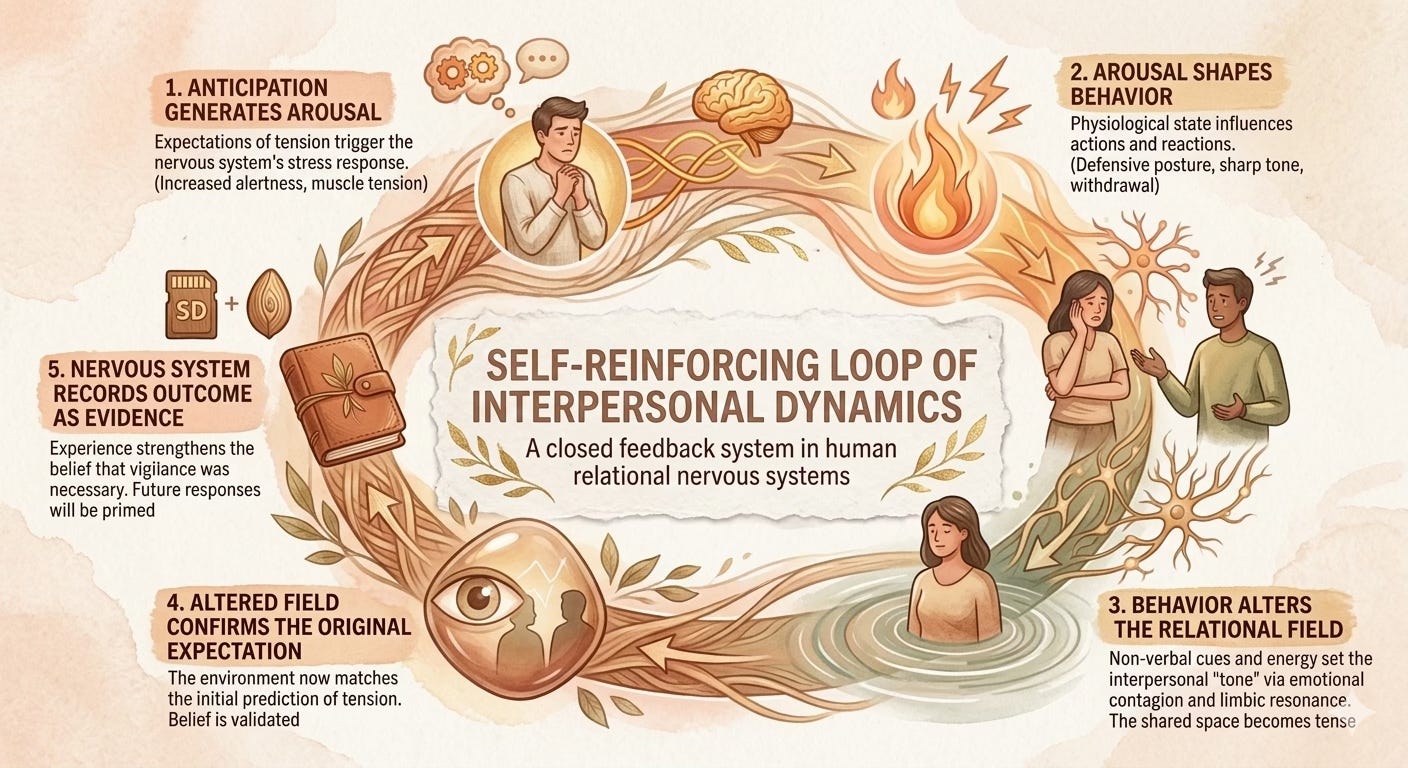
Clinically, this phenomenon is referred to as state-dependent perception. When the nervous system is activated, perceptual range narrows. Neutral cues are interpreted as hostile. Ambiguity is filled with threat-based meaning. Micro-expressions, tone shifts, or silence are filtered through expectation rather than observation. The individual does not enter the room searching for conflict; the body has already organized itself as if conflict is underway. This is where interpersonal dynamics become self-reinforcing. Human nervous systems are inherently relational and attune automatically through limbic resonance and mirror neuron activation. Others may not consciously identify the source of tension, yet their bodies register it.
Posture tightens. Vocal prosody shifts. The relational field organizes itself around the most dysregulated signal present in the room. What is often described as “frequency” in experiential language is well documented in clinical literature as emotional contagion and autonomic entrainment.
The result is a closed feedback loop: anticipation generates arousal, arousal shapes behavior, behavior alters the relational field, and the altered field confirms the original expectation. The nervous system then records the outcome as evidence, reinforcing the belief that vigilance was necessary. This is how trauma reenactment occurs without conscious intent, and why insight alone rarely interrupts these patterns. This mechanism is further amplified in individuals with trauma histories, attachment injury, and ADHD. For ADHD nervous systems in particular, transitions often lack natural pauses, allowing sympathetic activation to carry forward uninterrupted. The day becomes a continuous physiological sentence without punctuation—no breath, no reset, no recalibration.
What is frequently experienced as intuition is more accurately understood as memory acting as foresight.
The cost is not the absence of accuracy about potential harm, but the loss of nervous system flexibility. Entering relational spaces already armored reduces the capacity for novelty, repair, and genuine connection. Accuracy without regulation becomes another form of self-protection—one that quietly reproduces the very dynamics it seeks to avoid.
Why Not Use That Same Energy in the Opposite Direction?
From a neurobiological standpoint, mental rehearsal activates many of the same neural networks involved in lived experience. Visualization recruits the prefrontal cortex, limbic system, and autonomic pathways simultaneously, meaning imagined states can shift physiological tone in real time. When attention is intentionally directed toward calm, warmth, or receptivity, parasympathetic pathways—particularly vagal regulation—are more likely to engage. This is not a denial of threat, but a reallocation of anticipatory energy. Rather than allowing predictive threat modeling to default toward chaos, the nervous system is offered an alternative template. Over time, repeated rehearsal of regulated states increases nervous system flexibility and expands the window of tolerance. The body learns that anticipation does not have to equal bracing.
In this sense, the commute functions as a transitional container—a liminal space or portal, if you will—where nervous system state can be recalibrated before contact occurs. What is framed experientially as blessing the space is clinically understood as shifting autonomic set point prior to interpersonal engagement. In other words, you basically are mental rehearsing your play before you get into the room. Instead of what you already know may or may not happen, why not exercise new neural pathways and focus on what COULD happen—what you would like to happen? See what happens. Why not? If there is resistance to this practice, ask yourself why. Who resists something that could help them?
What Is Commute Calibration?
Commute Calibration™ is the name I give to a frequency practice I teach clients—it’s a form of nervous system and energetic leadership. It’s the recognition that the emotional atmosphere you walk into is usually co-authored by the energy you bring. And the energy you bring usually starts on the way there. Most people rehearse fear. Most people rehearse defensiveness. Most people replay all the old loops of judgment, rejection, disappointment, and chaos and then wonder why they keep reliving the same dynamics.
Commute Calibration interrupts that rehearsal and replaces it with energetic choice. You practice compassion before contact. You embody peace before confrontation. You picture the person you’re about to see as not perfect, but as receptive. Safe. Understand, they might not be, but that is not the point; it doesn’t matter if they are safe, because you are.
Let’s take a stretch break here real quick... This work is not easy.
As someone who has their own level of CPTSD, anxiety, and hypervigilance skills that make me a skilled pattern recognizer, I also have to check when I am actually feeding the stallion of my mind instead of settling with it—especially in my marriage. Safe, healthy relationships: the ones where there are no phones being hidden, codes, and secrets. Where cheating is not something you anticipate. Relationships where the conflict usually stems from attachment wounds rather than behaviors that align with infidelity and mind games. Mature adult relationships involve facing the ASS in each of us, but most importantly, the ass within ourselves.

I have had my fair share of assery moments in my marriage. The shame or embarrassment my brain can loop in... relationships are a perfect place to face the muck of the shadow. I feel my Commute Calibration even if that commute is just walking down the hall to talk to my husband. If you are in a current season of gridlock, that commute means everything. For many of us—myself included—the hallway is filled with panic child energy, catastrophe, and mental rehearsing of what’s in the hippocampus archives and projecting it onto the conversation I am about to walk into.
Let’s say you are about to talk to your boss. That whole morning—the day you wake up, your drive there, and the walk to the office—what is your mind rehearsing? How is that helping your bodily frequency, or hurting it?
Why is it so difficult for us to rehearse the ideal outcome?
Mental Rehearsal: What the Nervous System Is Actually Practicing
At a clinical level, Commute Calibration™ is a practice of intentional mental rehearsal. The brain is always rehearsing something. The question is not whether rehearsal is happening, but what is being rehearsed and who is leading it.
Neuroscience has consistently shown that mental rehearsal activates the same neural circuits involved in real-time interaction. The prefrontal cortex, limbic system, and autonomic nervous system respond to imagined scenarios as if they are already occurring. This is why rehearsed conflict tightens the chest, shortens the breath, and sharpens tone long before contact is made, just like the image above demonstrates. The body does not wait for reality to confirm the threat; it prepares based on prediction. Most people unknowingly rehearse defense, vigilance, and disappointment during transitions. These rehearsals strengthen old attachment templates and trauma loops, training the nervous system to arrive already braced. Commute Calibration™ interrupts this default rehearsal and replaces it with a deliberate one.
Calm is practiced before it is required.
Receptivity is embodied before it is tested.
Safety is generated internally rather than negotiated externally.
In this sense, Commute Calibration™ is not wishful thinking. It is directing the rehearsal toward regulation instead of reenactment. The nervous system is given a different script to embody, one that does not deny risk, but refuses to let fear lead the entrance. Over time, this changes what the body expects, how it prepares, and what it brings into the room.
This Isn’t Bypassing. It’s Energy Leadership.
From a trauma-informed perspective, this distinction matters. Bypassing avoids pain by dissociation or denial; while regulation metabolizes pain without allowing it to dictate behavior. What is described here aligns with self-led nervous system regulation. The goal is not to invalidate harm, but to prevent the body from reliving it prematurely or indiscriminately. Hypervigilance is a learned survival adaptation rooted in chronic threat exposure. So when left unexamined, it becomes a default leadership structure in relationships, where anticipation replaces presence. Which is why leading our nervous system does not erase memory; it interrupts automatic reenactment loops. This is how individuals move from trauma-driven reaction to intentional autonomic choice.
Clinically, this process expands the window of tolerance. Instead of entering relational spaces in a collapsed or combative state, the body is given a regulated baseline from which discernment becomes possible. Leadership here is not about control over others, but about refusing to outsource internal safety to external conditions.
This is why readiness is internal. The nervous system does not require consensus to regulate; it requires permission to stop rehearsing threat as identity.
Now, lets expand on window of tolerance for a moment.
The Window of Tolerance: Why Regulation Must Precede Contact
The concept of the Window of Tolerance, originally articulated by Daniel Siegel and expanded within trauma research, describes the optimal zone of nervous system arousal an individual can remain present, flexible, and responsive. Within this window, the nervous system is regulated enough to process information, tolerate emotion, and engage relationally without collapsing or becoming aggressive. When an individual enters a relational space already rehearsing threat, the nervous system is often pushed outside this window before interaction even begins. Anticipatory mental rehearsal activates either hyperarousal (sympathetic dominance: anxiety, irritability, defensiveness) or hypoarousal (dorsal vagal shutdown: numbness, dissociation, withdrawal). In either state, perception becomes distorted and the capacity for repair, curiosity, or mutual regulation significantly decreases.
What is often mislabeled as “being sensitive” or “overreactive” is, clinically, a nervous system operating outside its window. In these states, the body prioritizes survival over connection this comes with side effects and those look like: Your boundaries being experienced as threats, any feedback being experienced as attack, and ambiguity feels as if it is filled with danger. Practices such as Commute Calibration™ function by widening the Window of Tolerance before contact occurs— thus building our capacity. By engaging parasympathetic pathways through breath, imagery, and intentional rehearsal, the nervous system is brought closer to baseline regulation. This increases the likelihood that emotional input can be metabolized without triggering collapse, aggression, or reenactment.
Crucially, regulation does not require the absence of discomfort. The window is not a comfort zone; it is a capacity zone. Individuals within their window can feel anger without becoming violent, sadness without collapsing, and fear without surrendering agency. This is why leading the nervous system before entering charged environments is not avoidance— it is preparation.
Pause…
See how this is self-lead preparation instead of doom rehearsing? Where were we before in our commute to the difficult interaction was preparing for the worst. Which created emotional distress in us.
From this lens, we can see that energy leadership is clinically synonymous with state management. It is the decision to arrive within one’s window rather than demanding that others regulate first. Over time, repeated access to regulated states strengthens autonomic flexibility, making it easier to remain present even when stressors arise. This is how cycles break, not by eliminating threat, but by expanding the body’s ability to stay oriented to the present while discomfort passes through.
The Science Backs This Up
Research in psychophysiology and interpersonal neurobiology consistently demonstrates that nervous system states are not contained within individuals, but are co-regulated and transmitted relationally (Porges, 2011; Siegel, 1999, 2012). Stephen Porges’ Polyvagal Theory describes how cues of safety and threat are communicated through facial expression, vocal prosody, posture, and breath rhythm, allowing nervous systems to synchronize automatically during interaction (Porges, 2011). This process occurs below conscious awareness and precedes verbal exchange. Studies on autonomic entrainment show that individuals in close proximity often unconsciously align heart rate variability (HRV), breathing patterns, and muscular tension, particularly in emotionally charged or attachment-relevant relationships (Thayer & Lane, 2000; Thayer et al., 2012). Higher HRV, a marker of parasympathetic regulation and vagal tone, has been associated with improved emotional flexibility, social engagement, and resilience under stress (Grossman & Taylor, 2007). Conversely, dysregulated states—marked by low HRV and elevated sympathetic arousal, spread rapidly within relational systems (Hatfield, Cacioppo, & Rapson, 1994).
Mirror neuron research further supports this mechanism. Neural circuits involved in action, emotion, and intention activate not only when a person experiences a state directly, but when observing it in others (Decety & Jackson, 2004). This provides a neurological basis for why calm presence can de-escalate a room and why agitation can infect it. The nervous system is not merely responding to words; it is responding to embodied cues in real time (Siegel, 2012). Mental rehearsal research, widely utilized in sports psychology, exposure therapy, and performance neuroscience, demonstrates that repeatedly imagining regulated emotional states produces measurable physiological changes (Jeannerod, 1994; Guillot & Collet, 2008). Controlled studies show reductions in cortisol output, improved vagal tone, and increased stress tolerance when individuals practice compassion-based imagery, gratitude rehearsal, or calm-focused visualization (Lehrer & Gevirtz, 2014; Grossman & Taylor, 2007). These outcomes reflect biological conditioning, not symbolic intention. The body learns from what it repeatedly rehearses.
Trauma-informed frameworks reinforce that dysregulation travels faster than cognition. The limbic system processes safety and threat milliseconds before the prefrontal cortex engages in conscious interpretation, which explains why relational dynamics often shift without explicit confrontation (van der Kolk, 2014; Siegel, 2012). Bodies respond to bodies before language enters the equation. Regulation, therefore, becomes a primary form of communication. Whether described as frequency, coherence, or autonomic signaling, the mechanism remains consistent across disciplines. Regulation is communicable. Grounded presence alters relational fields by changing the nervous system signals available for others to attune to (Porges, 2011; Hatfield et al., 1994). If trauma can be transmitted through proximity and repeated interaction, so can stability, self-leadership, and calm.
From a clinical standpoint, this reframes leadership as state transmission rather than control. The most regulated nervous system in the room often sets the tone and its done not through dominance, but through coherence (Siegel, 1999; Thayer et al., 2012).
What You Radiate Is What You Regulate
When you enter a room already rehearsing trauma, you limit the possibility of connection. When you enter as a tuning fork—when you embody the frequency you want to experience—you reshape the room. You stop waiting for someone else to change. You stop scanning for the threat. You stop letting the past write the emotional code. You become the baseline. Your energy becomes the gravitational pull. Your nervous system sets the pace. You don’t just manage your emotions; you lead with them. That’s Commute Calibration. That’s what it means to walk into a space as a safe person because you chose it for yourself.
Try This the Next Time You Drive Into a Hard Space
No pressure.
No perfection.
Just your intention.
Breathe.
Shake your hands.
Exhale through your mouth like you’re sighing the tension out of your body. Not forcing it. Just letting the pressure drain. Let your shoulders drop. Let your jaw soften. Put on music that doesn’t collapse your chest or spike your nervous system, something that keeps you open instead of braced. This isn’t about distraction. It’s about not walking in already clenched. Now picture yourself in the situation you’re anticipating. The meeting. The job interview. The hard conversation. The family dinner. See yourself there. Not perfect. Not performing. Just present. Visualize how you want to feel in that space—steady, clear, grounded, warm, firm, whatever matters most to you. Notice how your body is holding itself in that version of you. Your posture. Your breath. Your tone.
Then let the scene play out in your mind. Not the worst-case version—this new one. The regulated one. The version where you’re with yourself instead of scanning for threat. Yes! that’s it! You’re rehearsing presence, not control. You’re practicing arriving. You’re choosing what your body practices before you walk in.
And then, quietly, to yourself, say: May I feel peace today.
May I feel grounded.
May I feel supported.
May I be open to joy.
And then say:
I bring calm.
I bring grace.
I am rooted and regulated.
I am safe to lead with love.
(add your own flavor to it)
It might feel weird the first time. It might feel silly. That’s okay. The body doesn’t need you to believe it yet. It just needs you to practice.
Frequency Is Contagious. You Choose What You Spread.
You can be the toxin. Or the tuning fork.
You can be the storm. Or the anchor.
You can rehearse trauma. Or you can rehearse transformation.
You don’t need anyone’s permission to shift. You don’t need their approval to soften. You just need a moment. A breath. A choice. And the car ride is a damn good place to begin, because bodies teach bodies. Nervous systems read nervous systems. Long before words land, before intentions are explained, before outcomes unfold, something quieter is already happening. The body is broadcasting. Others are attuning. Regulation spreads. So does dysregulation. This is not about being positive. It’s about being present. It’s about deciding that the past doesn’t get to write the emotional code of the room before you even arrive. It’s about choosing to practice the state you want to live from, instead of rehearsing the wound you’ve already survived.
You don’t change the world by forcing it to calm down.
You change it by arriving regulated enough to stay yourself.
That’s Commute Calibration.
Stay tuned for a video here I can demonstrate what this looks like visually.
Until next time data collectors

References & Extended Reading List
Decety, J., & Jackson, P. L. (2004). The functional architecture of human empathy. Behavioral and Cognitive Neuroscience Reviews, 3(2), 71–100. https://doi.org/10.1177/1534582304267187
Dispenza, J. (2014). You are the placebo: Making your mind matter. Hay House.
Grossman, P., & Taylor, E. W. (2007). Toward understanding respiratory sinus arrhythmia: Relations to cardiac vagal tone, evolution, and biobehavioral functions. Biological Psychology, 74(2), 263–285. https://doi.org/10.1016/j.biopsycho.2005.11.014
Guillot, A., & Collet, C. (2008). Construction of the motor imagery integrative model in sport: A review and theoretical investigation of motor imagery use. International Review of Sport and Exercise Psychology, 1(1), 31–44. https://doi.org/10.1080/17509840701823139
Hatfield, E., Cacioppo, J. T., & Rapson, R. L. (1994). Emotional contagion. Cambridge University Press.
Jeannerod, M. (1994). The representing brain: Neural correlates of motor intention and imagery. Behavioral and Brain Sciences, 17(2), 187–245. https://doi.org/10.1017/S0140525X00034026
Lehrer, P. M., & Gevirtz, R. (2014). Heart rate variability biofeedback: How and why does it work? Frontiers in Psychology, 5, 756. https://doi.org/10.3389/fpsyg.2014.00756
Maté, G. (2019). In the realm of hungry ghosts: Close encounters with addiction. North Atlantic Books.
Nathanson, D. L. (1992). Shame and pride: Affect, sex, and the birth of the self. W. W. Norton & Company.
Ogden, P., Minton, K., & Pain, C. (2006). Trauma and the body: A sensorimotor approach to psychotherapy. W. W. Norton & Company.
Porges, S. W. (2011). The polyvagal theory: Neurophysiological foundations of emotions, attachment, communication, and self-regulation. W. W. Norton & Company.
Schore, A. N. (2012). The science of the art of psychotherapy. W. W. Norton & Company.
Siegel, D. J. (1999). The developing mind: How relationships and the brain interact to shape who we are. Guilford Press.
Siegel, D. J. (2012). The pocket guide to interpersonal neurobiology. W. W. Norton & Company.
Thayer, J. F., & Lane, R. D. (2000). A model of neurovisceral integration in emotion regulation and dysregulation. Journal of Affective Disorders, 61(3), 201–216. https://doi.org/10.1016/S0165-0327(00)00338-4
Thayer, J. F., Åhs, F., Fredrikson, M., Sollers, J. J., & Wager, T. D. (2012). A meta-analysis of heart rate variability and neuroimaging studies: Implications for heart rate variability as a marker of stress and health. Neuroscience & Biobehavioral Reviews, 36(2), 747–756. https://doi.org/10.1016/j.neubiorev.2011.11.009
van der Kolk, B. A. (2014). The body keeps the score: Brain, mind, and body in the healing of trauma. Viking.