🏕️ WELCOME TO THE ROR MAP™
Before you dive in please understand this essay is hands on. It serves as the map through our ROR experience. It is full of Assessment and reflection questions along with the Mission briefing video you will see below. I encourage you all to come back and reassess your scores to see for adjustments and growth.
🧭 Mission Briefing:
🎯 Primary Objective
To investigate whether intentional joy, novelty exposure, movement, and structured compartmentalization can reduce emotional gridlock, interrupt resentment loops, and restore relational flexibility within the nervous system and interpersonal field.
🧪 Primary Hypothesis
Persistent high-conflict relational dynamics may maintain the nervous system in a chronic state of physiological threat activation, reducing access to emotional regulation, cognitive flexibility, relational attunement, and effective repair processes.
This project hypothesizes that intentional exposure to regulated joy, novelty, movement, play, co-regulation, and structured emotional compartmentalization may reduce defensive nervous system activation and increase perceived relational safety.
Through repeated exposure to these experiences, participants may demonstrate increased emotional flexibility, improved conflict recovery, greater relational openness, and reduced resentment-based reactivity over time.
In essence, this experiment explores whether regulated joy can serve as a neurophysiological access point for interrupting chronic resentment loops and facilitating relational repair.
🔬 Proposed Intervention
Repeated exposure to regulated joy, movement, novelty, and intentional emotional shelving may create alternative neural pathways capable of “backdooring” the nervous system out of chronic emotional gridlock and into increased flexibility, safety, and relational resilience.
🧠 Operational Theory
When the nervous system becomes trapped in repetitive conflict cycles, learning itself can become weaponized. In high-arousal states, insight alone is often insufficient for transformation. This project explores whether play, sensory regulation, and embodied participation can soften defensive patterning enough for meaningful rewiring to occur.
🛰️ Research Environment
Participants will observe emotional responses, relational behaviors, cognitive distortions, and nervous system activation patterns across a multi-month experiential field study known as: Rewiring Out of Resentment (ROR)
📂 Participant Role
Each participant acts as both:
observer,
and specimen.
The goal is not perfection. No No, we do not do perfection on this corner of the internet.
The goal is data collection, nervous system awareness, and increased relational flexibility over time.
⚠️ Field Conditions (What to expect)
Participants may encounter:
discomfort,
resistance,
avoidance impulses,
emotional fatigue,
cognitive dissonance,
and heightened defensive responses.
These responses are not considered failure.
They are considered: active field data.
🎒 Recommended Safari Equipment
Curiosity
Water (for when that resentment gets spicy and you want to activate into mob mentality behavior🤣)
Comfortable shoes (For the runners when discomfort hits)
Reflection journal
Emotional honesty
Willingness to stay in the vehicle during activation 😂
Willingness to share with the community. (sharing your story through our Advice Column Okay? Now What?, DMs, or the comment section.
This adds opportunity to explore actual lived scenarios from those within our shared corner of the internet.
You can access previous entries Here.
📣If something stings, it’s probably because you got out of the vehicle and started reacting to it-SK
🚫 Contraband Items (Do not Bring onto the safari)
Please leave behind:
emotional scorekeeping,
surveillance of your partner, other, or self.
doom scrolling during joy activity or intervention implementation.
“should” language,
avoidance behaviors or anxiety loops
substances used to bypass discomfort,
and the belief that healing should always feel pleasant.
🧪 Select Your Research Environment
🎟️Before entering the safari, researchers must identify the primary environment in which resentment appears to be most active.
❤️ RESEARCH ENVIRONMENT 01
Romantic / Partnership Dynamic
Objective:
To observe how resentment develops within attachment bonds, emotional labor dynamics, conflict cycles, intimacy ruptures, unmet expectations, and nervous system reactivity between romantic partners.
Field Questions:
What repetitive conflict loop appears most often?
What behaviors trigger emotional shutdown or activation?
What emotional need feels unseen or chronically neglected?
What resentment story do you replay most often?
What role do you believe you occupy in the relationship?
What role do you believe your partner occupies?
What would “repair” realistically require from both parties?
Nervous System Observation:
Does your body brace around this person?
Do you anticipate disappointment before interaction?
Is emotional closeness associated with safety or exhaustion?
Does joy feel accessible or threatening?
🌿 RESEARCH ENVIRONMENT 02
Family / Friendship / Workplace Dynamic
Objective:
To examine resentment patterns within non-romantic relational systems, including family roles, workplace expectations, social hierarchies, caretaking dynamics, unresolved emotional inheritance, and boundary fatigue.
Field Questions:
Where do you feel over-relied upon or emotionally depleted?
What role are you unconsciously performing?
What emotional burden feels chronically unacknowledged?
What expectations feel unfair, unequal, or invisible?
What relational dynamic feels impossible to escape?
System Mapping:
Is this resentment inherited, modeled, or reinforced culturally?
Are you operating from guilt, obligation, fear, or resentment?
Are boundaries present, inconsistent, or absent?
What behaviors reinforce the loop?
🔥 RESEARCH ENVIRONMENT 03
Individual / Internal Resentment Dynamic
Objective:
To investigate resentment directed toward the self, the past, missed opportunities, identity wounds, grief, shame, perfectionism, burnout, or unresolved emotional narratives.
Field Questions:
What part of yourself feels abandoned or neglected?
What internal narrative do you replay most often?
What are you exhausted from carrying?
What version of yourself are you grieving?
What unmet need keeps resurfacing emotionally?
What emotion feels hardest to release?
Internal System Observation:
Does rest create guilt?
Does joy feel earned or unsafe?
Does stillness increase anxiety?
Does your nervous system default toward self-criticism?
“Learning becomes a weapon in an aroused nervous system”-SK
🧪 ROR BASELINE ASSESSMENT
Participant Intake + Field Readings
Below is the assessment section. This section will provide you with an overall score. Pay attention to Section 4 as the calculation requirements are different. At the end tally up your total to get an idea of where you baseline is before beginning the activity.
🧭 SECTION 1 — EMOTIONAL CLIMATE READINGS
(Relational Atmosphere Assessment)
Rate each statement from:
1 = very low
10 = extremely high
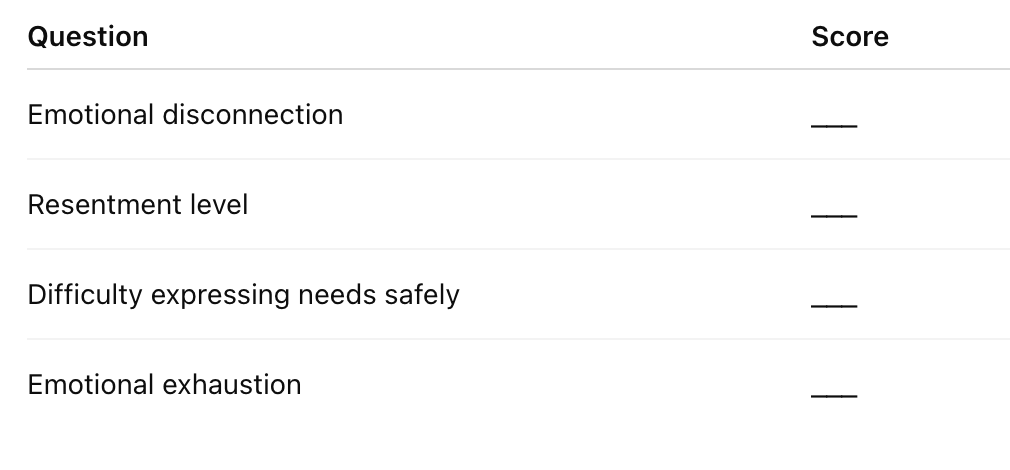
🔢 Emotional Climate Total:
___ / 40
📍 EMOTIONAL CLIMATE INTERPRETATION
0–10
Minimal emotional gridlock detected.
11–20
Mild relational strain present.
21–30
Moderate emotional fatigue and disconnection detected.
31–40
High emotional gridlock likely impacting nervous system regulation and relational flexibility.
🏃 SECTION 2 — ESCAPE & AVOIDANCE PATTERNS
(Withdrawal + Fantasy Readings)
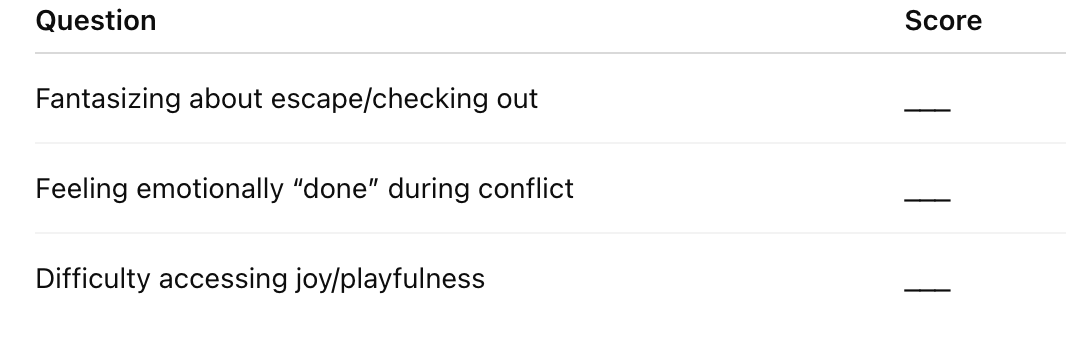
🔢 Escape/Avoidance Total:
___ / 30
📍 ESCAPE PATTERN INTERPRETATION
0–10
Low withdrawal patterning detected.
11–20
Moderate emotional avoidance present.
21–30
High emotional disengagement and survival-based distancing detected.
⚡ SECTION 3 — NERVOUS SYSTEM ACTIVATION
(Physiological Reactivity Readings)
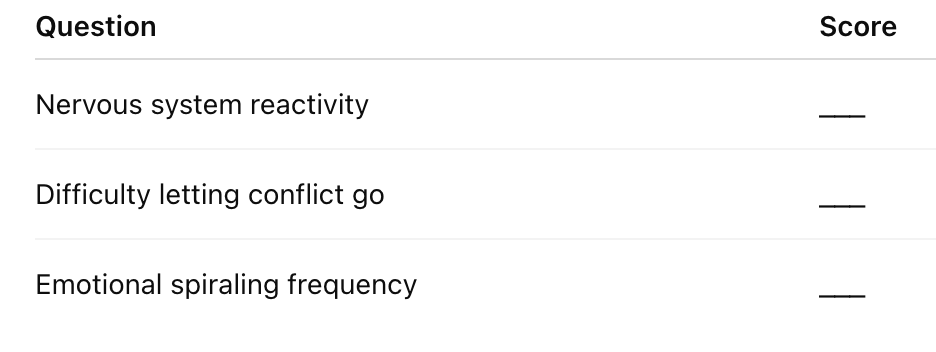
🔢 Nervous System Total:
___ / 30
📍 NERVOUS SYSTEM INTERPRETATION
0–10
Relatively regulated nervous system state.
11–20
Moderate activation patterns detected.
21–30
High-arousal nervous system state likely contributing to resentment looping and emotional rigidity.
🧠 SECTION 4 — WILLINGNESS & PARTICIPATION
(Experimental Readiness Assessment)
🛑Read Carefully Before Calculating Your Score
This section measures your current level of openness, resistance, and emotional readiness for the Rewiring Out of Resentment™ experiment.
Unlike the previous sections, this category is designed differently:
Higher willingness = greater readiness for change
Higher hopefulness = greater emotional flexibility
Higher resistance = greater protective activation within the nervous system
Because resistance represents emotional protection rather than participation capacity, the resistance score must be converted before calculating your final score.
Remember the values are 1-10 with 10 being the higher “more willing” and in this case “more resistant”
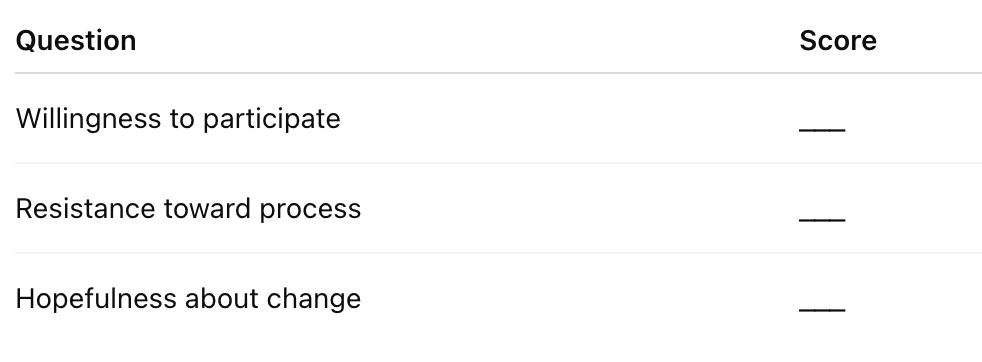
🧪 Resistance Conversion Formula
10 - your resistance score = adjusted participation score
🧪 Example Calculation
Original Scores
Willingness to Participate = 8
Hopefulness About Change = 8
Resistance Toward Process = 5
⚙️ Resistance Conversion Formula
Because resistance measures protective activation rather than openness, we reverse the score:
Formula:
10 - Resistance Score (5) = Adjusted Resistance Score (5)
So:
10 - 5 = 5
example score: ✅ Adjusted Resistance Score = 5 then I take my Willingness score and hopefulness score (8+8+5=21) look below the image for the total Participation score. Then review the interpretation in the section below. A score of 21 falls under High willingness.
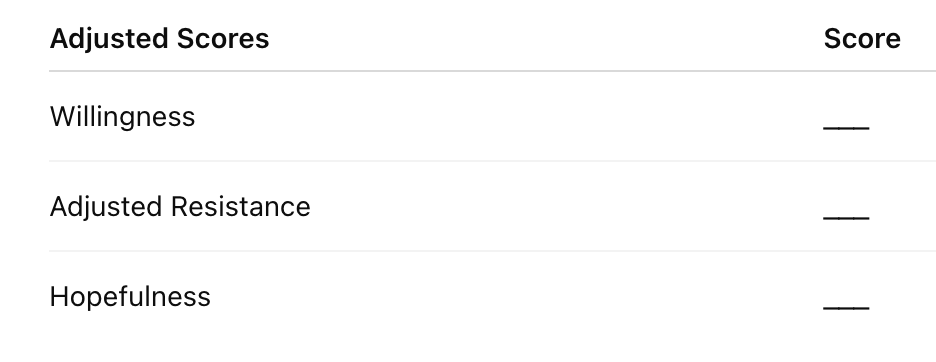
🔢 Participation Capacity Total:
21 / 30
📍 PARTICIPATION INTERPRETATION
0–10
Low readiness for emotional experimentation.
11–20
Moderate openness with protective hesitation.
21–30
High willingness for participation, experimentation, and nervous system flexibility.
🛰️ OVERALL FIELD CONDITIONS (scores from section 1-3 only!)
This score measures the current level of:
emotional gridlock,
resentment looping,
nervous system strain,
and relational fatigue present within the system.
Add together the totals from:
SECTION 1 — Emotional Climate
SECTION 2 — Fantasy / Escape / Avoidance
SECTION 3 — Nervous System State
⚠️ DO NOT include: Section 4
🌿 0–35
Low emotional gridlock currently detected.
🌤️ 36–65
Moderate resentment looping and nervous system strain present.
🌧️ 66–95
High emotional gridlock and relational fatigue detected.
⛈️ 96–130
🔬 What Higher Scores Mean
Higher scores may indicate:
increased emotional activation,
chronic resentment looping,
relational exhaustion,
nervous system rigidity,
and decreased access to play, flexibility, or co-regulation.
Lower scores may indicate:
greater emotional flexibility,
increased nervous system safety,
and improved access to connection and regulation.
⚠️ ROR FIELD DISCLAIMER
This assessment is not diagnostic. It is not pass or fail.
It is designed to:
increase awareness,
observe relational patterns,
identify nervous system strain,
and track emotional flexibility over time.
The goal is observation. Collect data and retake the assessment every 30 days.
Open Reflection
What is the very first memory, hurt, or dynamic that comes to mind when you think about resentment?
What do you fear would happen if resentment softened?
What feels hardest about choosing joy right now?
What activity immediately triggered resistance in you and why?
What narratives showed up when thinking about trying this protocol?
Does part of you believe joy with your partner is unsafe, temporary, embarrassing, pointless, or undeserved?
What emotional “evidence” has your nervous system been rehearsing most?
What would it feel like to stop monitoring the relationship for a moment and simply experience it?
Have you become more practiced at protection than connection?
Below is a list of activities to help you get started.
Free or Low Cost Activities
Neighborhood walks
Hiking trails
Basketball at a local park
Pickleball courts
Board games
Card games
YouTube dance classes
Stretching together
Sunset drives
Picnics
Farmers markets
Window shopping
Community events
Library events
Public concerts
Bike rides
Watching the stars
Cooking together
Watching a comedy special
Nature trails
Beach or lake walks
Home paint nights
Video games
Trivia nights
Paid Activities
Arcades
Bowling
Escape rooms
Comedy shows
Concerts
Recreational sports leagues
Mini golf
Pottery classes
Painting classes
Dance lessons
Axe throwing
Sporting events
Museums
Botanical gardens
Kayaking
Paddle boarding
Yoga classes
Couples massages
Cooking classes
Important Reminder
The goal of the activity is NOT to force deep conversations.
The goal is:
shared attention
movement
nervous system interruption
novelty
presence
laughter
reconnection through experience
Awkwardness is okay.
Silence is okay.
Resistance is expected.
You are not failing because discomfort shows up.
You are rewiring.
And rewiring requires repetition.
🗺️ROR MAP Glossary
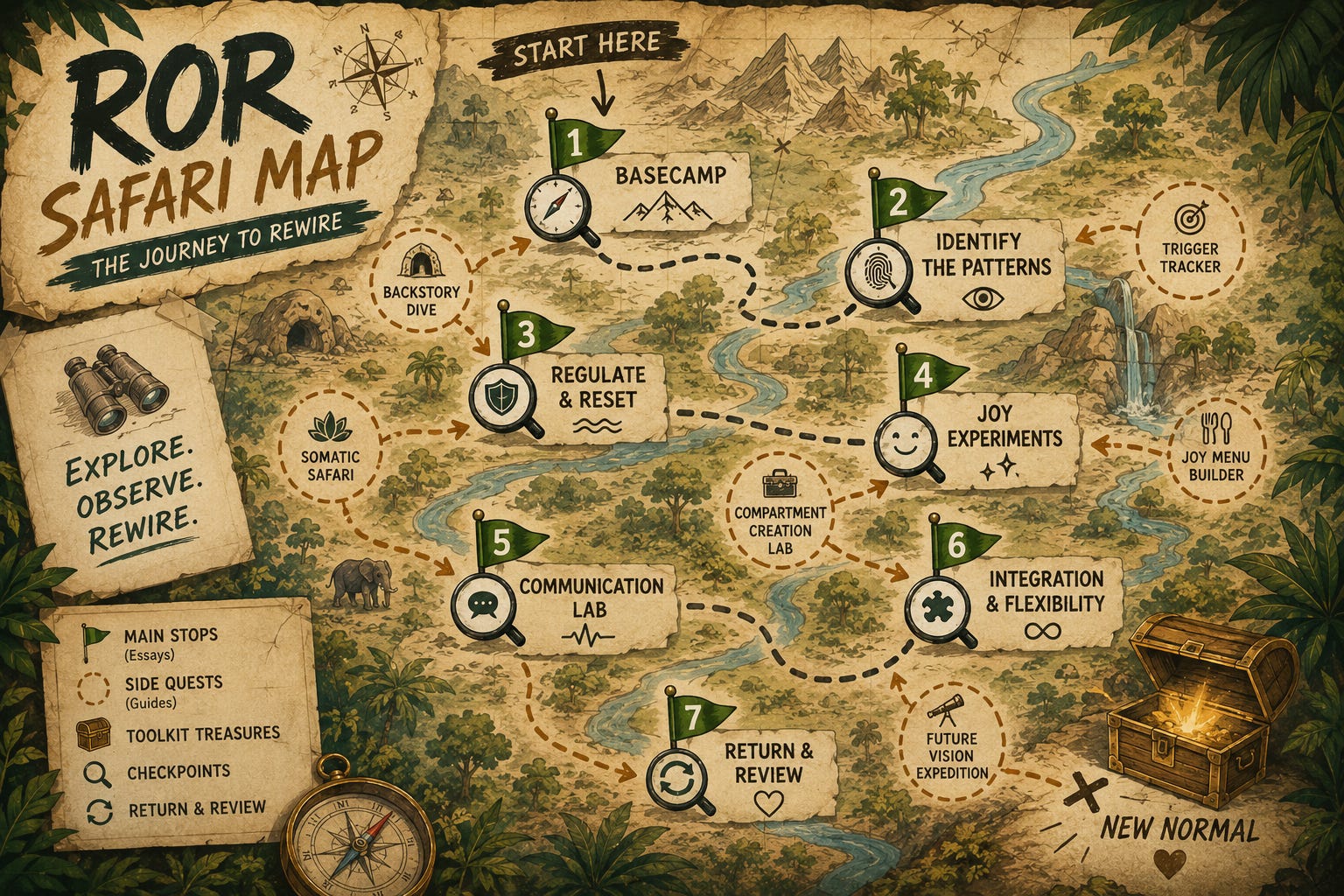
(This map is your central navigation hub for the Rewiring Out of Resentment™ journey.)
Each numbered stop represents a major essay, lesson, experiment, or nervous system checkpoint along the main road of the series.
Along the way, you’ll also encounter:
🧪 Side Quests — deeper explorations into culture, conditioning, attachment, resentment origins, family systems, and perception
🖍️ Tool Drops — practical nervous system tools, breathwork exercises, regulation strategies, and “crayons” for your toolbox
📍 Checkpoints — reflection prompts, experiments, and participation updates
🎒 Field Notes — community observations, collected data, and shared experiences from fellow travelers
🧭 The Safari Exists Across Multiple Terrains
The main Rewiring Out of Resentment™ safari lives inside the:
📚 Substack essays
🎥 Longform YouTube videos
This is where the deeper theories, reflections, tools, side quests, and nervous system experiments are fully explored.
📱 Shortform Content (IG + TikTok)
The shortform content is designed to:
make you think,
react,
feel,
question,
and reflect.
These clips are intentional nervous system interruptions meant to expand perception and pull you deeper into the essays and longform discussions.
🎙️ Podcast / Audio Reflections
The podcast space is more casual and conversational.
Episodes may pull from:
community experiences,
case-study style reflections,
relational dynamics,
cultural observations,
and personal transparency.
Think: campfire reflections after the safari. Yaay cozy and fun 🤗
🗾The Map Begins here.
(Due to limited space this may end up being a link if we reach character capacity 🫣)
Orientation: (You’re in it 😉)
ROR //Stop 1: Next
TBA
TBA
TBA
Wheeew,
You’ve officially been initiated into the experiment.👏🏽
The joy activity can begin at any time. You do not need to wait for the next stop to start collecting data. Your participation is the research. Every walk, pause, playful moment, nervous system interruption, or act of intentional compartmentalization becomes part of the field study. I am engaging in the same activity and so is my husband 🤭
Throughout the next couple months of this journey, you’ll notice “side quests” and “side missions” appear across essays, podcasts, short-form videos, and discussions. These are intentional. Resentment does not only live in romantic relationships. It lives in family systems, workplaces, gender roles, cultural conditioning, grief, identity, expectations, power dynamics, inherited narratives, and survival adaptations. This journey is designed to stretch our capacity for nuance while examining how resentment spreads across multiple relational fields.
Relationships are the hook.
NEXT STOP:
🦠 ROR //STOP 1 — The Infection Model
Next week, we begin exploring resentment through the lens of an infection model.
We will examine:
how resentment forms,
the emotional environments that allow it to spread,
the nervous system conditions that sustain it,
and how emotional “leakage” impacts the people around us.
This stop will also introduce several foundational ROR concepts, including:
emotional gridlock,
energy expenditure,
emotional contamination,
protective adaptations,
and the beginning stages of “gloving up” before entering emotionally charged environments.
With this work the goal is always observation.
We are learning how to identify the conditions that keep resentment alive.
Questions, reflections, reactions, and observations can be shared in the comments, DMs, podcast submissions, or community spaces throughout the week. Many of those discussions will shape future side quests, podcast conversations, and upcoming stops along the trail.
The safari has officially begun.
You have been release into the wild 🤪
I will see y’all out there!
—Come as you are, where you are.