

Data Collectors,
Welcome to Stop 1 of the ROR series.
This stop introduces the foundational framework of the entire Rewiring Out of Resentment™ series. In this stop, we begin exploring resentment not simply as an emotion, attitude, or personality flaw, but as an adaptive infection pattern that spreads through nervous systems, relational environments, family systems, and social conditioning.
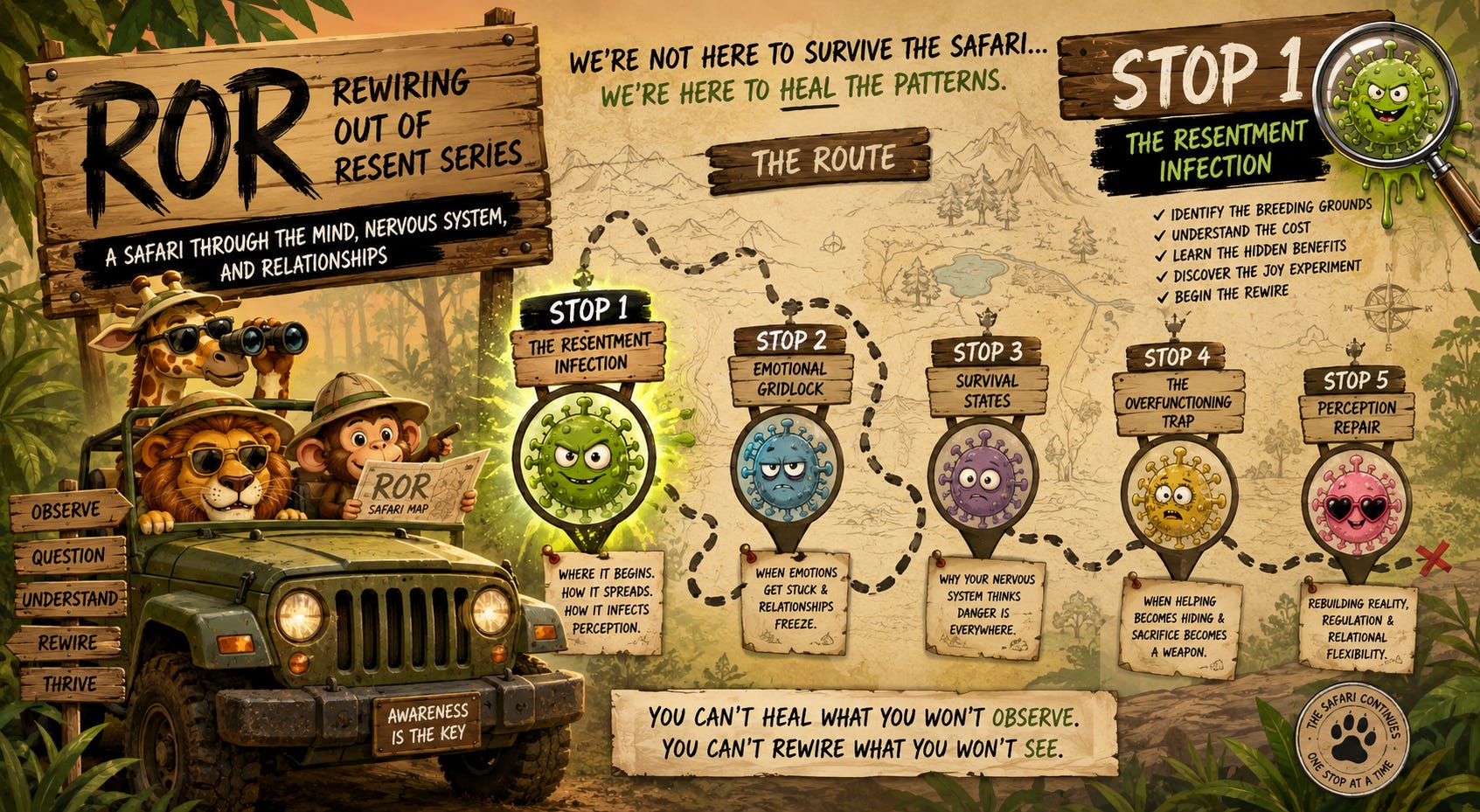
We are learning how resentment forms, what environments allow it to grow, how it spreads, and why so many people unknowingly live inside emotional contagion cycles without realizing it.
Let’s zoom into environments that can be breeding grounds for resentment. The most common areas I have seen are with those who tend to be over-functioners, people pleasers, those who struggle with emotional invisibility, and mothers with no life, hobbies, or unachieved goals outside of their role as mother and wife.
Over time, when we stay suppressing, over-functioning, etc., we get pulled out of our window of tolerance. When we are pulled out of our window of tolerance and stay out of it for long periods of time, we start to develop resentment. The infection has begun, but we must be careful. Once we have the infection, it is really easy to get hit harder because the system is weaker and more susceptible to the craving for bonding.
Those with a high resentment level tend to want to bond via shared gossip, dislike for others, or the need to complain about their partner with blind-loyalty friends or friends who are also stuck in similar patterns. Don’t get me wrong, co-regulation is necessary, and us ladies need to process a lot in order to regulate. But check your regulation session. Is it mostly you repeating the same upset? If so, you may be co-ruminating in a self-destructive way instead of a helpful way.
Why might it be self-destructive? Well, who do you typically co-ruminate with, and do you ever challenge the blind spots? Do you end with reflection on what is in your control? If not, we are in a self-destructive loop.
Chronic self-abandonment is the biggest behavior leading to resentment.
If we think of resentment as a bacteria that thrives and spreads like mold, we would explore which environments the resentment infection spreads and grows in the fastest. Here are some examples where, if the following behaviors exist in environments, I can guarantee you someone in there is struggling with resentment:
• Avoidance
• Emotional dishonesty
• Chronic survival mode
• Hypervigilance
• Emotional rigidity
• Suppressed grief
• Unresolved attachment wounds
• Repetitive relational gridlock
How do you suspect the infection spreads?
Through tone.
Through energy.
Through interpretation.
Through emotional leakage.
Through defensiveness.
Through withdrawal.
Through criticism.
Through passive aggression.
Through silence.
Through projection.
Through chronic emotional exhaustion.
Eventually, the entire relational field becomes emotionally contaminated.
Emotional Leakage
People often believe resentment only exists in words.But resentment leaks long before it speaks. It leaks through:
• body language
• sarcasm
• sighs
• irritability
• shutdown
• avoidance
• emotional numbness
• hypercriticism
• scorekeeping
• contempt
• chronic nervous system tension
Children absorb it.
Partners absorb it.
Coworkers absorb it.
Families absorb it.
Research consistently demonstrates that human beings are constantly reading one another’s emotional states through nonverbal communication. According to Stephen Porges’ Polyvagal Theory (2011), the nervous system is continuously scanning the environment for cues of safety or danger through facial expressions, tone of voice, body posture, and relational energy. In other words, even when nothing is being verbally said, the body is still communicating. This is why unresolved resentment eventually creates emotional climates where:
• play disappears
• curiosity disappears
• softness disappears
• repair feels exhausting
And once all of this disappears, the connection begins feeling unsafe. John Gottman’s research on relationships found that contempt, criticism, defensiveness, and withdrawal are among the strongest predictors of relational distress and disconnection (Gottman & Silver, 1999). Long before a relationship falls apart, the emotional climate often shifts first. Louis Cozolino (2014) reminds us that we are social creatures whose nervous systems are constantly influencing one another. We regulate together, dysregulate together, and often absorb emotional states without realizing it. In other words, resentment becomes atmospheric.
Emotional Cost & Nervous System Currency
One of the core ROR concepts is understanding energy as currency I call it “energy expense.” Everything costs something emotionally:
Conflict costs energy.
Suppression costs energy.
Masking costs energy.
Overexplaining costs energy.
Avoidance costs energy.
Hypervigilance costs energy.
Many people are emotionally bankrupt without realizing it, and when nervous systems become depleted, resentment becomes easier to access than joy.
Why do you think that is? Well, my theory is because resentment requires less vulnerability. Joy requires openness. Play requires flexibility. Connection requires risk. Resentment often feels emotionally safer because it protects the nervous system from disappointment, grief, vulnerability, and uncertainty.
But let’s do a quick cost-benefit analysis.
In psychology, a cost-benefit analysis is simply the process of examining what a behavior, thought pattern, belief, or coping strategy gives us versus what it costs us. Most behaviors persist because there is some benefit, even if that benefit is unconscious.
So, what is the benefit of resentment?
Anyone?...
What I have seen in my clinical practice, as well as within myself, is that one of the biggest benefits is stagnation. We get to stay in the comfy, cozy zone where development does not occur.
We get to avoid uncertainty.
We get to avoid vulnerability.
We get to avoid accountability.
We get to avoid looking at our own role in the dance.
We get to constantly complain about the things we are suffering with. Sometimes that, in itself, comes with a secondary gain, which could be seen as a benefit. Maybe we receive validation. Maybe we receive sympathy. Maybe we receive attention. Maybe we receive a sense of belonging through shared frustration. Maybe we get to stay connected to a familiar identity. The cost of this, though, is stagnation. Over time, resentment builds and begins infiltrating perception.
Perception is the root of my work.
The longer resentment remains unchecked, the more likely we are to interpret neutral situations through a contaminated lens. We stop seeing what is happening and start seeing what we expect to happen, now why on earth would some of us want what we expect? Yup good ol’ confirmation bias.
We begin collecting evidence for our pain. We begin filtering out evidence that challenges the story and before we know it, resentment is no longer something we experience.It becomes the lens through which we experience everything day to day. For those of you who are new to my corner of the internet, I would encourage you to start with my first YouTube video on perception. I will link that below.
Because if resentment is the infection, perception is often where we first begin seeing the side effects of the resentment build up.
Research on chronic stress and trauma suggests that prolonged activation of the nervous system narrows our capacity for flexibility, curiosity, connection, and play (van der Kolk, 2014). When the body is exhausted, survival becomes the priority. The nervous system begins choosing predictability over possibility, protection over openness, and certainty over vulnerability. Certainty is what we all want in this world today, but think about it. Much of what we are certain about is linked to suffering. That is a key indicator that you are in protector part frequency. Stephen Porges (2011) explains that the nervous system is constantly evaluating whether the environment is safe enough to engage socially. When the body perceives threat, it stops caring about joy. It stops caring about fun. It stops caring about connection. The nervous system is trying to survive. Think about it. If you were being chased by a bear, you wouldn’t be worried about date night, pickleball, painting, gardening, or trying a new hobby. You would be worried about staying alive. The problem is that many of us are carrying around nervous systems that act like the bear is still there. So when somebody says, “Why don’t you just go have fun?” or “Why don’t you try something new?” the body says, “Absolutely not.” this has nothing to do with not wanting joy or connection. But because your nervous system has spent so much time surviving that it has forgotten how to play.
This is one of the reasons resentment becomes such a powerful trap. Resentment is familiar. The disappointment is familiar. The frustration is familiar. The criticism is familiar. The story is familiar. The body knows exactly what to do there because it has practiced it thousands of times. Joy, on the other hand, asks us to loosen our grip. It asks us to become curious. It asks us to be present. It asks us to risk disappointment again. And for many people, that feels far more dangerous than staying angry.
This is why I believe resentment can become a baseline for functioning. The nervous system will often choose familiar suffering over unfamiliar peace. Many of us have never actually learned how to live on the lake. We learned how to survive in the storm waves because we were born there. So when the water finally becomes calm, we don’t relax— we freak out because wtf is down there!!!😅. We start looking around wondering what is wrong. We start anticipating the next wave. in doing all of this we do not realize we create our own waves. That is why this work is not simply about reducing resentment. It is about teaching the nervous system that safety, play, joy, curiosity, and connection are not threats. They are skills that many of us never had the opportunity to develop.
Bruce Perry’s work similarly highlights that stressed and dysregulated nervous systems lose access to higher-order functioning. When survival states dominate, our ability to reflect, empathize, and problem-solve, connection becomes significantly reduced (Perry & Winfrey, 2021). Lisa Feldman Barrett (2017) further argues that the brain is constantly managing a “body budget.” Every decision, emotional response, stressor, conflict, and interaction either deposits into or withdraws from that budget. When the account runs low, the brain becomes more reactive, less flexible, and increasingly focused on conserving resources.
This is why resentment can become so seductive.
Resentment gives us a story.
Resentment gives us certainty.
Resentment gives us someone to blame.
Resentment allows us to externalize discomfort instead of tolerating the vulnerability required for curiosity.
Joy asks us to soften.
Joy asks us to stay present.
Joy asks us to risk disappointment.
Joy asks us to remain open even when certainty would feel safer.
For many nervous systems, especially those accustomed to survival, softening feels far more dangerous than staying armored. This is one of the central hypotheses of the Rewiring Out of Resentment™ project:
That regulated joy may serve as a corrective emotional experience capable of restoring nervous system flexibility, increasing emotional capacity, and interrupting chronic resentment loops long enough for deeper repair to occur.
The Glove Up Concept
In future stops, we’ll expand deeper into the concept of “gloving up.” That will be for those who watched the orientation for ROR. it will be a Crayon to add the crayon box. 🖍️
Read the article here to understand what I mean when I say crayons.

For now, let’s think of gloves as emotional protective equipment.
Not emotional walls.
Not avoidance.
Not detachment.
Skills.
Pause.
Observation.
Discernment.
Regulation.
Compartmentalization.
Non-reactivity.
Boundary awareness.
Emotional responsibility.
But most importantly, the acceptance that multiple things can be true. Not just what you feel, think, and believe. Many of us enter emotionally charged situations completely unprotected, absorbing everyone else’s emotions, projections, expectations, and nervous system activation without realizing it. Then we wonder why we leave interactions emotionally contaminated. The goal here is not emotional numbness. No no we feel on this corner of the internet. The goal is learning how to stay present without emotionally raw-dogging every environment we enter.
Think of it this way. Do we pick up 💩 with our bare hands?
Research on emotional regulation and family systems repeatedly points to the importance of differentiation, which is our ability to remain connected to others without becoming emotionally fused with them (Bowen, 1978). In simple terms, differentiation allows us to stay in the room without becoming the room. It allows us to witness someone’s distress without automatically making it ours. It allows us to stay grounded in our values, observations, and reality while remaining open to the reality of another person.
That is what the gloves are.
Not disconnection.
Not superiority.
Not avoidance.
Protection through skill.
THE FIELD OBSERVATION
One of the most important things to understand:
Resentment is rarely caused by one singular event.
It is usually cumulative.
Micro-moments.
Repeated disappointments.
Unspoken truths.
Chronic emotional suppression.
Invisible labor.
Perceived inequity.
Inherited modeling.
Emotional exhaustion.
Eventually, the nervous system adapts to expecting disappointment. This expectation becomes perceptual. Meaning: the brain starts scanning for confirmation. This is where resentment narrows interpretation and reduces relational flexibility.
The nervous system stops asking:
“What else could this mean?”
And starts assuming:
“See? Here we go again.”
Cognitive psychology has demonstrated that human beings naturally search for evidence that supports preexisting beliefs while overlooking information that challenges them (Beck, 1976; Kahneman, 2011). Once resentment takes hold, the brain becomes increasingly efficient at gathering evidence that confirms the resentment story. John Gottman refers to a similar phenomenon as Negative Sentiment Override. In this state, even neutral or positive interactions become filtered through a negative lens because the emotional climate of the relationship has become contaminated (Gottman & Silver, 1999). This right here is why it is so difficult to rewire out of resentment. Many of us are anticipating the very pattern from our partner. We scoff at the idea of them doing anything to improve or change. We dismiss attempts before they have the opportunity to become real.
Many of my couples sessions result in individuals not necessarily wanting repair. They want me to validate them in front of their partner so they can feel justified in whatever it is they are doing at home.
That’s the issue.
If I had a dollar for every time I asked, “How badly do you want to confirm that as true?”
You see, when we are stuck in resentment for long periods of time, this is where Dr. Joe Dispenza’s work comes in. Over time, that mood becomes a temperament. That temperament becomes a personality. That personality becomes a predictable way of interacting with the world. The brain and body become habitually wired into expecting the very thing they do not want. Neuroscience research on neuroplasticity supports the idea that repeatedly activated neural pathways become increasingly efficient over time (Doidge, 2007). The more we rehearse disappointment, suspicion, criticism, and resentment, the easier those pathways become to access. This is where those frequent flyer miles come in, because many of us frequently fly the neural pathway of resentment. Robbing us of the blessing to repair.
So when your partner does something to shift out of the pattern, many people immediately question it as if it is suspicious.
They look for the catch.
They wait for the other shoe to drop.
They anticipate failure.
That suspicion often leads the other partner to feel rejected in their efforts to change, causing them to internalize beliefs about whether change is even worth attempting. Especially when the person they are trying to reconnect with has already decided they don’t believe it and now both people are trapped. One person is trying to prove they can change. The other person is trying to prove they can’t.
That is resentment’s favorite playground.
THIS WEEK’S FIELDWORK
Your Assignment
This week is not about fixing anything. This week is about observation.
Your assignment is to begin noticing:
where resentment leaks,
what environments intensify it,
what interactions drain your energy,
and how often your nervous system anticipates conflict before it even happens.
You are also encouraged to begin implementing the joy experiment introduced during orientation:
movement,
novelty,
walks,
play,
sensory regulation,
intentional pauses,
recreational activities,
or moments of emotional compartmentalization.
Not because you “feel like it.” Let’s be real: if we all waited to get things done because we felt like it, nothing would ever get done. This experiment is testing whether regulated joy can interrupt emotional gridlock patterns long enough for deeper repair work to eventually occur. My husband and I have been implementing this practice as well, as we have found ourselves caught in a season of resentment with each other. If I can be honest, too, between you all and me, much of our resentment comes from inherited scripts. It also does not help the dynamic that my MIL lives with us. She, in Indian mom fashion, brought all her expectations into our home. Part of what my husband has to learn is building the culture that WE make, regardless of how his mother feels about it. And men, I say this with love. Many of you are okay with upsetting your wife instead of upsetting your family, and it shows.
Let me ask you something, especially for those who are living in their own homes. What’s the worst that can happen if you disappoint your mother? What’s the worst that can happen when you prioritize the family you created instead of the script your mother fused into you?
One thing I have noticed about Indian families (and the same rings true for multiple cultural dynamics) is that internalized patriarchy often lives in women. I have to learn how to not allow my MIL’s pollution and expectations to create nervous system movement in my home and within me. That’s where real exposure therapy comes in. It’s easy for me to shrink because “she’s an elder,” but the roles change when elders move into YOUR home. This is something many elder generations do not want to hear.
It’s why “it’s the culture” or “it’s the religion” is the common statement many use to sort of dead the conversation about their accountability. I don’t buy it, though. It has nothing to do with culture or religion if it is not applied consistently across all members of the family. When incongruences are present, we are often looking at family systems dynamics, scapegoat dynamics, and the inability to admit that those dynamics exist. All of this leads us, as individuals, to chase the approval of our parents.
This is where regression shows up. If you have not healed those wounds, you will end up always chasing the approval of a parent who will never give that approval to you. That’s what happens with the narcissistic need to be needed. Priority becomes their needs, especially when those needs are based on severely outdated scripts. Men will end up enabling the disrespect their mother shows toward their wife without even realizing it. Simply because they are in the regressed frequency. Ladies, we forget the men we love also had to survive their upbringing. This is where grace and compassion is necessary. The internet will not teach this though because it benefits from chaos, dysfunction and emotional cut offs.
That’s why this work is not about blame. It’s about understanding what happens to the nervous system and the mind when we are around our family of origin and all that was sedimented from childhood gets brought back to the surface. Family systems research has long observed that adults often regress into earlier roles, emotional patterns, and attachment behaviors when interacting with their family of origin (Bowen, 1978). In other words, highly capable adults can suddenly find themselves thinking, feeling, and behaving like much younger versions of themselves when old family dynamics are activated. Trust me this rings true even for me.
Through the joy experiment, my husband and I realized that physical activity through recreational sports brings us joy. I am competitive. 🤭 So whooping his A** in a recreational activity feels very satisfying as a regulation tool. 🤣
UNTIL NEXT TIME...
Your assignment is simple. Continue the joy experiment.
Collect data.
Observe your nervous system.
Notice where resentment shows up.
Notice where resistance shows up.
Notice where you want to turn around.
Notice where you want to quit.
Notice where you want to prove the hypothesis wrong.
Most importantly, notice what happens when you choose to participate anyway.
When we do this work we must understand.. Savannah!! Are you listening 🤭 The goal is not perfection.
The goal is observation.
The goal is collecting evidence.
The goal is becoming curious about your own patterns rather than automatically believing them. As the Safari continues, there will be additional stops, side quests, field observations, and a few surprise tools along the way. If you see the 🖍️ emoji, pay attention. It means we’re adding a new skill to the crayon box. For now, keep your hands and feet inside the vehicle at all times. If something stings, activates, irritates, or challenges you, don’t panic.
Collect the data.
The Safari has officially begun.
See you all out there!
And again.
From the bottom of my heart. Thank you for being here, thank you for being heart open to the work. Because connection is what humanity needs, not division.
As always come as you are where you are. 🫶🏽
Remember knowledge is power ignorance is a choice.
References
Barrett, L. F. (2017). How emotions are made: The secret life of the brain. Houghton Mifflin Harcourt.
Beck, A. T. (1976). Cognitive therapy and the emotional disorders. International Universities Press.
Boszormenyi-Nagy, I., & Spark, G. M. (1973). Invisible loyalties: Reciprocity in intergenerational family therapy. Harper & Row.
Bowen, M. (1978). Family therapy in clinical practice. Jason Aronson.
Cozolino, L. (2014). The neuroscience of human relationships: Attachment and the developing social brain (2nd ed.). W. W. Norton & Company.
Doidge, N. (2007). The brain that changes itself: Stories of personal triumph from the frontiers of brain science. Viking.
Gottman, J. M., & Silver, N. (1999). The seven principles for making marriage work. Crown Publishers.
Hochschild, A. R. (1989). The second shift: Working parents and the revolution at home. Viking.
Kahneman, D. (2011). Thinking, fast and slow. Farrar, Straus and Giroux.
Lerner, H. G. (1985). The dance of anger: A woman’s guide to changing the patterns of intimate relationships. Harper & Row.
Perry, B. D., & Winfrey, O. (2021). What happened to you?: Conversations on trauma, resilience, and healing. Flatiron Books.
Porges, S. W. (2011). The polyvagal theory: Neurophysiological foundations of emotions, attachment, communication, and self-regulation. W. W. Norton & Company.
Satir, V. (1983). Conjoint family therapy (3rd ed.). Science and Behavior Books.
van der Kolk, B. A. (2014). The body keeps the score: Brain, mind, and body in the healing of trauma. Viking.
Welwood, J. (2000). Toward a psychology of awakening: Buddhism, psychotherapy, and the path of personal and spiritual transformation. Shambhala Publications.
Extended Reading
For those who wish to go deeper down the rabbit hole, I highly recommend the following:
📚 The Body Keeps the Score — Bessel van der Kolk
Trauma, nervous system activation, and how the body stores unresolved emotional experiences.
📚 The Polyvagal Theory — Stephen Porges
Understanding safety, connection, threat detection, and the nervous system’s role in relationships.
📚 The Dance of Anger — Harriet Lerner
A foundational exploration of resentment, boundaries, self-abandonment, and overfunctioning.
📚 Family Therapy in Clinical Practice — Murray Bowen
The gold standard for understanding family systems, emotional fusion, differentiation, and inherited relational patterns.
📚 Invisible Loyalties — Ivan Boszormenyi-Nagy & Geraldine Spark
An exploration of intergenerational burdens, relational debts, destructive entitlement, and inherited family obligations.
📚 The Neuroscience of Human Relationships — Louis Cozolino
How relationships shape the brain, regulate the nervous system, and influence emotional functioning.
📚 What Happened to You? — Bruce Perry & Oprah Winfrey
A practical and accessible introduction to trauma-informed understanding and nervous system development.
📚 Thinking, Fast and Slow — Daniel Kahneman
How cognitive biases, assumptions, and mental shortcuts shape perception and decision-making.
📚 How Emotions Are Made — Lisa Feldman Barrett
A powerful challenge to traditional views of emotion that helps explain why perception is so central to human experience.
Loved reading this, Savannah. Thanks for such a great piece. Looking forward to the series! :)