Welcome back to our rewiring out of resentment series. In our last stop, we unpacked the fertile soil where resentment grows. Those unspoken expectations, the swallowed truths, the invisible ledger of keeping score.
Today, we are pulling up the map and looking at how we actually talk to each other. Or rather, how we fail to talk to each other. In human relationships, whether that’s with your partner, your family, or the culture at large—there are three primary highways of communication. When we know how to navigate them, they lead to connection, repair, and true belonging. But right now? Our collective infrastructure is broken. Most of us are either hiding out in safety zones or trapped on what I like to call Spicy Island.
Let’s look at the map.
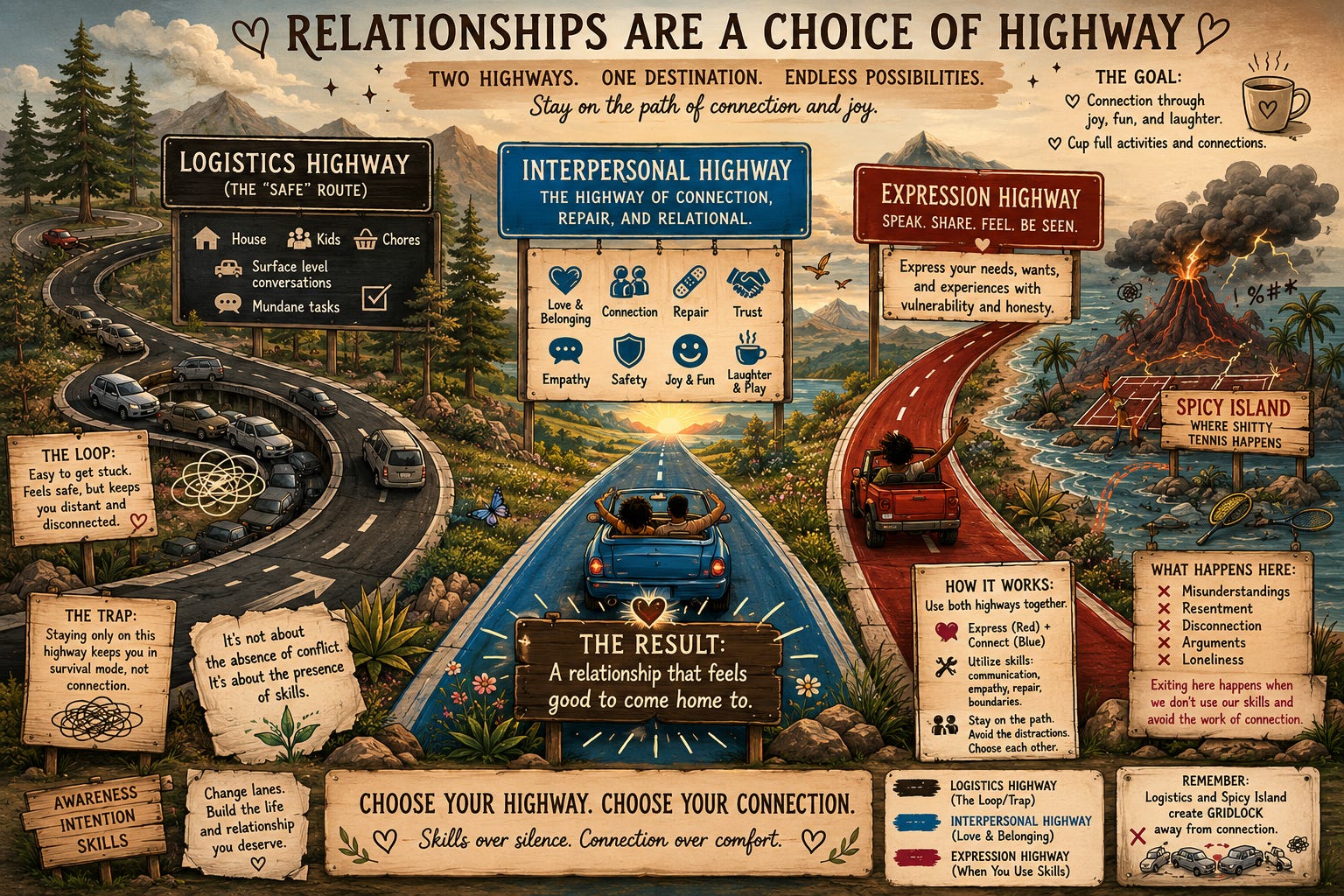
The Three Highways of Communication
To understand why we get so gridlocked, we have to understand the routes we choose to take:
The Logistical Highway: This is the transactional route. “Who is picking up the kids?” “Did you pay the electric bill?” “What time is the meeting?” It’s safe, it’s clinical, and it requires zero emotional vulnerability.
The Interpersonal Highway: This is the relational route. It’s where we check in on the state of us. “How are you holding up with work?” “I feel like we’ve been passing ships lately, and I miss you.” It acknowledges the other person’s humanity and the space between you.
The Expression Highway: This is the raw route. This is where we share our internal world—our boundaries, our grief, our core needs, and our direct impact. “When that happened, I felt incredibly hurt and unseen.”
Here is a vital truth: We need the Expression Highway and the Interpersonal Highway working together in order to have connection, repair, and belonging.
What we actually do: we camp out on the Logistical Highway as a defensive strategy to avoid the Expression Highway entirely. Why? Because over time—in our relationships, our communities, and our online spaces—our amygdalas have been conditioned to believe that the Expression Highway is a dangerous, volatile place to go. Over time we condition the nervous system to expect shitty tennis matches and nervous system activation. We’ve learned that if we express a raw truth, we will be punished for it. So, we stay transactional. Now, if we look around though you will realize we can’t build intimacy on a highway of logistics— too many of us need depth. Eventually, the pressure builds, we swerve off the road, and we skip the path of repair entirely—landing us straight on Spicy Island.

Welcome to Spicy Island: Think Spooky Island but Spicy style with DARVO, Weaponized Trauma & Pathology, and History Digging
Spicy Island is the land of high-reactivity and zero accountability. It is the destination we reach when we don’t know how to cleanly express ourselves, so we weaponize our defense mechanisms instead.
When we are on Spicy Island, DARVO behavior runs the show: we Deny the behavior, Attack the person bringing it up, and Reverse the Victim and Offender.
The Anatomy of a Spicy Island Pivot: Instead of hearing, “It hurt my feelings when you forgot our plans,”the response becomes, “You always expect me to be perfect, and your tone right now is actually making me feel unsafe.”
Suddenly, the original issue is gone. We deflect by digging into history, pulling up a Rolodex of past sins from 2018 to justify our current behavior. We over-explain. We weaponize therapy speak. We weaponize our diagnoses and our trauma—not as a pathway to be understood, but as a shield to avoid the vulnerability of clean expression. We scream that we are being blamed, but in the exact same breath, we blame, accuse, and attack. We do the very things that make the Expression Highway dangerous for everyone else, fully blind to our own hypocrisy. This is the ultimate tragedy: we use the hostile nature of the highway as our excuse to avoid it, while actively contributing to its hostility.
The Olympic Meaning-Making Team and “Shitty Tennis”
How do we justify this to ourselves? Well it’s simple: we are all gold-medalist members of the Making Meaning Olympic Team.
Psychologically, humans are meaning-making machines. When an event happens, we don’t just experience it; we immediately create a narrative around it. We have seen this over the course of our safari through human behavior. You see, because of confirmation bias, the moment we create that narrative, our brains hunt for proof to validate it. The feeling feels so intense that we treat it as an objective, default truth. “I feel rejected, therefore you are actively trying to maliciousy exclude me.” Once we decide our narrative is the absolute truth, we feel entirely justified in attacking and blaming.
This leads directly to what I call Shitty Tennis.
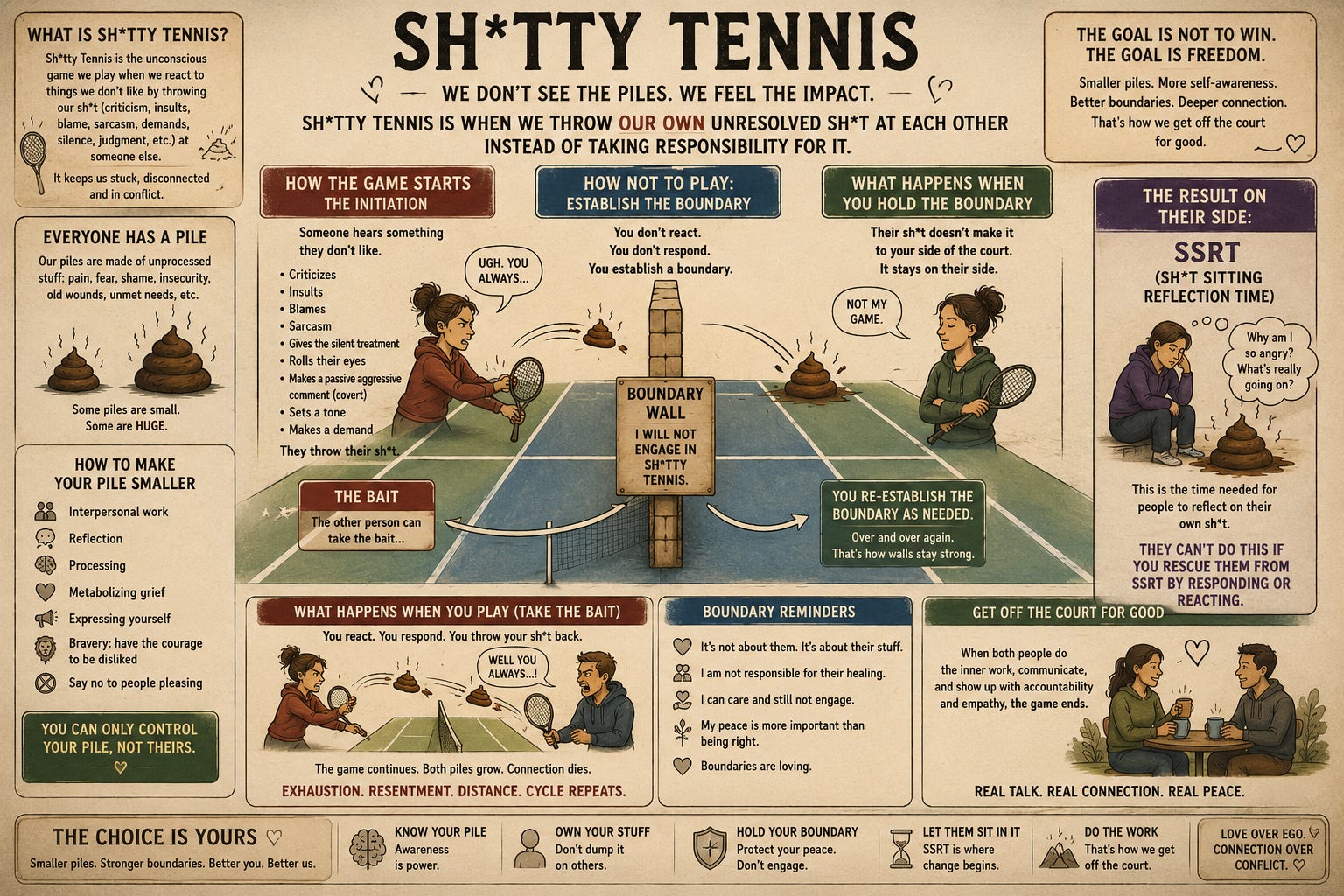
We all walk around with an invisible pile of shit anchored to our ankles. For some people, that pile is a mountain because of a total lack of self-reflection, zero accountability, and a habit of intellectualizing their growth instead of actually implementing themselves within it. In Shitty Tennis, the minute we feel an uncomfortable emotion, we can’t sit with it. We don’t take accountability for our pile. Instead, we grab our rackets and smack that shit right over the net onto the other person. “I’m feeling anxious, so I’m going to make this your fault.” They smack it back. No one is playing to win a game of connection; everyone is just trying to offload their discomfort. This is where you see insults, personal character attacks, and tactics utilize to GET A REACTION FROM YOU! Now— how to you get out of the match if someone is trying to summon you?
We must first learn boundaries but reinforcing them.
If you do not respond to someone’s shit that they throw no matter how bad you want to say something back. We must understand any attention is good attention even if it’s negative. So your reactive or even a response gives these individuals fuel. The key is no response. That causes their shit to get stuck on their side of the court. Thus— require them to sit in what I call SSRT (Shit Sitting Reflection Time) we rob people of SSRT every time we react and give them the distraction from that time out.
From the Micro to the Macro: Gotcha Culture and Power Dynamics
This isn’t just happening in your living room. We are seeing this play out on a massive, sociological scale. We are living in a macro culture of bait-and-switches.
In online discourse, people will bait you into a conversation under the guise of wanting to discuss one thing, only to flip it on you, exploit a nuance, and DARVO the entire interaction. We are trapped in a toxic Gotcha Culture. People follow creators, leaders, and peers not to learn, but to catch them slipping—to collect “frequent flyer miles” on the Spicy Island fast lane by diminishing their message or forcing performative accountability. It has become so dangerous that even premier researchers like Brené Brown have openly spoken about the reality of facing severe backlash and literal death threats just for trying to navigate complex topics. When the macro culture operates this way, our collective nervous systems register total unsafety.
We see this mirror itself in the workplace too. In professional environments, communication quickly turns into anxious tiptoeing. Why do you think that is? My theory— your livelihood is on the line. You have to feed your family. When organizations lack psychological safety, management relies on systemic power imbalances to keep people quiet. Employees repress their Expression Highway because the cost of speaking up is financial or professional ruin. Meaning you risk cut hours, write ups, etc. what ever way to intimidate you out of the behavior of self-advocacy. Now look online. We don’t like what someone said we try to cancel people. We try to silence them. We try to shrink messages that make us uncomfortable because sitting with the discomfort would require us to look at our own shit pile and sort through it.
You see—not to be petty (well maybe a little petty🤭) cancel culture is comical because they can only cancel someone who believes in whatever being canceled actually means. That would require picking up the shit (opinions) of others with your bare hands. I don’t recommend that.
The Goal is Repair, Not Perfection
Let’s be very clear about something: We do not always have to discuss macro-level societal injustice in order to have an honest conversation about what is happening unjustly inside a family system or a relationship.
Example: A teenager is curious about their absent father and wants to understand the situation for themselves. Their mother, however, is emotionally volatile and difficult to approach. She frequently badmouths the father, making it nearly impossible for the teen to explore their own thoughts and feelings about the relationship.
When the teenager attempts to have a conversation, the discussion quickly derails. Instead of listening, the mother begins yelling, shifts the focus to her own childhood wounds, recounts experiences of neglect and infidelity, and accuses the teen of being ungrateful for even bringing up the topic. The original concern is never addressed. What began as a young person expressing curiosity, differentiation, and a desire to form their own judgments becomes consumed by the mother’s emotional reaction.
In essence, the parent has an adult tantrum simply because their adolescent expressed how they feel about the family dynamic.
We have to stop this constant moving of the goalposts is just another deflection away from the Expression Highway.
The adolescent's attempt to engage in healthy differentiation is met with emotional flooding, defensiveness, and role reversal, effectively shutting down the conversation and preventing genuine family dialogue.
If you think about this from a development standpoint. This is how we become arrested in our communication development with the ability to express. It’s why many of us learned to shut down or react in explosive ways simply because patterns that occurred like the example above.
Now from the mother’s perspective.
When the Expression Highway and the Interpersonal Highway are connected, something beautiful happens: repair becomes possible.
Choosing to walk these highways isn’t about perfecting your communication. It’s not about never making a mistake, never feeling defensive, or never taking a boat ride to Spicy Island. It is about having the courage to dismantle the bait-and-switches, put down the Shitty Tennis racket, and step into the messy, vulnerable work of repair.
True belonging lives on the other side of that bridge. Let’s stop avoiding the drive.
Leave a comment below: Where do you find yourself getting stuck? Are you hiding out on the Logistical Highway, or are you a frequent flyer to Spicy Island? Let’s talk about it.
Till next time data collectors