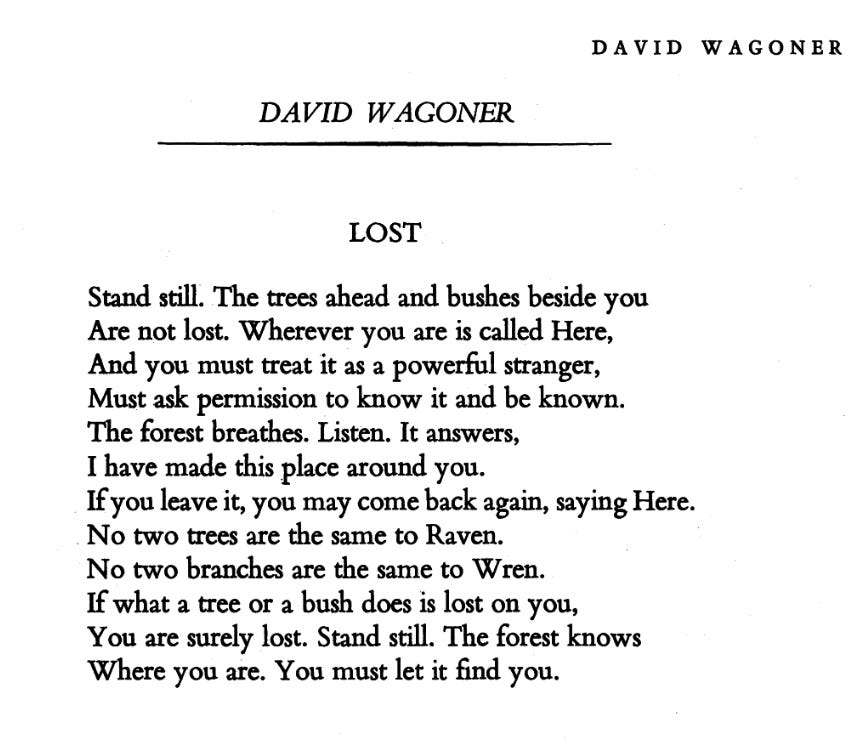
Many of us may feel lost in the forest of life right now. We might be lost in the hippocampus forest—the archives of our minds. The past, the imprint, the wounds, the scars left on our hearts. We might feel lost in our marriage or in our relationship, in our life choices, our career. We may feel lost in where we’re going, what we’re doing, and what we have done. I find myself in that place too. It’s a liminal hallway that sometimes seems to continue to stretch farther out the more I continue on. When I read the poem “Lost” by David Wagoner and I dive and pick it apart in the way that my brain loves to, I realize how much my sense of self has been rooted in fear and panic. How the imprint in my timeline, the fear of abandonment all have led me—took the wheel and driven me through my life. It’s easy to feel that we have healed when we are single, living alone, or unchallenged by others around us. My marriage has revealed a lot of what is still leading me in panic and fear.
And when you’re in panic and fear, your entire relationship to your surroundings changes. It’s almost like one of those holographic images where you’re in a hallway, but it’s moving so quickly that everything around you is blurry. My attention starts to narrow, my brain starts to search for danger, and I can find it in everything because—well— I am in the unknown. Since my nervous system is a runner and a track star, I become preoccupied with getting somewhere else. Somewhere—Safe. What is safety id danger is all you have known? I think that last part is true for many of us00 reaching for safety as certainty. We’re always trying to get somewhere else. Make this much money. Have this car. Buy this house. Have these children. Have this wedding. Have this. Have that. Thinking that once we have it, we’ve arrived.
But what truly is arrival?
In the poem Lost, it taught me a lot about learning how to be. In a way that has been so difficult for me. Especially in society today, we’re being conditioned to be with the noise, to be with the headlines, to be with the injustices, to be with the grief, the ache of the world. And all of that information within the environment has become an obstacle rather than just what it is— data.
So when I read, “let the forest find you,” I see it as a message. A message to stop frantically trying to escape our present experience long enough so we can actually inhabit it. That leads me to think about my marriage, and the many marriages of my clients, peers, and friends. How do you inhabit something as an anxious when you’re with an avoidant? Because if you think about it both sides of the coin are not inhabiting the relationship—they are running from it. We’re running from it in our own different way. The algorithm loves to shame avoidant partner, damn near condemn them. I have my beef with the algorithm beucase it definitely can infiltrate our minds, how we perceive, and what we deem as “safe.” “Stay away from an avoidant,” “They’re a narcissist run.” Everyone’s a this, a that, or a something else. But what about the people who are doing the pointing? What about the people who are doing the labeling? Who are they? Where are they lost? What are they doing to contribute to what they attract into their life. whether thats a career, friends, a partner, a lifestyle. We all play a role in the life we chose to participate in.
“Victim blamer” has become a phrase for the uncourageous. Those without the courage to step into the shadow of their own behavior.
I reflect on the idea of being lost and how, for me, it feels like being lost is a relationship between ourselves and our demand to know where we’re going. I can be sitting in a forest with somebody, picking you up and plopping you besides me in the trees, and wherever you are in your life, navigating whatever it is, despite us being in the forest in that moment, we’re not actually in the same place cognitively and emotionally anymore. We’re lost within our own interpretations. We might be in the forest. But we’re probably lost in our own mind within that forest, in our own griefs, in our own aches, in our own perceptions of what is or what will be. Despite the lush trees and bushes around us helping guide us back to the now.
For many—myself included. The now is terrifying.
I think about what my work teaches. I think about psychology, biology, neuroscience. All that fun juicy stuff. How our thoughts can literally change our heart rate and our breathing. It can shift our body, digestion, and our hormone balance. What we appraise cognitively impacts the way that we perceive it, which is the filtration our mind uses to cast out our perception of the world—often times projecting that as a default truth for everyone else. And all of that has an influence not only on our automatic responses, but also our neuroendocrine responses within the body. So again, if we’re lost in the forest, if I take you from whatever crisis you’re dealing with at this moment and I plop us in the forest, you’re just going to be another person lost in a forest with all those automatic responses happening in the body.
I think about self-fulfilling interpersonal patterns. And how my current life right now is literally a self-fulfilling pattern. Being in this marriage, living in this military life, having an in-law in my home, navigating the dynamics of what that feels like. Oftentimes feeling as if I don’t even belong in this life.
Where is, Savannah? Where does she fit?
How has what I expected due to the imprint in my timeline unconsciously influenced what I’m noticing in my current reality because of fear? And how is that impacting the way that my body responds, which impacts how I behave, which, of course, then influences my lived experience?
If we as a society are being conditioned not only by what we’ve already experienced—our childhood adversities, the imprints in our timeline. But also being normalized through conditioning to live in an environment that pushes lack of safety on us every time we pick up our devices. Now we’re perpetually, repeatedly thinking about lack of safety, lack of trust, which only creates our attention becoming sensitized to evidence of unsafety, meaning that’s all we see. So any form of ambiguous information gets interpreted through that expectation lens because we’re being conditioned to normalize it. We go through 20 different emotions while scrolling our phones. Everything is ADHD now, and labeled “genetics.” I can’t help but scream at the fact that the environment gets bypassed. Our habits, and how we choose to live out our daily life cognitively is something we can learn about. Watch a YouTube video about, scroll reels about. yet, what are we actually taking from that education? How are we applying it to our life behaviorally?
When we are mobilized, we behave differently, and people are responding to that behavior, and that response becomes new evidence for the original belief, which is where confirmation bias lives, which is why I talk about undercurrents that many of us, myself included forget that we are emitting out into the world as emotional pollution. The concept of “we are not our thoughts” is such a hard concept sometimes for me to understand as I simultaneously drown in my own feelings of doom, uncertainty, and panic.
If I’m lost in the forest, based off this poem, I could practice separating what comes up inside my mind. One of the thoughts says, “I’m doomed,” and I could ride with it, embody that feeling because of the automatic response—which for me typically looks like a psychological metaphor for jumping off the cliff. Or I can simply say, “My mind is bringing up this thought that says “I’m doomed,” and now I’ve created a very different relationship with that same thought, all because of choice. And yet that choice seems so difficult to make.
When you think about ACT, I immediately think of cognitive defusion. It teaches us to create a little bit of space between ourselves and our thoughts. Instead of “I’m doomed,” it becomes, “I’m noticing that my mind is telling me I’m doomed.” The thought hasn’t disappeared, and we aren’t forcing ourselves to replace it with something positive. We’re simply changing our relationship to it. The thought becomes something happening within our awareness rather than an absolute truth we have to organize our entire body and behavior around. if I apply this concept to what the poem teaches. Then cognitive defusion is essentially learning that just because a thought appears in the forest with you, it doesn’t mean it knows the way out. It won’t provide you with the sense of certainty. The GPS coordinates to get to that certainty. We all learn that the nervous system is drawn to familiarity right. So what is certainty then if now what you are familiar with?
Being able to observe those thoughts as just a mental event rather than just completely becoming one with it and identifying with it. Getting sucked in by them as if it was VECNA pulling you into the upside down. Which is very hard even for someone like me that teaches this stuff. The Bible even brings speaks on this with Corinthians 10:5. Paul talks about “taking every thought captive.” The Bible also talks about renewal of the mind.
How many of us are actually practicing those things? How many of us actually know what that would look like concretely?
I think the poem is really helping us to ask ourselves: What are we being asked to surrender?
Someone like me, who has an overactive brain and thoughts that zip around creating intense physiological states that impact my perception and how I show up in the “now,” surrendering feels extremely scary. Because what do you mean you want me to stay lost? Especially when you have an imprint of abandonment in your timeline. Being “lost” doesn’t just feel like uncertainty. Being lost can feel just like abandonment. It can feel like nobody is coming, like I have to figure this out, like I need to know where I’m going before something bad happens.
And what happens when you’re constantly living with that fear of abandonment? For me, I become frantic about trying to orient myself. I need to know where I am, where this is going, what this means, what’s going to happen next. But I’m asking the same mind that is terrified by uncertainty to somehow manufacture certainty for me. So it searches. It analyzes. It predicts. It watches. It tries to turn every piece of information into that GPS. And because it cannot actually know the future, the searching never really ends.
Maybe that’s part of what surrender is asking of us. Not to stay lost forever. Not to become passive or pretend that direction doesn’t matter. But to stop demanding that we find our way out of the forest while we’re too frightened to even see the forest clearly. Maybe surrender begins with allowing ourselves to be where we are long enough for the panic to stop deciding what everything means.
To just stop trying to orient yourself.
In our current modern society today, that might literally mean stop scrolling. Stop the noise. Stop the comparisons. Stop the what-ifs. Stop the shoulds and the shouldn’ts.
When I think about this period in my life that I’m in, the things I’m navigating within my own marriage, the fears, the questions, the doubts—will we survive this? Will we get through it? Will we remain together? Will we separate and divorce?—have been drowning me for most of my marriage. I used to tell myself I never wanted to get married because I didn’t want to deal with the pain of having to get through a divorce. I don’t necessarily think that’s a healthy thought process to start a marriage. It was definitely a protective narrative. So now, at 35, I’m faced with looking at what direction I want to take.
As I work with so many couples, I see how so many people, so many women, are gripping. Gripping the relationship to its death. Overanalyzing every nonverbal behavior to its death. While their partners simultaneously avoid the relationship to its death. But are they avoiding the relationship? Or avoiding the intensity of what feels intolerable to face? I ask this for both who fall in the role of avoidant and anxious, because if you ask me. Both roles are avoiding something. They’re avoiding the intensity that comes with facing relational distress, crucial conversations, and relational dynamics that come with all forms of relationships.
We’re all out here on a self-fulfilling prophecy mission of confirming the very things that we constantly cling to and fear are true. And now, with all of this language online and the education and the labels and the ideologies, we’re using all of that to support our own demise.
Isn’t that ironic, what humans do willingly to themselves? Isn’t it confusing too?
Some of us wish and pray for the very things that we see everybody else doing. I think the influencer world has created this notion that there’s a perfect life out there, a perfect person, a perfect marriage, a perfect something. And when we’re constantly looking for “the right one,” “the right job,” “the perfect life,” we have to really ask ourselves:
What is “perfect?” What is “happily ever after," and where did we even see it to even know that it exists?
Because if you think about it, that’s going to be extremely subjective depending on who you’re asking.
I think getting lost in the forest is a metaphor for a deeper form of wisdom. When you think about stillness, and what I’ve internalized stillness to mean for myself, it requires the involvement of distress tolerance skills, but we’re not going to go there. I want to just pull away from all the educational words.
I think it just truly involves tolerating uncertainty without immediately manufacturing certainty to soothe ourselves.
As somebody who constantly needs certainty in order to feel safe, this has been such a hard concept for me to grasp.
When we think about psychology, it may say: becoming aware of the thought without immediately obeying it. From a nervous system lens, it might say: reduce enough mobilization that you can perceive more than a threat. But if we’re coming from a more contemplative state, it might say: become still enough to observe consciousness rather than being swept by every mental event that takes place within the mind.
And then I’m going to reach for Scripture here just for funzies:
“Be still and know that I am God.” — Psalm 46:10
None of this says, “Be still and know your desired outcome.” That’s certainty. None of it says, “Be still and know you’re on the right path.” That’s also certainty.
We are basically taking certainty and we’re placing it somewhere else.
I don’t necessarily know what’s happening next.
I just know I’m in the forest.
I just know I’m lost.
I just know I’m still.
I just know who God is.
I just know I am in the now.
Finding security in that narrative versus the fear-based ones. Pulls us out of the VECNA grip, that often leaves us suffocated.
Stillness does not give us the definitive answer for our future and where we will end up. If our marriage will last. If this job will work out. If this business idea will grow.
But I do think stillness provides us with something very valuable.
Stillness reveals how much of our own suffering was coming from our demand to know the future before we were even willing to inhabit the present.
What do you think?
—Till next time.
Come as you are, where you are.