

Data Collectors,
I want to start of by saying this topic was inspired by a safari member of ours who wrote into my DM with a very amazing question. I want to share it with you but I will protect the identity of the person.

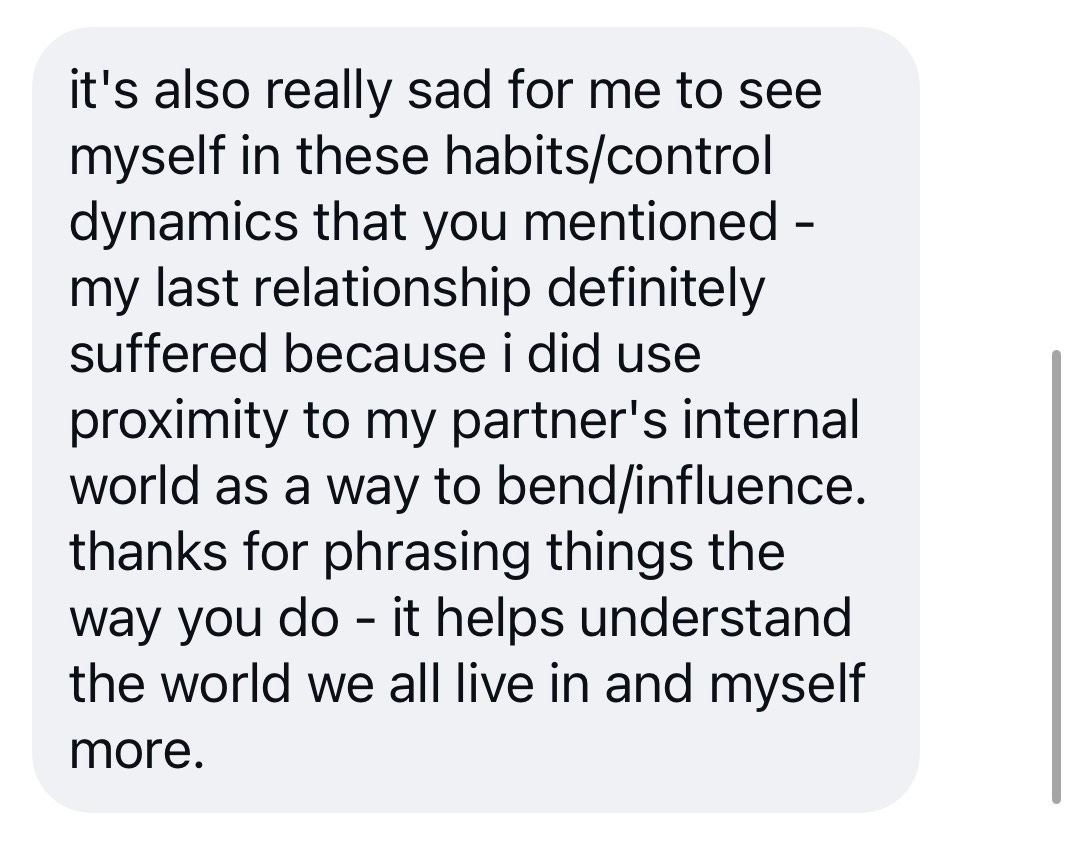
What you read below is based of this response.
Are we ready?
Let’s get into it.
The Mirror of Fear: The Anxious, The Avoidant, and the Gap Between
“Allowing someone to pass” I love this. This right here is radical acceptance. Is this easy to practice? Not in the slightest. Especially, in a society today that is conditioning narcissistic and borderline personality traits in people who need their wounds named in order to be safe. No.
The reason this work is not easy is because the oppositional force to healing is resistance and well— resistance is being conditioned pavlovian style in the micro (us). The resistance to accountability, responsibility, and ownership of where you are NOW, instead of pointing the finger at the elders or parents who have harmed us.
To me, “letting someone pass” is an act of unconditional love for yourself. It’s the visceral realization that if someone insists the sky is green, you don’t have to litigate the blue. You don’t have to prove, you don’t have to fix, and you don’t have to convince them of anything. Zoom out…
Haven’t you noticed. We are nothing but beings stuck in loops of feeling “not good enough” “not worthy enough.” So we over perform, over function, or over induldge to cope with the pain of “not being enough.” We’ve become a society that is constantly “proving” ourselves at work, in our families, and in our relationships. We are bleeding out our life force energy trying to be “seen” by people who won’t ever notice us because they are just a reenactment of a lesson we needed to learn, maybe 5 years ago so we can finally ascend.
Think of it like Iyanla Vanzant’s In the Meantime— if we are starting in the basement, the goal is to move up the floors. We can’t do that if we’re weighted down by litigation. "That policing behvaior that came from a whole year of being stuck at home in isolation with hysteria fill and a sickness that was infecting everyone. Was it COVID or was it this very emotional contagion? thats up for you to reflect on. Look at the psychological implications of what happens to humans when stuck inside fo far too long?
The birth of:
Hall Monitors,
“You aren’t politically correct” police
What society calls “Karens”
Don’t be fooled. These hall monitors, mob mentality members are the ones who have no control in their own life so they are out in the world controlling others. This provides the mob mentality member (we have all been there by the way) an escape into the illusion of control, so it can distract them from their own internal feelings of hopelessness.
See the loop?
If I can correct you I get dopamine. Now we have a bunch of dopamine addicted hall monitors running the streets instead of policing their own habits, routines, and mental health.
If someone wants to be wrong, let them. That’s the “Let Them” theory in action. When we are actually at peace within ourselves, we don’t need to control the external environment or the people in it. We can just allow them to be exactly where they are.
What will you do with all that extra time from hall monituring it up? OMG, maybe you can get to that walk you have been wanting to do for age, or make some bread, watch that show you wanted to…
Time becomes available when the mind is not fixated on the behavioral change others will not do. Focusing on them while you do not do what you could be doing is the hypocrisy loop we don’t see.
The Shadow of Survival: Identification with the Aggressor
Now, let’s zoom back in.
We point a lot at the older generation, but lets remind ourselves they still raised us. What survival adaptations did we inherit simply for being in proximity to them?
This is self-assessment.
We often identify as victims of communal narcissism, but we rarely discuss the Narcissistic Survival Adaptations (NSA) we adopted to endure it.
Identification with the Aggressor: This Freudian concept explains how a child adopts the traits of a controlling caregiver to feel a sense of power rather than helplessness.
Proximity as Leverage: We may find ourselves using proximity to a partner’s internal world as a way to bend or influence them—the very habit used against us as children.
Let’s unpack the last one because I myself have had experiences where that very proximity leverage has been used against me in friendships with women. These women are typically the ones that dictate emotional climates within their own family. I correlated some of the harm done to me by being a people pleaser. Now, Some people get close boucle they want to know the shadow aspects of you so they can feel better about themselves. This is very common. This Is where the need for discernment comes in.
The “Huge Child” and Arrested Development
Clinically, many adults we encounter (including ourselves) are functioning from a state of Developmental Arrest.
The Puer/Puella Aeternus: These Jungian archetypes represent the “huge child” in an adult body someone who was never safely mirrored and thus never moved into functional adulthood.
Adaptive Child vs. Functional Adult: Pia Mellody’s framework describes the “Adaptive Child” as the part of us that uses manipulation or control because it doesn’t believe in the safety of the “Functional Adult” boundary.
In Pia Mellody’s framework, this is the distinction between the Functional Adult and the Adaptive Child. When we are “allowing them to pass,” we are operating from the Adult; when we are trying to fix the external environment to feel safe, we are operating from the Child.
We cannot complete our missions in life from the operation of the child.
In this section of your Field Notes, we’re looking at the hard truth of the “Mission Block.” If you’re stuck in the Adaptive Child loop, you aren’t just stressed you’re essentially “offline” drifting is what Napoleon Hill would call it from your own destiny. You can’t reach the higher floors if you’re busy fortifying the basement.
The Mission Block: Survival vs. Alignment
When you operate from the Adaptive Child, you are trapped in the Activated Survival Self. In this state, your nervous system is “firing and wiring” in a loop of hypervigilance. You think you’re in a place of power because you’re controlling the environment, but clinically, you’re just in a state of high-functioning panic. Over time this consistent exposure raises your baseline for functioning.
The Amygdala Hijack: Your brain is stuck in a survival loop, which means you literally cannot access the Prefrontal Cortex, the part of you required for vision, mission, and long-term creation.
The Alignment Problem: You cannot complete your mission in life from a survival state because your “authentic self” isn’t the one driving. The Adaptive Child is an expert at surviving the past, but it has no idea how to navigate the present.
The Schema Trap: You can’t advance to the next mission if you’re still playing by the rules of the child’s schema. It’s like trying to run new software on an old, corrupted operating system.
Debunking the Myth: What is a “Functional Adult”?
I myself find myself looking for the “adult ADULTS” 😂 We’ve been sold a lie that being an “adult” means having a mortgage, a job, and “shoulding” yourself into submission. But as we see in the field, many of these “adults” are just huge children with bigger bank accounts, more toys, and kids.
In our work, Adulthood is not a chronological age; it is a regulated state.
Presence over Performance: A Functional Adult lives in the present moment, not the “In the Meantime” basement of past reenactments.
Internal Agency over External Control: An adult doesn’t need to “litigate the blue” because their reality isn’t up for debate. They have nothing to prove.
The Anchor: Adulthood is the ability to stay okay within yourself even when the external environment is falling apart or someone is insisting the sky is green.
Relational Equality: The adult operates from a place of “equal to”—not the “superiority” or “less than” dynamics that the Adaptive Child uses to feel safe.
The Ascension
If the goal is to move up the floors, the “Functional Adult” is the elevator. You have to be willing to sit in the neurosis of adulthood, the discomfort of not controlling others—so that you can finally have the energy to complete your mission.
Your mission requires your presence and the Adaptive Child is always somewhere else, trying to fix a past that’s already over.
The Adaptive Child: The Survival Expert
The Adaptive Child is the version of you that stepped in when the actual adults in the room were “huge children” themselves. It is a set of behaviors, thoughts, and feelings that you “adapted” to survive a communal system that wasn’t safe or sane.
Motivation: The primary goal is control as a form of safety. If I can manipulate the environment or “fix” the narcissist, then I won’t be hurt.
Behavioral Traits: This part is often “less than” or “superior to” others. It’s the part that engages in the “What About Me?” sticker behavior or uses proximity to influence others.
Reality Perception: It sees things in polarities (black and white). It’s the part that feels a “Narcissistic Injury” when the world doesn’t name its pain.
The “Fleas”: This is where we harbor our Identification with the Aggressor. We use the same controlling tactics we learned from the narcissist because, to the Adaptive Child, power is the only alternative to powerlessness.
The Functional Adult: The Grounded Anchor
The Functional Adult is the part of your psyche that lives in the present moment. It is the “you” that has moved up from the basement to the higher floors.
Motivation: The goal is connection and self-regulation, not control.
Behavioral Traits: It operates from a place of “equal to” others neither a victim nor a perpetrator. It recognizes that its value is inherent and doesn’t need to be proven or litigated.
The “Let Them” Theory: The Functional Adult is the part that can “Allow Someone to Pass”. It understands that someone else’s insistence that “the sky is green” is a reflection of their developmental arrest, not a threat to the Adult’s reality.
Boundaries: Instead of trying to change the other person (external control), the Functional Adult sets a boundary on what they are willing to tolerate (internal agency).
The Balancing Act in the Field
The “neurosis of being an adult” is that we are constantly toggling between these two. We go to work as the Functional Adult, but the moment a boss or a spouse triggers an old “narcissistic injury,” the Adaptive Child grabs the steering wheel.
The work of “ascending” is learning how to notice when the child is trying to “fix the environment” and gently bringing the functional adult back online to keep the Prefrontal Cortex from checking out.
The Cognitive Tax of the “Green Sky”
Every time you try to change someone else’s distorted reality, you are paying a Prefrontal Cortex (PFC) Tax.
Amygdala Hijack: Arguing with a narcissist triggers your survival brain.
Top-Down Regulation: “Allowing them to pass” is a conscious choice to keep your PFC online. If you spend your life “fixing” the narcissist, you develop a chronic mood that eventually becomes a temperament and a personality.
Conclusion
The balancing act is realizing that we only try to fix the environment when we are not okay within ourselves. When we lack internal agency, we resort to external control. The work is to move from External Control to Internal Sovereignty.
Your manipulation was once your medicine, but now it is your poison.
If you are waiting for the environment to change so that you can finally start your life, you are being held hostage by your own Adaptive Child. This part of you thinks that controlling the “green sky” is the path to power, but it’s actually the anchor keeping you stuck looping in the basement.
The Adult Reality: Being a “Functional Adult” means realizing that your mission is independent of other people’s dysregulation.
Radical Acceptance: When you stop litigating, you stop giving your power away to people who aren’t even in the room with you.
The Work: The next time you feel that pull to “fix” or “prove,” ask yourself: Am I trying to move up a floor, or am I just decorating the basement?
Let them pass, so you can finally arrive.
Let me know what comes up for you with this one. Thank you to the person who wrote in. ‘Allow them to Pass’ is my new Mantra 🥰
Till next time Data Collectors.
Reference List
Dispenza, J. (2012). Breaking the habit of being yourself: How to lose your mind and create a new one. Hay House.
Freud, A. (1936). The ego and the mechanisms of defence. International Universities Press.
Jung, C. G. (1959). The archetypes and the collective unconscious. Princeton University Press.
Mellody, P. (1989). Facing codependence: What it is, where it comes from, how it sabotages our lives. Harper & Row.
Schwartz, R. C. (2001). Introduction to the internal family systems model. Trailheads.