

Hi! Before we begin, a quick note.
I’m playing with a new feature here: voiceovers. I stumbled on it and thought… hmmm why not? So here’s a raw, unedited recording of me reading this piece — mistakes, background noise, commentary, giggles, and all. Just note this isn’t a polished production. It’s me — showing up, experimenting, and letting it be messy on purpose. We can call it exposure therapy, call it modeling imperfection, call it me being too stubborn to re-record. (← The last one.)🙃
My goal is to find a bit of a flow with these. Being able to listen to the article may be helpful. Either way, I’m still figuring it out and I am taking you all on the ride with me.
So take a listen, see how it lands in your nervous system, and let me know if this format feels helpful, human, or just fun. I’ll go from there.
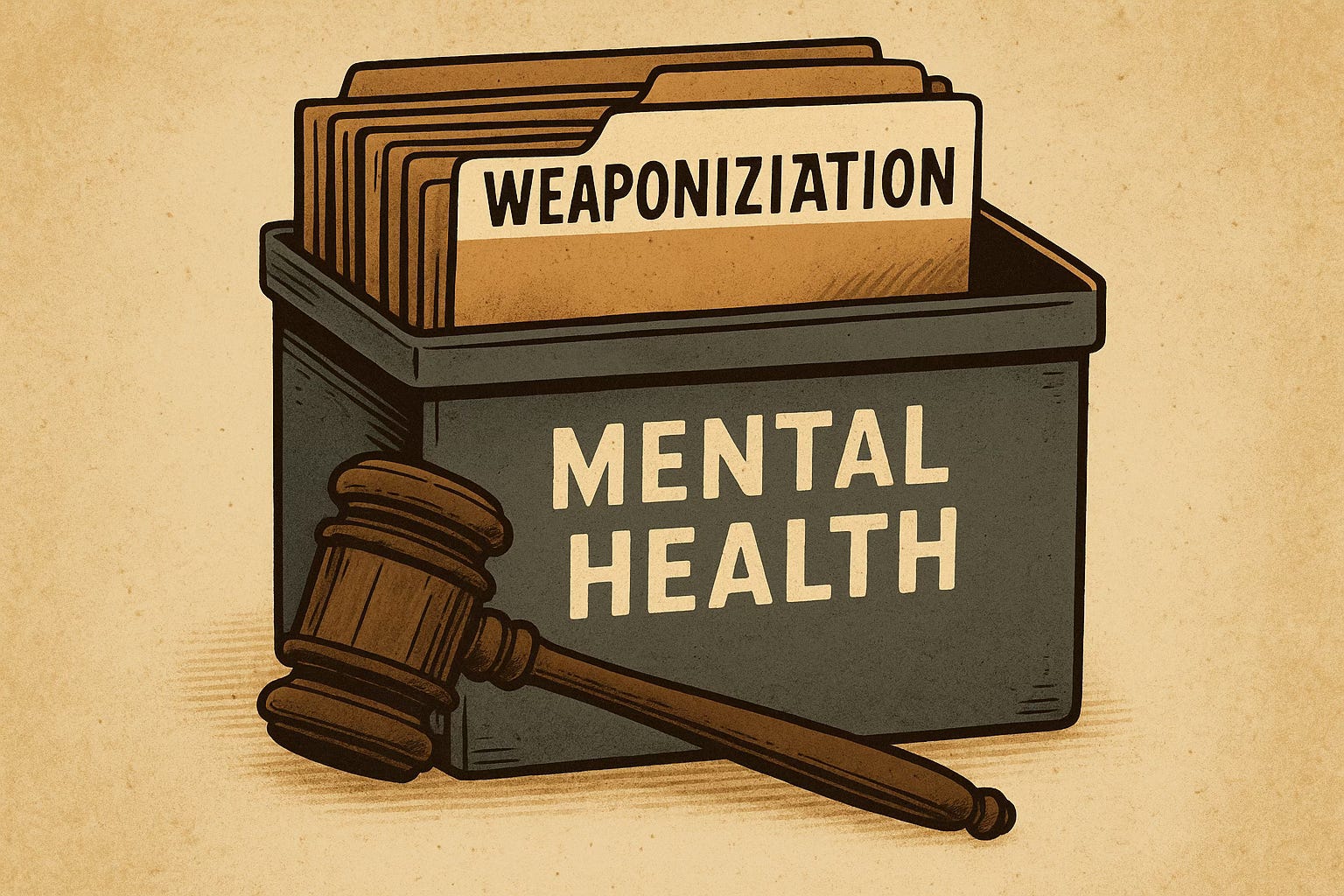
I use to believe mental health awareness would liberate us. And in many ways it has. People now name their wounds, seek support, and have a greater level of language for internal suffering. The thing is something strange is happening beneath the surface. Language meant to help us heal is being used to avoid growth. Diagnosis has become identity. Awareness has become a weapon. A generation claiming to be “doing the work” is actually reinforcing cycles of helplessness, emotional reactivity, and victimhood. Oof …And are you ready for this one? It can even perpetuate— racism and social justice issues…
Hear me out.
This piece isn’t about shame—it’s about reclamation. Because I feel it’s about time that we stop confusing verbal fluency for emotional mastery or “healing.” We as a society are peacocking empowerment and the mask is starting to slip.
I. When Awareness Becomes Avoidance
Kids test boundaries. They learn early which parent is more likely to give in, which one reacts emotionally, which one stays consistent. Now—What about when they scan the way their parents move through the house, assess their tone, their mood? This is emotional survival—it’s adaptive. But what happens when we carry those same dynamics into adulthood?
We test boundaries with our partners. Our therapists. Even with ourselves. We say things like,
“I’m just explaining myself,”
…when in reality, we’re trying to emotionally hijack a conversation to avoid being held accountable.
We’ve normalized this kind of self-explanation that masquerades as vulnerability but is often strategic evasion. And it works—until the person in front of us starts seeing through it.
In family systems theory, this is called triangulation—when individuals manipulate relationships to manage discomfort instead of facing it directly (Minuchin, 1974). Many adults are triangulating with their trauma labels.
Examples of Adult Triangulation I’ve Seen In Sessions…
Trauma story as the middleman:
Instead of telling my partner “I feel ignored when you scroll during dinner,” I reroute through my wound: “This is just like when my dad never listened to me.” My partner isn’t dealing with me directly anymore — they’re dealing with my trauma story.Diagnosis as the third point:
Rather than saying, “I’m feeling overwhelmed and need a break,” I insert my diagnosis: “Well, my ADHD makes it impossible for me to focus right now.” The diagnosis does the talking, and accountability gets blurred.Identity/label as mediator: This happens in the Macro level ALL. The. Time.
Instead of saying, “That comment made me feel xyz,” I anchor it in a label: “As a [insert identity], you can’t say that.” The conversation stops being about the direct relational dynamic and becomes filtered through the identity.Emotional pain as shield:
When a friend asks for honesty, I don’t respond directly. Instead I say, “You know how much trauma I’ve been through — you can’t expect me to handle this.” The trauma is pulled in as a shield to avoid direct engagement.Past relationship as triangle:
In conflict with my spouse, I say, “You’re acting just like my ex.” Instead of speaking to my spouse about the behavior, I triangulate by dragging an old relational template into the present moment.
II. The Double Standard of Diagnosis
We live in a time where people introduce themselves by their diagnosis. “I have ADHD.” “I’m neurodivergent.” “I’ve experiences narcissistic abuse.” These terms are real and valid. But their timing, the when and how we use them—often reveals whether they’re tools or shields. Please Understand, for many this process goes unconscious. The Diagnosis— A tool that invites us into healing can immediately become a shield to deflect responsibility.
When a partner sets a boundary and we say, “Well my anxiety is high, so that’s why I shut down,” —we’ve just excused a relational pattern without inviting any effort toward change.
This is a misuse of what’s known as the biopsychosocial model (Engel, 1977)—a framework meant to understand illness holistically, not to excuse chronic relational patterns. It emphasizes that we are both influenced by and responsible for our context.
III. The Algorithm Is Not Your Nervous System’s Friend
If your nervous system can be hijacked by a TikTok scroll or an Instagram comment, you are not in control of your life. We like to believe we’re the authors of our own lives—that we’re writing the script, choosing the plot, and steering the story. But, if we’re honest, many of us aren’t authors at all; we’re merely just characters being written by forces we don’t even notice. The trauma we rehearse, the labels we cling to, the content we consume, the outrage we feed — all of it functions like an invisible puppeteer. These algorithms aren’t neutral; they learn from our attention, what’s wild is many of us know that. Yet what we click on, fixate on, and revisit isn’t just “content” — it’s a slow-drip. drip. drip, of narrative poison that shapes the way we think, feel, and respond until we’re choking on the emotional pollution emitting from many of us. This becomes the norm— it becomes our personality.
Every swipe, every headline, every viral sound activates an emotion. And your nervous system—already wired to scan for threat (Porges’ Polyvagal Theory, 2011) interprets that digital stimulation as real.
Below is a visual to help represent the nervous system baseline and how it spikes due to excessive media consumption, content, and even lifestyle/relationship choices that keep our nervous systems in a state of constant disruption.
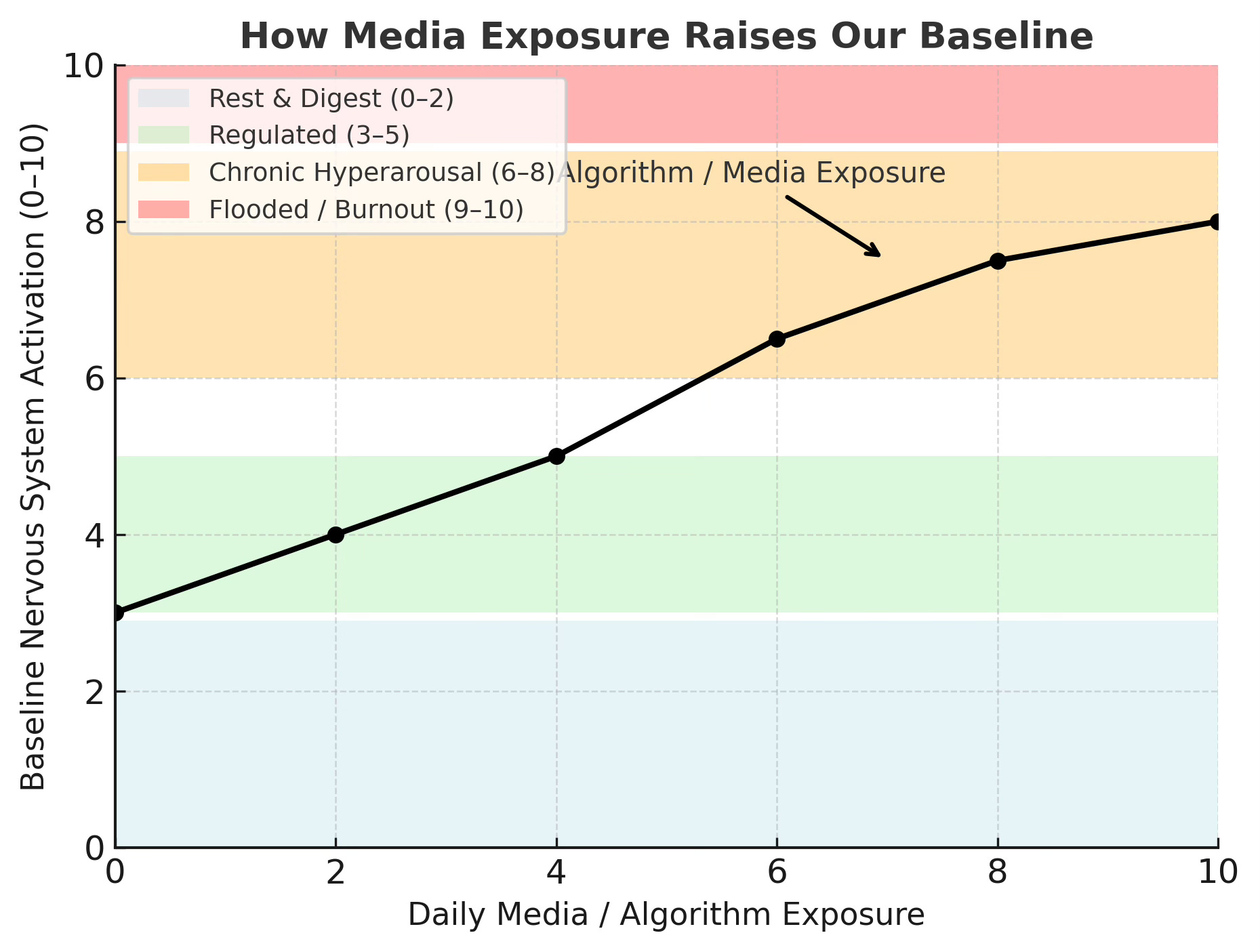
How to read this graph:
The Y-axis shows your baseline nervous system activation on a scale of 0–10. The X-axis represents your your cumulative daily input not just algorithmic/media exposure, but also, what you’re consuming through your diet, relationships, environment, unresolved emotions/wounds, family dynamics, work stress, and unspoken truths. This is what Jung referred to as the shadow, the unconscious material we avoid, suppress, or disown. But the more we deny it, the more it rules our physiology and perception.
At the bottom (0–2), we see Rest & Digest — the calm, restorative state our bodies are designed to return to.
Between 3–5 is the Regulated Zone — where you can think clearly, stay present, and adapt to stress in healthy ways. This is where our baseline could hover.
As exposure increases, the line climbs into 6–8, the Chronic Hyperarousal Zone — where many people are now stuck. Here, even small triggers feel overwhelming.
At 9–10, we hit Flooded / Burnout, when the system is maxed out and shuts down.
The curve shows how cumulative daily input slowly but steadily raises our baseline. Instead of living at a “3–4,” many of us are operating at a chronic “7–8” without even realizing it. Then, when symptoms show up — anxiety, depression, ADHD-like struggles, we reach for diagnoses or labels, often overlooking the deeper cause: a baseline hijacked by the outrage cycle and the content we consume.
It’s not just digital input. Our baseline is also shaped by what we eat, what we believe, and what we energetically absorb. The body keeps score of every unprocessed emotion, every tense family dinner, every people-pleasing loop at work, every relationship that leaves us dysregulated. We’re constantly consuming, not just through our eyes and ears, but through our nervous systems. In what I call undercurrents of energy.
This is where I may get a bit crunchy for some of y’all, but bear with me okay? :)
Have you ever walked into a room and could feel a thickness or intensity? The feeling you get at the scene of a deathly car accident, a funeral, or maybe at a concert, or yoga class? That is the under current of energy and it is contagious. It’s made up of unspoken truths, unhealed wounds. Leaving all of that unreleased tension in the body to become energetic stagnations that clog our system, block flow, and keep us activated. These invisible inputs matter just as much — and often more — than what’s scrolling on our screen.
Now add the brain’s negativity bias (Baumeister et al., 2001), which makes us more sensitive to negative information. That means:
You’re not just consuming content
You’re mentally rehearsing pain
You’re reinforcing your emotional baseline through repetition
And if what you rehearse is what your brain learns to expect—then you are building a muscle for hypervigilance, not resilience.
IV. Emotional Reasoning ≠ Truth
Feelings are real, but they are not always reliable.
If you treat every emotional wave as truth, you are engaging in emotional reasoning—a classic cognitive distortion where one assumes that because they feel something, it must be true (Burns, 1980).
“I feel rejected, so you must be abandoning me.”
“I feel criticized, so you must be attacking me.”
“I feel anxious, so you must be unsafe.”
We think its insight…
Look again…
It’s a form of entrapment if you zoom out enough. No really—zoom out more…
Cognitive Theory Reference: Beck (1976) emphasized that distorted thinking leads to emotional suffering—not the other way around. Our interpretations, not our circumstances are what shape our distress.
V. Learned Helplessness Is Now Marketed as Empowerment
We’re witnessing a cultural epidemic of learned helplessness. What Seligman (1975) first described as a cognitive state of perceived powerlessness has now become a brand. We don’t just identify with our wounds—we monetize them.
We don’t just share our struggles—we narrate them endlessly to avoid change.
We collect terms like “trauma,” “gaslighting,” “inner child,” but we apply none of it with nuance, discipline, or embodied action.
And we call that empowerment?
VI. Sex, Dopamine, and Emotional Pollution
Let’s talk nervous system hygiene.
Many of us are entangled—energetically, sexually, emotionally—with people we don’t even like. We’re seeking dopamine, not true intimacy. Every time we use sex or attention as a self-soothing strategy, we’re entering into energetic contracts that carry consequences. We later wonder why our baseline anxiety increases. Why we feel shame. Why we spiral.
Imagine a boat floating on water. If it begins to vibrate, it sends ripples outward—affecting everything around it.
Your nervous system is the boat. Your energy is the ripple.
If you’re vibrating in resentment, jealousy, grief, or shame—you’re sending out emotional pollution. You’re likely infecting yourself again by staying in the same ecosystem. Cozolino (2010) notes that relational fields shape the brain’s plasticity. We become who we are in relationship—not just with people, but with patterns.
VII. Reenactment Isn’t Destiny—It’s Unconsciousness
When you repeatedly find yourself in the same relationship dynamic, it’s not the universe punishing you. It’s your nervous system trying to resolve an old wound by recreating it. This is trauma reenactment. It is not random. It is your body’s failed attempt at resolution. Remember the amygdala doesn’t have eyes. it is relying on your interpretation based on information it pulls from the hippocampus ( the imprints in your timeline.) It can’t differentiate between a Lion and a text message. Until you become aware of this, your adult choices will be steered by the inner panicked child’s fear.
VIII. The Real Empowerment Is in Resilience
Resilience isn’t flashy. It doesn’t get you likes. It doesn’t go viral.
But it’s what keeps you sane.
If we don’t rebuild that muscle—if we keep outsourcing our safety, our healing, our identity to diagnosis, algorithms, and relationships—then we are not liberated. We are enslaved. By our own trauma loops.
Nietzsche once wrote,
“He who has a why to live can bear almost any how,
But you have to build a how that doesn’t rely on being coddled, praised, or seen.”
IX. From Awareness to Embodiment
We as a society do not need more language.We need more practice.
Practice being present
Practice taking ownership
Practice saying “I was wrong” without a self-diagnosis attached
learning how to be bored instead of being full of world crisis.
Everybody wants to know how to “be self-embodied.”
You start by learning how to be with yourself.
Before you clap back, post, or perform your healing—pause long enough to notice what’s happening in your body.
That micro-second of awareness is where the body and brain decide whether you’ll repeat the past or rewire it. Dr. Joe Dispenza’s work enters the chat…
Here’s the part most people skip: embodiment starts in the body, not the brain.
You can’t think your way into presence.
You have to feel your way back into it.
Trust me when I tell you loves, when you catch that wave of presences… It feels gooood. Real good.
The Real Window of Tolerance
Clinically, The Window of Tolerance (Siegel, 1999) describes the optimal arousal zone of the nervous system—where you can think, feel, and respond without becoming overwhelmed or shutting down. When you move above this window, your body enters hyperarousal (fight, flight, panic). When you drop below it, you experience hypoarousal (numbness, freeze, dissociation). Within the window, your brain and body can stay connected enough to process emotion, access empathy, and engage choice instead of reflex.
Now here’s where I deviate a little: buckle up gang, we’re taking this safari off road…
If you’re constantly tolerating what hurts you, drains you, or disrespects you, you’re not inside your window— you’re out of it. You’re abandoning yourself inside a frame that no longer fits. True regulation isn’t “staying calm while being mistreated.”
It’s recognizing, “This is no longer tolerable for my nervous system.”
That’s the wisdom of embodiment — not the performance of it.
In my work with clients from all walks of life and relationship dynamics, I’m intentional about removing any sense of moral hierarchy from the healing process. My role isn’t to decide what’s “right” or “wrong” for you—it’s to help you discover what’s sustainable.
Sustainable for your nervous system, your growth, your safety, and your peace.
Because sustainable healing can only exist where autonomy and compassion meet. When I tell clients, “I’ll support you in whatever you choose,” I mean it.
If they choose to stay, we explore how to do so without losing connection to self.
If they choose to leave, we explore how to do so without collapsing in shame.
Paradoxically, it’s often when clients feel free not to be judged that they finally feel safe enough to choose differently.
Practice, in Real Life
Check your body before you check your phone.
What sensations are present? Tight chest? Jaw locked?
That’s data — not dysfunction.Ask yourself, “Am I self-abandoning or self-regulating?”
One numbs. The other nurtures.Orient back to the room.
Feel your feet. Name five colors. Let your body remember it’s here, not back there.Repair with yourself before you rush to repair with others.
Self-connection first, then conversation. That’s what actually rewires the loop ( Cozolino, 2014).Speak from ownership, not pathology.
“I felt hurt when…” lands differently than “My trauma response made me…”
The true test of healing isn’t what you say online.
It’s what happens in that sacred pause between stimulus and response. That’s where the nervous system learns a new story:“I can stay with myself, even here.”
Because embodiment isn’t a vibe.
It’s a practice of non-abandonment. And it starts with one honest, regulated breath. The true test of your healing is not what you say online—it’s what happens in the space between stimulus and response in your real life.
Reflection Questions:
When do I use mental health language to deflect instead of reflect?
What emotion do I default to as protection—shame, anger, self-pity?
Do I truly practice what I preach or do I just say it well?
What ripple is my nervous system sending out today?
Final Note: Self-Leadership Starts Here
This isn’t about trying to perfect-tify it all. It’s about power—the kind that’s built, not borrowed. It’s time to stop treating your feelings as facts. It’s time to stop reenacting the story. It’s time to step into nervous system sovereignty. That’s where the real healing begins.
📚 Reference List
Beck, A. T. (1976). Cognitive Therapy and the Emotional Disorders. New York: International Universities Press.
Baumeister, R. F., Bratslavsky, E., Finkenauer, C., & Vohs, K. D. (2001). Bad is stronger than good. Review of General Psychology, 5(4), 323–370.
Burns, D. D. (1980). Feeling Good: The New Mood Therapy. New York: William Morrow.
Cozolino, L. (2010). The Neuroscience of Psychotherapy: Healing the Social Brain. 2nd ed. New York: W. W. Norton.
Cozolino, L. (2014). The Neuroscience of Human Relationships: Attachment and the Developing Social Brain. New York: W. W. Norton.
Dana, D. (2018). The Polyvagal Theory in Therapy: Engaging the Rhythm of Regulation. New York: W. W. Norton.
Dispenza, J. (2012). Breaking the Habit of Being Yourself: How to Lose Your Mind and Create a New One. Carlsbad, CA: Hay House.
Engel, G. L. (1977). The need for a new medical model: A challenge for biomedicine. Science, 196(4286), 129–136.
Herman, J. L. (1997). Trauma and Recovery: The Aftermath of Violence—from Domestic Abuse to Political Terror. New York: Basic Books.
Minuchin, S. (1974). Families and Family Therapy. Cambridge, MA: Harvard University Press.
Nietzsche, F. (1889/1956). Twilight of the Idols and The Anti‑Christ. (Trans. R. J. Hollingdale). London: Penguin.
Porges, S. W. (2011). The Polyvagal Theory: Neurophysiological Foundations of Emotions, Attachment, Communication, and Self‑Regulation. New York: W. W. Norton.
Schore, A. N. (2003). Affect Regulation and the Repair of the Self. New York: W. W. Norton.
Schwartz, R. C. (1995). Internal Family Systems Therapy. New York: Guilford Press.
Seligman, M. E. P. (1975). Helplessness: On Depression, Development, and Death. San Francisco: W. H. Freeman.
Siegel, D. J. (1999). The Developing Mind: Toward a Neurobiology of Interpersonal Experience. New York: Guilford Press.
van der Kolk, B. A. (2014). The Body Keeps the Score: Brain, Mind, and Body in the Healing of Trauma. New York: Viking.
Recommended Reads — Expanding the Conversation
If the essay resonated, these texts deepen the same questions you raise about awareness, identity, and embodied regulation:
1. Gabor Maté – When the Body Says No: The Cost of Hidden Stress
Explores how emotional suppression manifests as physical and psychological illness.
2. Bessel van der Kolk – The Body Keeps the Score (for readers new to nervous‑system language).
3. Peter A. Levine – Waking the Tiger: Healing Trauma
Practical somatic framework for releasing stored survival energy.
4. Deb Dana – Anchored: How to Befriend Your Nervous System Using the Polyvagal Theory
Gentle, accessible guide to self‑regulation and relational safety.
5. Richard Schwartz – No Bad Parts
Modern expansion of Internal Family Systems—perfect for readers exploring “protector parts” and internal dialogue.
6. Viktor E. Frankl – Man’s Search for Meaning
The philosophical backbone for the section on resilience and responsibility.
7. Joe Dispenza – Becoming Supernatural & Breaking The Habit of Being Yourself (my personal fave!)
Bridges neuroscience, meditation, and neuroplasticity for readers drawn to the embodiment angle.
8. Alan Watts – The Wisdom of Insecurity
A spiritual‑philosophical complement to the articles argument about the illusion of control.
9. Brené Brown – The Gifts of Imperfection
Grounds vulnerability and accountability in emotional literacy rather than performance.
10. Johann Hari – Stolen Focus: Why You Can’t Pay Attention—and How to Think Deeply Again
Context for the “algorithm isn’t your nervous system’s friend” section.