

Data Collectors,
Before we begin, due to the society we live in and the amount of polarity and "whataboutme" toxin plaguing the planet.
Let’s ground in the reminder:
This work is not about blame it’s about patterns.
Think every time you plug your brain into the work. You are now in connection with yourself. We are all in the room—together. When those of you share, bear with me, okay? I love to see it. The gridlock moments, the frustrations, the realizations—the "shift" is what my clients have been collectively calling it. Sharing helps not just me, but those in the background silently watching, listening, and reading.
In my work with humans. Please trust me when I say:
We are ALL so similar in the wounds we each carry.

As someone who has worked in many different settings living in El Paso has ignited a level of emotion in me for the clients I serve here. Let me be frank here (not sure why its frank, but thats for another day…)
For the women or men who have been harmed by family members who have engaged in SA acts, coercion acts etc. While their parents, family etc covered it up—kept it silent, and told their child to stay quiet about it. These cases always make me wonder why.
I bring that curiosity into the room.
For many, MANY, having these conversations is extremely uncomfortable. I mean, on the uncertainty scale you’re talking UN.CER.TAIN.TY… Are you catching what I’m throwing? This is scary for the generational roots of some of these families. I know we love the Costco style of things sometimes, but this work gets heavy. Especially if kids, or even the adults, fear that the family will collapse once they share the information or emotions that are heavy on their heart with the family.
What do you think the issue with this is, long term?
Keeping it a secret
Because over time keeping that secret is essentially the muscle you teach the family. Silence, Swallowing, aching alone. Can you imagine what little kids feel when their parents “don’t believe them” simply because believing them puts them at risk of danger.
Zoom Out…
This happens in the workplace all. the. time.
Can you imagine if you are navigating this in the workplace AND at home. Which one are you going to prioritize? Well if we look at the hierarchy of needs.
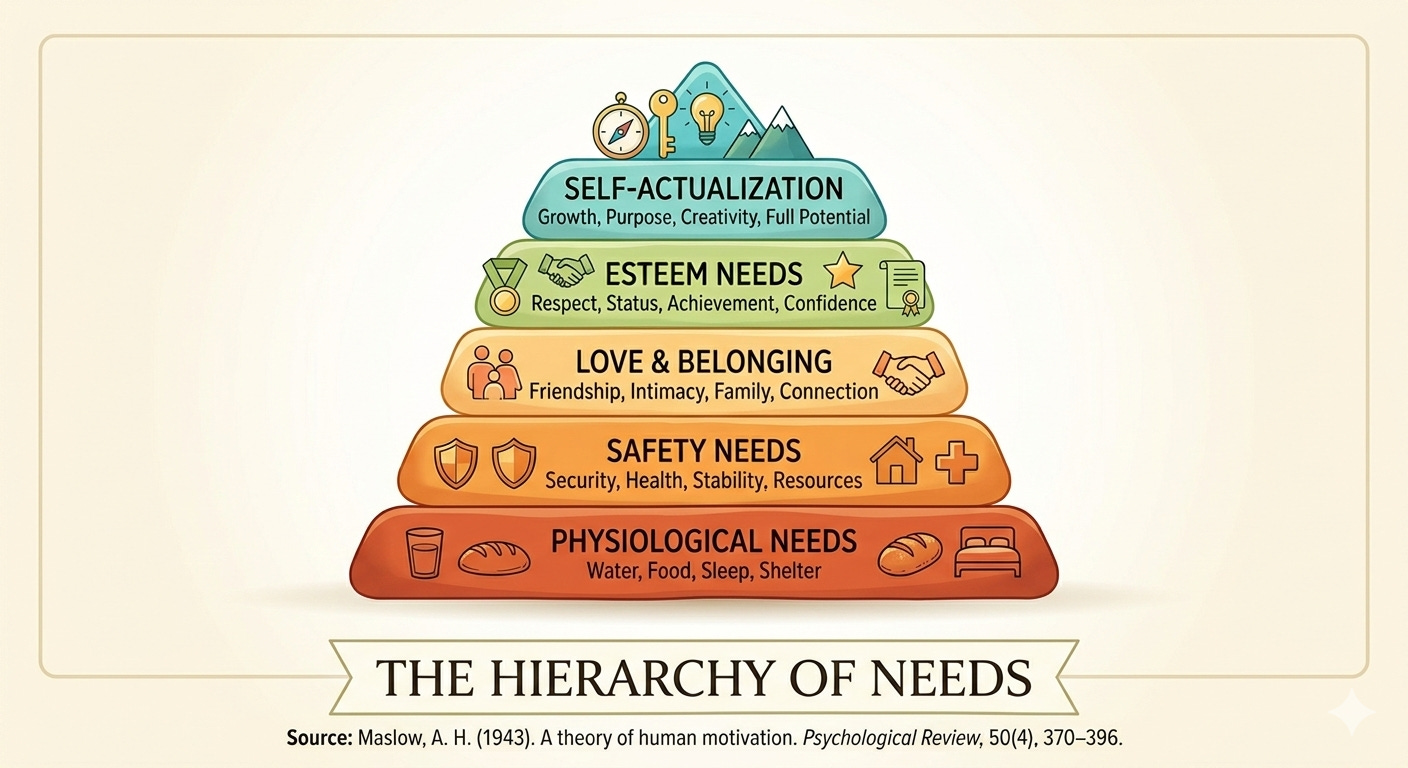
If your job is at risk, what provides your physiological needs: water, food, sleep, shelter? Your brain can only focus on those needs until you can achieve them. Now, see where "Love & Belonging" is on the image above? Many of our own parents, elders, colleagues, etc., choose belonging because their amygdala, just like ours—considers the concept of belonging a physiological safety need. It is the biggest threat to self. So much so, we lose track of ourselves and maybe can’t even hold a job, stable relationships, etc. The job represents a level of commitment that (like Leonardo DiCaprio and his dating age rules 🤭) some people cannot access or are unwilling to. This simply can be because the level of comfort associated with being committed to something, even a job, long-term is terrifying for some. "Am I going to be stuck here forever?"
Now, consider the concept Napoleon Hill coined as “drifting” from his book Outwitting the Devil. When we lose track of ourselves, sometimes we end up prioritizing relationships over our children. We prioritize ourselves over our children.
So, when we pick that need to belong. It could be belonging to a work system, it could be the feeling of needing to belong to a side (a parental side, a political side, a friends' side) that side could also be choosing the side of yourself. Every single one of those decisions is polarity, which we have to be careful of because the mind is sticky and rigid. If we train it to be consistently that way without adding the flavor of new ones, we are weakening our muscles of critical thinking and our ability to learn discernment. What ends up happening is we stretch our window of tolerance.
We stretch our window of tolerance.
Looking at the image below, being stretched into the different color zones. The red zone or the brown zone happens because the environment or other people are stretching you outside of what is the optimal arousal zone. The zone we want to aim for. Understand that even having days where we end up in the hyperarousal zones, but we make it back into the optimal arousal zone, those are still fantastic wins. If we have days where we're stuck in the hyperarousal zone, let's see if we can work on our level of metacognition here— so we can train our ability to notice when we drift into the red zones.
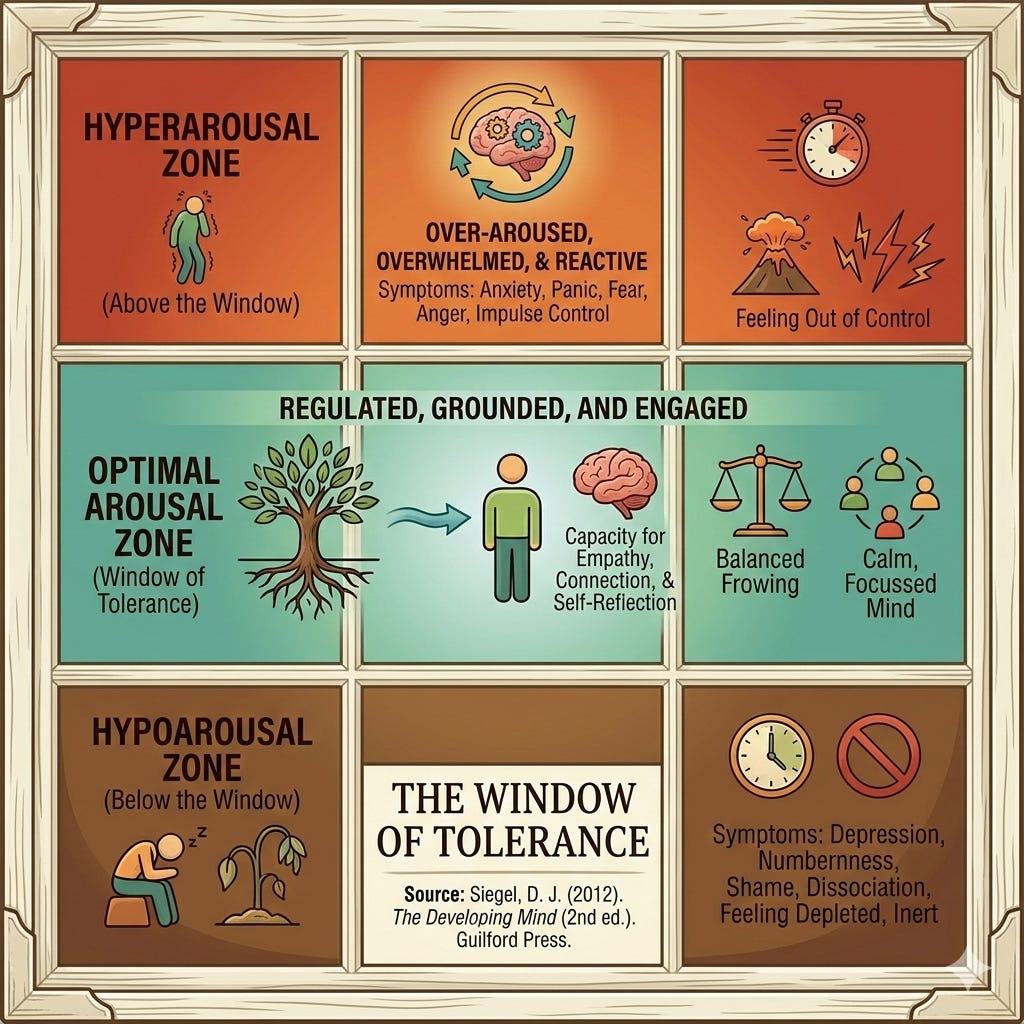
When we stretch our window of tolerance, we are basically telling our "little self" as we hammer that square peg into that round hole: "This is not sustainable for us." We say to the subconscious, "You can’t handle anything else but the pain and discomfort of this round hole we do not fit into." We dismiss our nervous system; we dismiss our resiliency of what we have already endured and survived; we dismiss our brain's magic ability to rewire. We keep hammering away, chipping at ourselves, not realizing the long-term effects this will have on our sticky little brain.
Teaching that silencing what happens is safer than speaking up is a lie. Also remember: every knowing being of what information is forced into silence, their body knows the lie it is holding. Think of the mind-body connection here. It almost makes us reflect on recent research by Dr. Michael Slepian (Columbia University), which has shifted our understanding of secrecy. It isn’t just the “hiding” that hurts; it is the cognitive load of living with the thought. We often talk about “carrying” a secret or “weighty” regret as if it’s just a metaphor, but the biology to that story tells a much grittier version.
When we hold onto a lie or a deep-seated regret, our brain doesn’t just store it in a quiet folder; it treats that information like a constant, low-grade threat. Dr. Michael Slepian (2019) found that the real damage of secrecy isn’t the “act of lying,” but the exhausting mental loop of thinking about it. This “cognitive load” keeps the body in a state of high alert, which eventually shows up physically.
Now, zoom out. Where are you looping in the same way, keeping you on high alert? Women? Many of us feel our partner needs to change his behavior, delete his socials, and do what you say in order for the relationship to be at “peace.”
Think of it as a "Body Tax." When you’re stuck in the Hyperarousal Zone the top part of Dr. Dan Siegel’s (2012) Window of Tolerance your nervous system is red-lining. You see this in the field as chronic jaw clenching, "mysterious" digestive flare-ups, and a heart rate that won’t settle down. I see it in my clients' sleep patterns, inflammation in the face, back pain, and irregular or missing cycles for women. Roese and Vohs (2012) point out that chronic regret acts like a glitching program in our hardware; we keep trying to "fix" the past, which spikes our cortisol and creates systemic inflammation. Essentially, if the mind refuses to process the pain or tell the truth, the body starts screaming through symptoms to get our attention. Do we listen? Probably as much as the parental wound listened to the little you…
As the saying goes, the body keeps the score.
Internalized Patriarchy Is a Survival Strategy
Now, one of the patterns I have been seeing and holding for many clients in this city. Across workplaces where men act inappropriately toward younger women, a consistent pattern appears again and again. There is almost always an elder woman in proximity to power who minimizes complaints, discourages reporting, reframes harm, or “handles it quietly.” She may scold the man privately. She may offer vague reassurance. She may advise the younger woman to “let it go,” to “be careful,” to not cause trouble. What she rarely does is confront the system or side publicly with the vulnerable.
Is this a coincidence?
I think it’s conditioning.
Research in feminist psychology and sociology consistently shows that women who came of age in rigid patriarchal systems often internalize male-dominant norms as a means of survival rather than their true internal belief. Deniz Kandiyoti famously described this as "patriarchal bargaining"the unconscious negotiation women make to secure safety, resources, or status within male-dominated hierarchies. Um… Tyra Banks? Perfect example of that. Can we see how silent we as a collective get when the label of "villain" gets placed on someone that looks like you? Hmm… Now we start reaching for justifications. I call this the selective outrage.
For elder women, proximity to male authority often became the price of stability.
Speaking up historically meant:
loss of income
social exile
retaliation
moral condemnation
or becoming the “difficult woman”
So silence became framed as a wisdom many chase and even are honored for. Endurance became framed as strength. Compliance became reframed as well…Maturity.
What do you think this does to the collectives sticky brains?
They adapt into the belief that compliance is safe and demanding it is the mature thing to do.
Why Younger Women Are More Threatening Than the Man Himself
From a systems perspective, younger women are considered dangerous because they are unconditioned. Divergent much?
They haven’t yet learned to override discomfort.
They haven’t yet traded safety for belonging.
They haven’t yet normalized harm as “just how things are.”
Family systems theory shows that individuals who disrupt homeostasis even by naming truth are often targeted more harshly than those causing harm. This is something even I have experienced first hand being online. And guess what, it’s the women who are the most aggressive in the DM’s.
Now, In these dynamics, the man is predictable. The younger woman is destabilizing to the predictable system. So the system responds by silencing her, not stopping him. Raise your hand if you have been silenced in the workplace? Shit, over 10 years ago, I had a whole orthodontist demand I take my review down, tried to bride me with services to do it. This shows up everywhere
Now I want you to reflect briefly for a moment. Any of this sound familiar for you?
Attachment, Power, and Identification With the Aggressor
Clinical psychology adds another layer.
Anna Freud described identification with the aggressor as a defense mechanism where individuals align with power to reduce their own vulnerability to what is threat to their safety. Elder women who endured sexism, harassment, or exploitation without protection often unconsciously identify with male authority rather than with younger women whose pain reactivates unresolved grief, rage, or helplessness. Protecting the man protects the psyche from confronting what was never protected in themselves.
Grief…
Why “Handling It Quietly” Feels Safer Than Accountability
Organizational psychology research on institutional betrayal shows that systems often prioritize reputation management over individual safety. Elder women placed in supervisory or gatekeeping roles are frequently tasked explicitly or implicitly with containment rather than justice.
This creates a role conflict:
Confronting the man risks destabilizing the institution.
Supporting the younger woman risks exposing systemic failure.
Silencing preserves order.
Order becomes confused with ethics.
Cultural Context Intensifies the Pattern
In collectivist or reputation-based cultures including many medical, religious, academic, and tight-knit ethnic communities, hierarchy is protected at all costs. I have seen this in therapy sessions and in clinical behavioral health capacities, especially with children and the loyalty binds to the parent, even if that parent is harmful. Research on honor-based systems shows that whistleblowers are often treated as traitors, regardless of what the truth is. Elder women, having survived within these norms, may view silence not as a form of harm, but as responsibility.
Also, zoom out a bit.
This is what helps us lead with curiosity instead of blame, because those of us that are accustom to living in chaos waves, the moment we reach the calm waters of the lake, we begin to feel unsafe. Why? Because the waves are familiar and we built skills adaptations to survive those waves. This is the same concept of the generations before us that do not know how to adapt to a world with "boundaries" and "safe spaces." Often, especially here in this city, I will see the older generations of women weaponize those very terms to get back the control that worked for them, but disconnecting their family from themselves in order to manage the women's emotions. This is what outsourcing is. In cultures where we scapegoat "The Culture" to justify harm, this is why you see it in the workplace; it spreads there.
The younger woman is framed as reckless.
The elder woman is framed as realistic.
The man remains untouched.
Sort of the same dynamic when they were kids right? (now, pause. We know if we are exercising our dendrites for nuance this is not the case for all correct?)
Just checking…
Think about it. Many times when I work with clients who have been cheated on, the woman turns on the "other woman" instead of turning on the man who was unfaithful. This in itself represents the very pattern these young women, as kids, watched their mothers do. They would hold the daughter accountable while bypassing what the son does. I saw this within my own family dynamics growing up, but also my husband’s family. I married into a Punjabi family; the hardest part about being in cultures that use religion and "this is how we are" is how often I watch little girls get bypassed. Little girls get slapped, or even their lip gets busted, because their little brother was never taught respect, boundaries, and the word "no." Many times in families that do not have the skills on how to navigate these complexities, they laugh when incidents happen. Many mothers also feel unsupported when faced with challenging boys with bad behavior and aggression. So how do they even get support? Especially if the elders are telling them how to parent.
This Is How Patriarchy Replicates Itself Without Men Having to Enforce It
How do you think patriarchal systems survive? Truly? It didn’t survive because men are powerful. They survive because women are trained to manage harm quietly, absorb discomfort, and redirect accountability downward. This does not make elder women villains, but for many who have not exercised the cognitive muscle of discernment, they will see this as blaming women. That is quite the contrary to my work. I speak about these patterns because someone has to.
For many who grow up in abusive environments with a mother or father who would allow the brother to get away with being physically harmful to the daughter,and only intervene with the son screamed for mom. If mothers and son cultures are being scrutinized for the way in which they are parenting, especially their boys. They are going to do what they need to do in order to survive that dynamic. Not understanding the unconscious dynamic they're creating within their children.
Field Note: The Metabolism of Harm and the Body Tax
This conversation is not about bashing men, and it is definitely not about bashing women. I want to go on a brief tangent real quickly about this because it is probably one of the aches I have experienced the most being online publicly. The amount of people who discharge their own unhealed wounds onto you, simply because they never learned how to metabolize them, is the same ache that shows up in the workplace. I myself have experienced workplace dynamics: being ambushed, having women threaten my license—all of it. Working in a school setting in this city really opened my eyes to selective avoidance: how we bypass harm depending on who did it, yet hold others accountable simply because we don’t like them, or because they said something we misperceived, or better yet, hating you because of how much others love you.
It’s easier to frame discussions that are difficult by externalizing blame, yelling “victim blamer.” But the one thing I have learned about those who scream that? They often suppress, hide, and cover up harm. This suppression isn’t just a social habit; it’s a physiological burden. As Slepian and Moulton-Tetlock (2019) noted, the “cognitive load” of keeping secrets or hiding harm drains our mental resources and keeps the nervous system in a state of constant, low-level threat.
How are families supposed to heal if the older generations shut you down from talking? Meanwhile, they still expect you to honor what they need you to honor for them because it regulates them. But have we ever asked what makes our parents and the generations before us so activated to begin with? Avoidance and suppression do so much to the body. Chronic regret and unresolved trauma act like a “glitching program” in our biology, spiking cortisol and causing systemic inflammation (Roese & Vohs, 2012).
Substance use gets manifested as a coping means because to live with harm, an ache, or a breach of safety—without being protected by your own parents—feels like a level of abandonment. It leaves you feeling safer to just mimic the same adaptations they keep trying to instill within you. This is the core of the "mind-body" trap: when we are forced out of our Window of Tolerance (Siegel, 2012) by a lack of protection, our bodies begin to "keep the score," manifesting that emotional abandonment as physical pain, fatigue, or addiction. It is about understanding how certain people repeatedly get away with harm inside cultures and systems built on avoidance and why that pattern persists across generations.
Because when harm is never named, it doesn’t disappear.
It mutates and spreads.
This Happens to Men Too and Often by Other Men
Men are also harmed in these systems. In workplaces, institutions, teams, fraternities, religious settings, and medical hierarchies, younger or lower-status men are often subjected to boundary violations, humiliation, coercion, hazing, or sexualized misconduct by more powerful men.
And the response is often the same:
minimize
normalize
joke
redirect
silence
“Don’t be dramatic.”
“That’s just how he is.”
“You’ll get over it.”
The system protects the offender because he holds power and the culture has learned to orbit around it. The same way it learned to orbit around the woman in the other example.
Avoidance Is the Root, Not Gender
Cultures that are organized around avoidance prioritize:
harmony over truth
reputation over repair
stability over safety
containment over accountability
In these systems, naming harm is more threatening than the harm itself.
In these systems, naming harm is more threatening than the harm itself. So the response becomes managerial in nature. This is how people “get away with things”—not through conspiracy, but through collective discomfort with confrontation. If I had to point the finger at the culprit of what I see in the community I serve in El Paso, this is the pesky culprit: Fear of confrontation.
It Starts in Childhood and It’s Not Subtle
What I have seen in my clinical practice, especially at the time when I was working with children... Unfortunately, due to the amount of subpoenas you get when working with kids, it just became so problematic for my other clients to work with kids because now we pull systems in. But what happens if the system the child’s family is in is also the same system that the city operates in? Now you have school staff, judges, therapists, and doctors that condition the same avoidance. It’s probably why me working here ruffles feathers, because I have no issue with confrontation, because I don’t see it as confrontation; I see it as communicating.
In many families, little boys are allowed to:
hit
bite
spit
rage
break boundaries
Behaviors that would be swiftly corrected in daughters are reframed as:
“He’s just energetic.”
“He doesn’t know better.”
“Boys will be boys.”
Meanwhile, daughters are taught early to:
self-regulate
anticipate others
manage emotions
be agreeable
take responsibility
This is not because parents don’t love their sons; it is because many mothers do not feel safe enforcing consequences on boys the way they do with girls. Why is that, I wonder? Who is watching? 👀
That discomfort matters, but so does the need for inquiry.
The Invisible Tron Highways (A.K.A: undercurrents of energy)

When Avoidance Meets Puberty, the Body Carries the Cost
When behavior is never named, limited, or metabolized, it doesn’t resolve, it discharges. This discharge becomes the invisible Tron highways of undercurrents the eyes can’t see but the body can feel. When that incongruences is named gaslighting starts. We see this at the macro all the time, we DARVO: Deny, Attack, Reverse, Victim, Offender.
Unaddressed aggression, entitlement, shame, and confusion often convert into:
hypersexuality
compulsive sexual behavior
substance use
emotional numbing
risk-seeking
This is what happens when we regulate the wrong way because no one taught us the healthy way. Avoidance doesn’t create peace it creates pressure. What happens to people under pressure with no release valve?
They implode on themselves. If you are in the cross fire that means you too.
Why Elder Women Protect Men Later in Life
When sons grow into men without ever encountering meaningful relational limits, the system adjusts around them rather than asking them to adjust or at least learn to adapt.
Elder women often step in as buffers:
smoothing conflicts
explaining behavior
discouraging complaints
reframing harm
Psychodynamically, this is linked to identification with the aggressor, a defense described by Anna Freud, where aligning with power reduces one’s own vulnerability. Protecting him feels safer than confronting the system that failed to protect anyone. Have a son and your mom will start interfering with your parenting because her old operating system can’t understand the new age princinspae of accountability. Also, please note. there are many mothers who step into the identification role with their own daughters. This could be due to wanting access to grandkids, or fear of losing the relationship. We also want to consider the intrinsic motivation behind those fears and attachment regardless if valid. Validity is not the point here. Inquiry is. The goal is to understand the why behind the behavior within ourselves. So if you are playing the role as the mother of the daughter who you fear will cut you off, take the grand kids, etc. That message is for you. Reflect, How did my daughter learn this. Not from the lens of blame. From the lens of investigator of patterns.
Now, Circling Back:
We have to circle back to where this begins: the family system. When silence shows up as a means of safety, it creates a devastating bind. Imagine a little girl coming forward to her mother, letting her know, “Hey, your boyfriend touched me,” or “So-and-so did XYZ.” If that mother has unhealed attachment dynamics, if she hasn’t learned how to advocate or voice her truth—she is paralyzed. She may be too afraid of rocking the boat with the family member whose son did it, or she’s terrified of the fallout within the family structure or her own partnership. The reasons don’t matter when we look at the impact long term. In that moment, that mother may unconsciously silence a real, visceral trauma in her daughter. The harm gets minimized because of the mother’s fear of facing a discomforting conversation.
This is exactly why, when I train my clients through effective communication protocols, I tell them: It is not about doing it perfectly. It’s about getting it out. That is the real work just getting it said. Because if you don’t do it now, the world will eventually put you back into that exact same position. You’re going to have to do it at work for yourself, or you’re going to have to do it somewhere else to advocate for your own child. The “Body Tax” and the systemic pressure will keep rising until the silence is broken.
The Conversation That Needs to Happen
The real question is not "Who is the villain?" It is:
Why does confrontation feel more dangerous than harm? Especially a harm that many of us are already silently suffering in?
Why are daughters expected to tolerate limits sons are not given?
Why does silence feel like safety? Who taught us it? Where do you think they learned it from?
What would accountability look like if it wasn’t confused with punishment?
This is not a gender war (despite the algorithms plot to turn the genders against each other. ) This is a systems inquiry, and systems only change when what was once unspeakable becomes discussable. All my work asks is…. Let’s put it on the table.
Like kinetic sand that we dig our hands in— Feel and explore.
Reflection for the Reader
Where have you seen harm redirected instead of addressed?
When has “keeping the peace” required someone else to carry the cost?
Whose safety was ultimately protected?
What came up for you with this?
Our corner of readers is growing and this is so so exciting for our corner of the internet! 🥰
As always Safari members.
Come as you are. Where you are. 🫶🏽
📣Don’t Forget: Advice Column is available.
For questions, patterns, or situations you’re carrying write in.
Link here.
References
Kandiyoti, D. (1988). Bargaining with Patriarchy. Gender & Society, 2(3), 274–290.
Roese, N. J., & Vohs, K. D. (2012). The Visualization of Regret: A Functional View. Current Directions in Psychological Science, 21(3), 172-177.
Siegel, D. J. (2012). The Developing Mind: How Relationships and the Brain Interact to Shape Who We Are. Guilford Press.
Slepian, M. L., & Moulton-Tetlock, E. (2019). The Cognitive Load of Secrecy. Journal of Experimental Psychology: General, 148(2), 217-232.
Van der Kolk, B. A. (2014). The Body Keeps the Score: Brain, Mind, and Body in the Healing of Trauma. Viking.