

Data Collectors,
I’m sitting here going for a walk right now, listening to FKJ Radio, surrounded by so much lush beauty. I mean, this is the City of Trees, and I am so grateful to be from the City of Trees and have the luxury of getting to come back and visit. I’m getting to walk in such beauty. It’s so painful at the same time because I miss home. Military life has taken us away from this beauty. So I’m thinking to myself because I live in the desert now, and the thought that came to my mind was the word “disorder.” As I am walking, I am thinking to myself, Okay, Sav... what does disorder actually mean? Well, first we have to look at the word order for there to even be a disorder. I am going to take us all on a semantics journey.As I contemplate this, we have to use word choices. For me, I internalize this curiosity as if there is disorder, it almost implies something is wrong. And if there is order, then that means right? Meaning there is a correct order? Is that the right order? And now, when I dive deeper, I start to think, Okay, what does “order” mean? To be right? To be wrong? Or to be incorrect? I think of order as sequence. If things are in order, they are in sequence. Okay, so then what sequence? To me, sequence is like 1, 2, 3, 4, 5. You don’t go 1, 5, 7, 8, 9. It’s in order.
Okay, so if you go back to order real quick, it can be in order chronologically. It can be in order by height. It can be in order by birthday. The order is dependent on what the context is, meaning what we are looking for that we want to be in order. So with that being said, back to sequence—sequence of what? See how we did all of this digging just from the word disorder? So sequence of what order?
And as I sit here, filling up my cup with my preferred drug of choice, which is nature walks, parts of me want to grieve and be upset. Be frustrated because I’m living here, meaning El Paso, not my home city of Sacramento, or at least back in California. I’m here—in this dry, crusty desert that I have so much resentment toward. This isn’t necessarily where I want to be, but it’s where we are currently living as of now. And as I’m visiting back home, I try to soak up as much of the nature and weather as I can. I could be constantly thinking about the grief of it all, or maybe even a little resentment because my husband’s military career is why we had to leave our home state. I could spiral and loop in my mind with thoughts of whyyyyy.
Going through this beauty in the emotional energetic frequency (think David Hawkins here), the state of pissed off, resentful, bitter, angry—those are low-vibrational emotional states. That low-vibrational state definitely is impacted by my husband, who I am going to use as the external factor in this behavioral equation. For those of you reading, it could be your partner, location, your kids, work, etc. It can be your external family, and when we are vibrating at low-vibrational states because of whatever the external factor is for you, in return it is causing us to operate in such a state that it becomes our baseline for functioning. A constant state of panic. Fear of abandonment. Fear of not being chosen. Fear, fear, fear. And there’s a sprinkle of a weekend here and a trip there, and maybe a month or two here of joy or connection, but a lot of it is dopamine. The sugar I get from the Trolli Sour Gummy Worms or the Nerds Clusters that I know I can’t be eating because if I eat them consistently over time—or binge eat them in one sitting (don’t judge me, I have my months 😫)—that candy f*cks my shit up. 😅
They literally make me so inflamed. You can see it in my face. You can see it in my body. I can feel the brain fog. I can feel the sluggishness. When I’m consuming things through my food that do not bring life to me, this happens. We don’t acknowledge it because it gives us that feel-good comfort.
Now, you can replace the candy with food. You can replace food with sex. You can replace sex with shopping, shopping with alcohol or weed, or even doomscrolling and posting pictures of yourself. The key idea here is: pick your poison—suffer the side effects. The problem with whatever poison you choose is what determines the circuit in the brain with how long that high lasts. So it might last—meaning the duration when you consume it—and then you’re high on it for X amount of seconds, minutes, hours, days, etc. What I mean by this is I consume XYZ, and I feel the dopamine high of that for ____ amount of time. I am enjoying the high of said ___ thing. Then, because of that high and the duration of it, we realize that amount of time becomes smaller and smaller. Meaning the amount of time I am high, enjoying that dopamine spike, gets smaller and smaller every time. As a result, if the high is very temporary— meaning it does not last a long time, you end up repeating usage to experience that dopamine high longer.
So I eat Trolli Gummy Worms and feel good, “pleasure” in that moment for, let’s say, I’m fulfilled for that hour. Until the next day, or maybe even later that night, when I am craving more sugar from those sour worms. Maybe it’s weed or a cigarette, and you get relief and pleasure during the duration of smoking it. Maybe you are high for a good 1–3 hours. Then you come down and crave more, so you take another hit. So if you are getting the sequence of what I’m trying to flow here, if I continue to eat these Nerds Gummies, these Trolli Sour Worms, and I’m eating them every day—and sometimes it’s the first thing I eat right when I wake up—I learn I can’t keep them in the house because I will stuff them places. I’m being silly here, but we do the same thing with our poison of choice. People do it with marijuana, alcohol, shopping, scrolling, etc. My point in saying all of this is—over time, I’m consuming it more and more and more, and it’s making me sicker and sicker and sicker. Then, over time, we live in that sickness. A week, a month, a year, two years, three years, four years, five years, 10+ years. That sickness is no longer sickness anymore. It is our baseline for functioning.
Sickness is all we know. So now it’s not even registered by the brain as sickness due to being so accustomed to that baseline. So maybe my skin is breaking out because of all the sugar, the brain fog, the ADHD symptoms, the weight gain, and the inflammation. All of those symptoms are my body trying to alert me—Savannah, the higher self—that something is wrong. But over the course of time, I bypass those signals, and I keep eating the sugar. I notice the changes but do nothing about them because I am getting relief from the dopamine the sugar provides, even if it lasts a short duration. I learn I can and will just consume more. Now, if it’s our baseline for functioning, the modern world says, ding, ding, ding—disorder. Whether that’s depression, anxiety disorder, ADHD, psychiatric disorders, personality disorders, based on the poison you picked.
Let’s understand something here. The poison you pick can very well be influenced by what you observed growing up, by your family or your environment. So maybe you grew up in a family that eats highly processed foods, candies, sodas, etc. This is your baseline for functioning. The thought of eating healthy sounds like death because sugar is a primary in your diet. Remember, I speak in metaphors and analogies. Sugar can be any of those addictive behaviors we listed above. I say all this to help the reader understand. This isn’t about blaming. It is about exploring what influences the choices you make. What influences the highway you choose to drive on. Remember my Highways of Communication? I will link that essay below.
🗺️📍Stop 2: The Three Communication Highways

Welcome back to our rewiring out of resentment series. In our last stop, we unpacked the fertile soil where resentment grows. Those unspoken expectations, the swallowed truths, the invisible ledger of keeping score.
So now fast-forward. Now we’re here in our disordered highway because that’s what the modern world says, but what if we’re not disordered? What if we’re drifted? Think about it—it’s like we were under a spell and it takes somebody outside of you or maybe deep deep work within you to kind of clean that window enough that you can finally see the light of who you used to be— the “higher self.” This isn’t about comparing who you used to be…No, it’s about comparing where your soul used to be and I’m talking about all of us as humans. Many of us may never have connected with ourselves at a soul level and that could simply be due to upbringing and not witnessing that work being modeled. We are all souls on a journey and our souls know the way home, but we’re the ones in the car driving it, because we’ve been given the vessel (our bodies) to drive it. We have been given the free will and agency to pick or oats and ride our lives on it through our choices. We all have free will and agency that we are not exercising enough in a way that does not leave us self abandoned. Because we’re not driving our own cars metaphorically steering our own ship. When we don’t steward our own lives that comes with side effects. So, as a result there is no order. There is no sequence. There is just this feeling of being out of alignment.
And I think because we have developed language for everything, which I think is an amazing trait that us humans have the ability to do. We take things way too far. To the extremes the same way we do with our poisons —remember the poisons? What causes us to disconnect from ourselves, whether it’s sugar, a substance, a food, a behavioral pattern, thought pattern etc. Those behavioral patterns can be having no habits, no structure, you’re not doing what you know at a soul level you should be doing. I don’t like using “should” language, but this type of should feels more like a need. It’s part of the responsibility that comes with being alive. It’s the duty we were given with our place here on Earth. It’s our responsibility to take care of what we have within us.
This vessel—that’s what I’m going to call it. Our bodies. But not just our bodies. Our nervous systems. Our minds. Being mindful, and full of intentional effort with our habits, our body, our mind, and our soul becomes part of the responsibility of taking care of ourselves. I think we’ve gotten so used to broadly naming things that I’m not even sure we know what we’re naming anymore. And if we don’t actually understand what we’re constantly naming, it becomes a form of cognitive laziness. A shortcut that provides nothing concrete for the mind to hold onto.
A perfect example of this is when people say, “We need to work on communication.” Communication this. Communication that.
Okay... but what does that actually mean?
Then we say, “Oh, I feel...” So now we have feelings. And boy, are they complex. You actually have to dive into the pool of those feelings and pull out specific emotions—anger, sadness, frustration, resentment, grief, shame.
We have to get concrete with the specific feeling, meaning we have to name it.
Yet what I’m noticing lately about our nervous systems is that we almost always have the blueprint that explains why we do what we do. Why we communicate the way we communicate. I feel____ because of ____.
Okay? And?
So with communication what exactly do you need to work on with communication? We must learn to get specific. Otherwise, we are holding a blank map with the word communication stamped on it, but with no directions telling us which way to go first.
Example:
“We need to work on communication when we are in an activated state.”
Okay... why?
“...Well, when we communicate, it turns into a fight where we overly criticize one another, speak harshly, interrupt, attack, and deflect...”
The dysfunctional dance.
Perfect. Now we have a path to take. Meaning we have a direction to turn so we can improve the dysfunctional dance by exiting the loop that keeps us stuck and disconnected. Think of Adlerian psychology. I believe everything has a time and a place, but sometimes we get so lost in the past of our trauma that we stop paying attention to the present symptom that trauma is contributing to in the present moment. We keep reaching back into the hippocampus archives, searching for answers, while the present-day consequences continue unfolding right in front of us, thus creating the gridlock we want help navigating through. What I mean here is this: maybe the symptom we’re trying to understand isn’t just about what happened back then. Maybe it’s also about the fact that this is all we’ve ever known. All we’ve ever felt. Maybe reaching for the past has become the only direction we, as a collective, know how to look towards.
I also believe that if we as humans don’t know another baseline to operate from, that could be true for other people as well. Our partner. Our family. Our friends. Our co-workers. They, too, may not know another way to be.
Let’s zoom in closer here.
If I feel____ emotion, that emotion may cause me to behave in a way that maybe everyone in my family behaves, too. So it becomes normalized within my blueprint, but not necessarily normalized within my partner’s, my friends’, or my co-workers’ blueprints. Let’s think about avoidant families here. When emotions enter the chat, the family learns to frequent Logistics Highway as a means of avoiding Expression Highway. Over time, we all inherit that pattern. We become frequent flyers to Logistics Highway. If that is true for me, you, and the cat down the road, then that means this occurs for many of us as humans. So when emotions enter the chat, we head straight to Spicy Island Town. We get loud. We cuss. We slam doors. We shut down.
All of those behaviors don’t actually tell us about the emotions that are at play. They don’t tell us about the vulnerabilities that have been activated. They just activate us right into the logistics autopilot path. For some households, pissed off and okay are the only two emotions that operate within the system. So we never explore deeper to get to the root cause and bridge the gap. We scream. We yell. We fight. We avoid. Meanwhile, the connection suffers. Families and couples start to drift from each other. We can only act like nothing is wrong for so long. Eventually, the pressure cooker fills up, and it needs a release.
Let’s zoom out a little more.
We have to think about what we’re currently navigating in our relationships. What are we navigating in our families? In our marriages? What behavior is happening to us that we are navigating with our partners or with our family?
'“I don’t get enough attention.
They made me feel neglected.
They don’t make me feel good enough.
I always feel left out.”
Okay? How do you know what not feeling “good enough” even feels like enough to even pinpoint that feeling to begin with? What were you experiencing before this person to have the ability to identify not feeling good enough?
Spend some time here because this concept is hard.
We often blame the present person for “making” us feel that way. But no one can make us feel something if we didn’t know that feeling existed to begin with. So if that feeling exists, it means it existed before the person who is currently poking at it. Which is a signal to the body that it’s an old wound that maybe has not gotten a chance to scab over and heal. So we have to understand that the stories our mind tells us when the wound gets touched become a portal. A time-capsule portal that can send us back to the original injury.
Remember, The Body Keeps the Score.
Now, what if the original injury was created by the same person who is currently poking it? For example, your partner created a wound, and now you want that behavior to change. Okay... what are you comparing their current behavior to? What is the reference point? We could be comparing it to the way that person made us feel in the beginning of our relationship. Maybe they used to behave XYZ, and now they don’t. So because they don’t behave the way they used to, now you do not feel “good enough.”
Let’s zoom out even more...
Is it possible that what feels like not good enough isn’t happening simply because they are no longer doing what they used to do or what you need them to do? Is it possible that what they gave you in the beginning created a feeling? And in the beginning, that feeling was good enough. So that feeling became the “poison” you got addicted to. You needed them to continue doing what they were doing to keep you feeling good enough. So the moment they stop...
BAM.
Now you don’t feel good enough.
When we get addicted to a poison, just like the examples before with substances, candy, scrolling, etc., we hyperfocus on the feeling we receive from it.
I eat Trolli’s to feel ____, which equals dopamine.
When we fall in love, we are flooded with oxytocin, serotonin, and dopamine. We get that cocktail from the “poison” of choice—that feeling of the honeymoon stage. If that poison provides us with such a good cocktail of hormones, we have to admit to ourselves that we’re not even living in reality anymore. We’re chasing the cocktail. We’re chasing the feeling the poison gives us. The poison, essentially, is the dopamine. The dopamine we get from falling in love. The dopamine we get in the early dating stage with high sexual chemistry. Just like the dopamine we get from substances, scrolling, shopping, or candy. And that dopamine comes with attachments.
Because I think about substance use, I think a lot about attachment. I think that’s why substance use is such a common thing for people to reach for. It can become rooted in attachment. We attach to other things, too. I have a whole-ass blankey—yes, I call it Blankey and I have had it since I was born 😫. I’m attached to it not being washed because I need it to smell a certain way. It provides me a sense of comfort. Some people get attached to other people. Others get attached to drugs, shopping, or dopamine of any kind, wherever they can get it, and get it fast. Now, my Blankey is an attachment. It comforts me. That’s a pretty mild example, but as humans, we tend to go to extremes.
Think about the word extremes. Think about the word extremist. When you hear those words, where does your mind immediately go?
Mine goes straight to politics because people are so extreme these days in the political arena. But more importantly, it goes there because that word has been primed in me due to the media.. If my mind immediately goes to politics, I’m now highlighting another mechanism of the brain. So let’s go back to disorder. I’m just pulling words from what exists in our modern society today. This isn’t me trying to push an agenda, despite that being a wound that many of us have. Being suspicious of ulterior motives. I’m highlighting perception here. I want to talk about this out loud with people who can handle a conversation like this, because I know many of you are going to assume a meaning behind what I’m trying to do, and there really isn’t anything I’m trying to do other than explore how our minds organize meaning.
There’s disorder everywhere we look. But now I want you to go outside. I want you to observe nature around you, whatever that looks like: stray animals, trees, bugs, birds. And I want you to sit with that energy.
I want you to notice how life goes on for everyone... but humans.
Now, I want you to go somewhere. If you can, go somewhere in nature. If not, go somewhere people naturally gather. Maybe it’s your downtown plaza or whatever your community has. I want you to simply observe the world around you. The buildings. The birds. The bugs. The trees. The wind. Just watch it all. Then I want you to watch the people living within it. Just gaze over them. Notice their mood. Notice their happiness. Watch them talking with other people. Connecting. Relating. Watch them laugh. Or maybe you see a parent going off on their kid, and you find yourself thinking,
“Sister... I feel you. It’s hard.”
Wish her well.
Or maybe you see a mom that’s pissing you off because she’s on her phone, not paying attention, and her child almost jumps off of ______, almost gets hurt, or runs into the street, and she still isn’t paying attention because she’s distracted talking. Now you’re feeling some kind of way.
What is that feeling creating inside of you?
Maybe it’s anger. Maybe you want to walk over there and say, “Hey, lady. You need to pay attention to your kid.” Maybe you feel the urge to tell her how to parent. For me, my immediate response is panic for the child. I want to intervene. That panic becomes the intervention. It’s almost automatic, like a reflex. My nervous system doesn’t really ask permission—it just moves. Now, depending on the situation, that response looks different. If it’s a fight, I’m coming in with “Ay yo!” energy. If it’s something like this, I’m much softer. “Hey, excuse me. Your child almost fell off of this.” Or, “Hey, your little one almost ran into the street.”
I don’t know what’s going on in your life, but I’m going to check in because that’s where my nervous system naturally takes me. Some people don’t care. And that’s something we end up observing, too. We witness people neglecting their own lives in the same way they neglect their children. Sometimes they genuinely don’t seem to care. Sometimes people call someone for help, and then it’s out of their hands.
But then you realize something else.
Even the systems we call often don’t do anything until someone is already dead or missing. This leads me to my next point. If we’re going to call humans “disordered,” then we also have to be willing to acknowledge that many of the systems we’ve built are disordered, too. If we’re going to be labeled as disordered humans, then maybe we also need to start considering disordering some of these systems. We need to question the systems that were built before us.
The tax system is one that I keep thinking about. Are you telling me that in order to own a house—even after you pay it off—you still have to pay property taxes? It sits on land you should own. It’s ridiculous. Where’s the incentive to actually own something? Then, if you rent, you’re constantly chasing because the rent goes up every year. Now you have kids to feed. Now it costs half your paycheck just to get to work because of gas. And we’re all just sitting here watching this shit show of a system feed us and gaslight already “disordered” people.
I’m currently watching this little Filipino family at the park, covered by shade and trees, and it’s beautiful. They’re playing cards, and people are riding bikes around the park area too.
Being back home in California, being with my family fills up my day in a way that I didn’t realize I missed. There are people to talk to. Smiles. Laughter. Stories being shared. Moments being made. Behavior that brings us forward to— the present. But I think we’re losing sight of those moments because we’re on autopilot, drifting in the fog. Remember the fog of the poison I brought up earlier? That poison could be substances. Scrolling. Maybe you’re dying inside. Maybe you feel like shit. Maybe you’re exhausted. Maybe your body is trying to alert you to something through symptoms. Maybe it’s affecting your mental health.
Whatever it is, we’re no longer fully present in these moments.
We’re in our heads. We’re analyzing. We’re overthinking.
“What did they mean?”
“What was that smirk?”
“Why did they say that in front of everybody?”
Especially when we’re around family, we lose the moment of connection because we’ve drifted somewhere else.
Think about it this way.
With the Highways of Communication, Logistics Highway represented by the everyday tasks: the kids, school, appointments, chores, groceries. It was the baseline category that most relationships naturally travel through. But what if there’s also a baseline highway for functioning? A loop that just keeps looping and looping and looping.
The difference is that everyone’s baseline highway is different.
These highways aren’t universal. They’re broad ranges of ways that people function. Mainstream psychology might call them Type A personalities, Type B personalities, personality traits, temperament, or something else entirely. Whatever we call them, I think there are many different baseline ways of functioning. Many “lanes” to operate in within baseline highway.
But there is one common baseline that I see so many of us operating in.
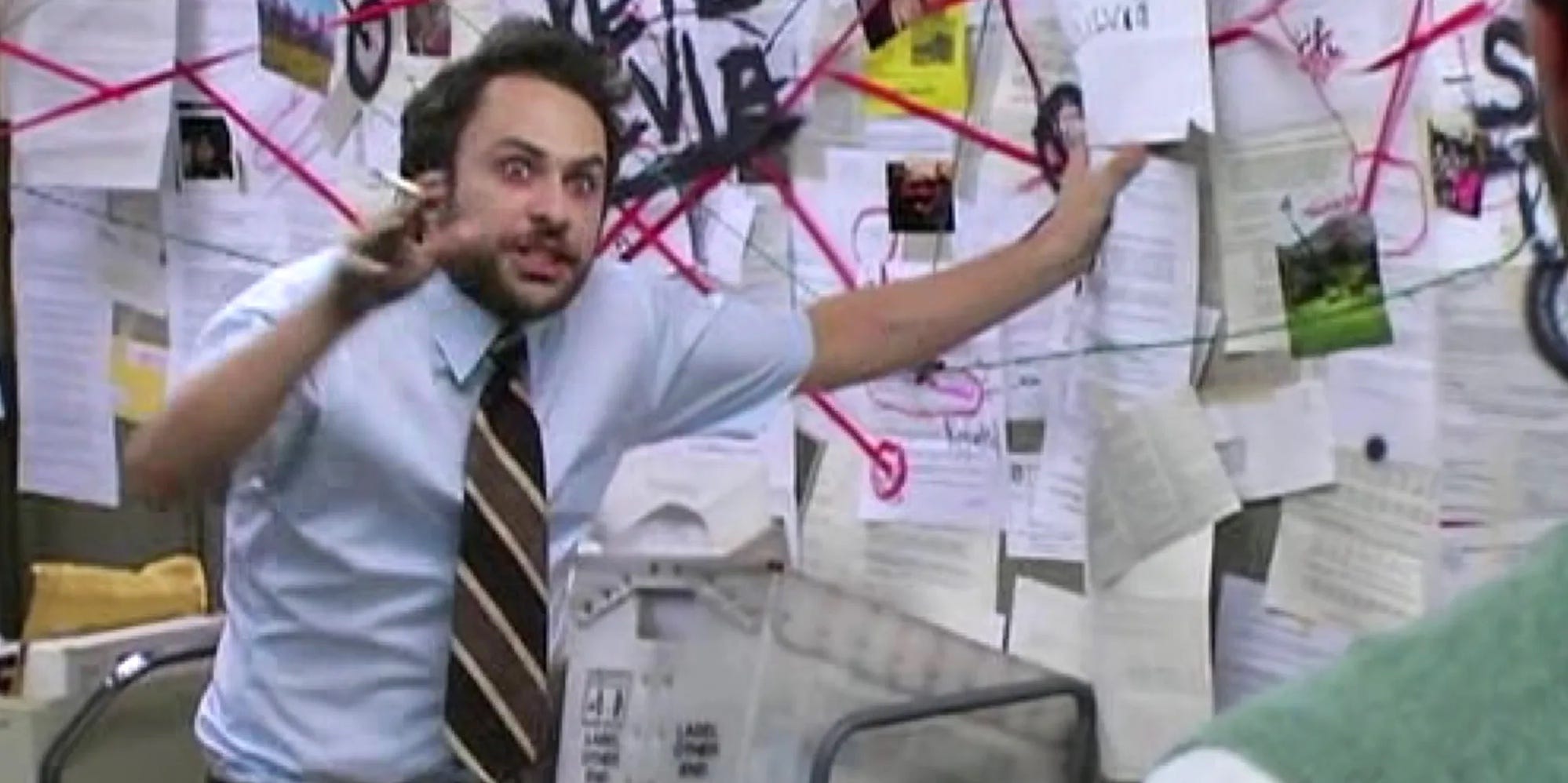
The image above this is what I call the Charlie Day phenomenon. I show this to my clients because I see it in myself, too. We’re always here trying to crack the case in the present moment.
“Am I with the right person?”
“Does he love me?”
“Does she love me?”
“Am I being taken advantage of?”
“Is this the right job for me?”
“Why do they always have to talk shit?”
It’s the pathway of hypervigilance.
If hypervigilance is our baseline, then our Baseline Highway also has a spectrum of lanes. And what I mean by spectrum is this: the Baseline Highway has multiple lanes that we can drive in. Some of us weave through all of them. Some of us chronically stay in one lane. Others chronically stay in another. Think about the people who drive in the left lane. They’re in the fast lane... but they’re driving slow, holding everyone else up. Think about the people who genuinely want to heal. They aren’t just intellectualizing everything. They’re trying to embody what they’re learning. They’re implementing skills. They’re eating healthier, and regulating themselves. They’re doing the work.
Let’s call that the Regulated Lane.
But even when you’re trying to stay in that lane, you inevitably find yourself behind people who don’t belong there. People whose behaviors pull you out of your window of tolerance (out of that regulated lane). People whose nervous systems begin interacting with yours until you slowly find yourself drifting out of your own lane.
Maybe this metaphor isn’t perfect yet, but stay with me.
We all encounter people who activate us. Sometimes we stay in toxic dynamics because of them. Sometimes we stay because of ourselves. Either way, we become caught in an internal loop that creates distress. When we’re around certain people long enough, they can activate us to such a degree that we’re no longer operating from our Regulated Lane.
Do you see what just happened?
You’re no longer in that lane... but you still feel like you are.
Because the amygdala doesn’t have eyes.
It doesn’t realize you’ve drifted outside of the lane you were trying so hard to stay in. Remember, we’re still talking about the Baseline Highway. This highway has multiple lanes across a spectrum. This is where I think our ego can quietly creep in. We become so convinced that we’re still operating from our highest self that we don’t even realize we’ve changed lanes.
I actually think floors work as a really good metaphor here, too.
In The Meantime, Iyanla Vanzant talks about how we all begin in the basement, and over time we work our way up through different floors. Some of us eventually allow people into our lives who are still operating on developmental floors we’ve already outgrown. They’re simply on a different floor. Since they’re operating from a different developmental level, their behavior begins interfering with ours. That interference creates reactivity. And if we repeatedly allow ourselves to lose our cool, over time that reactivity can become our new baseline. That new baseline only hurts us because we slowly begin drifting out of the Regulated Lane.
I can already hear people saying, “Well, what about what they’re doing?”
Exactly.
Now you’re in the Charlie Day cycle.
You’re not wrong. They very well may be contributing to the problem. But look at where it put you. It pulled you out of alignment. That right there tells you everything you need to know. And yet, you still don’t leave that lane. Why? Because you’ve become comfortable there. You’re addicted to it. That is your part. That is your role in the lane drifting that is occurring.
Let’s go all the way back to the beginning when we talked about disorder.
We broke down disorder. Then we explored order. That led us to sequence. Sequence depends on the sequence of what is being placed into order. So, within this psychological and human behavioral framework, I’m talking about the sequence of habits. The sequence of behaviors. The sequence of what we consistently practice. It’s also about how strong our discipline muscle becomes in maintaining the sequence of habits that keeps us in the Regulated Lane as our baseline.
You see what I did there?
Now we have a roadmap.
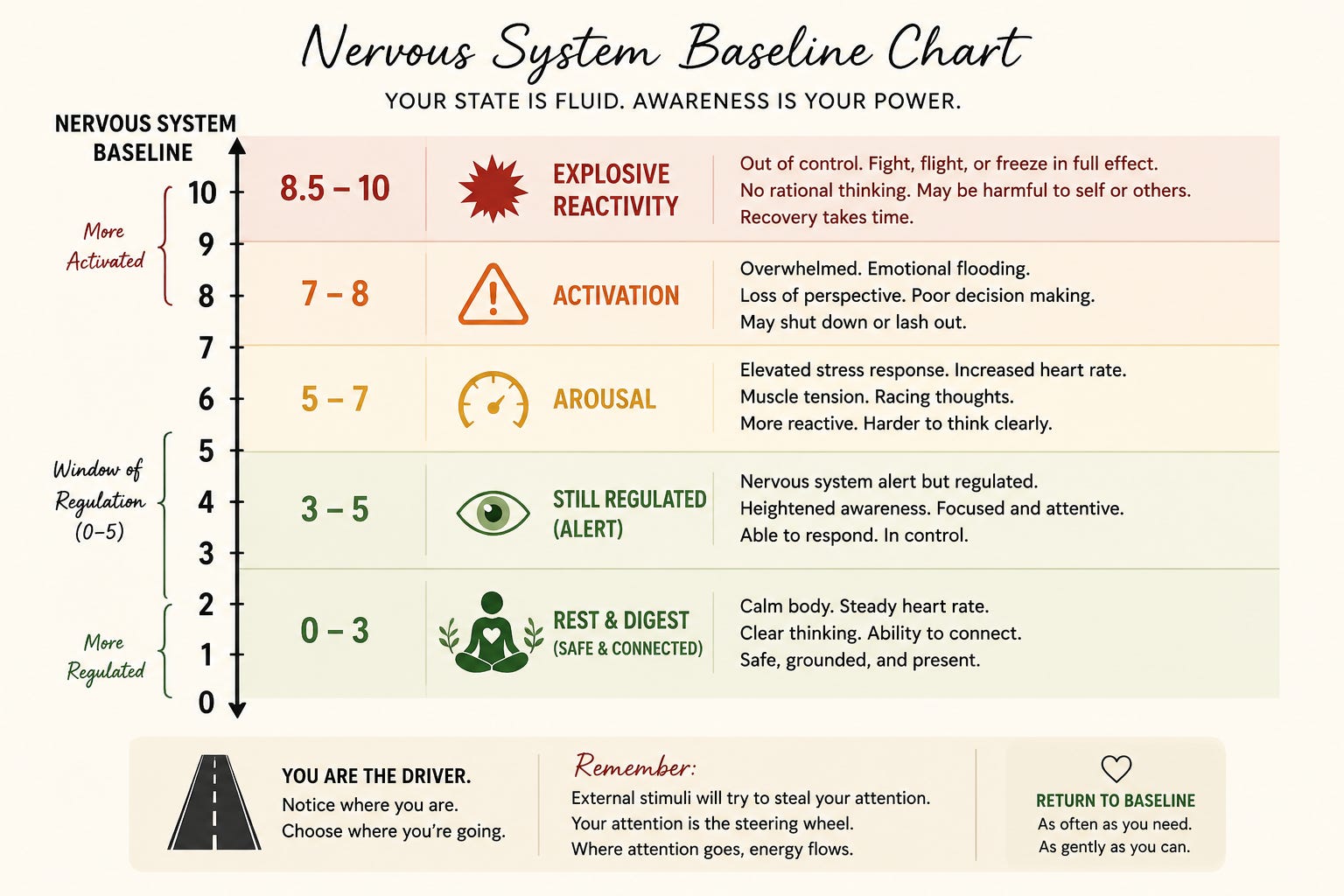
I have this nervous system baseline chart as shown above. On that chart, 0–5 is regulation, and 0–3 is that beautiful rest-and-digest regulation lane that is the goal for our wellbeing. That’s where we want to be. But here’s what’s fascinating. You can still be in the Regulated Lane and have something grab your attention 3-5 lane. You’re still driving in your lane, but some external behavior happening outside of you has the ability to cause your eyes to drift over into someone else’s lane because you’re thinking, What the hell are they doing now? That can happen in thirty seconds. It can happen in five minutes, or over an entire afternoon. What I’m trying to describe here is an attentional shift. If you’re still regulated, you’re simply aware of the external stimulus. You noticed it. Your nervous system hasn’t necessarily left regulation lane yet.
Now, depending on how long you stay focused on that stimulus determines whether or not you remain in the Regulated Lane.
Does that make sense?
Think about a teacher. A parent. A burnt-out partner. It really doesn’t matter who it is.
Sometimes all it takes is staying focused on that external stimulus for just a little too long...
Snap.
Now you’ve drifted into another lane.
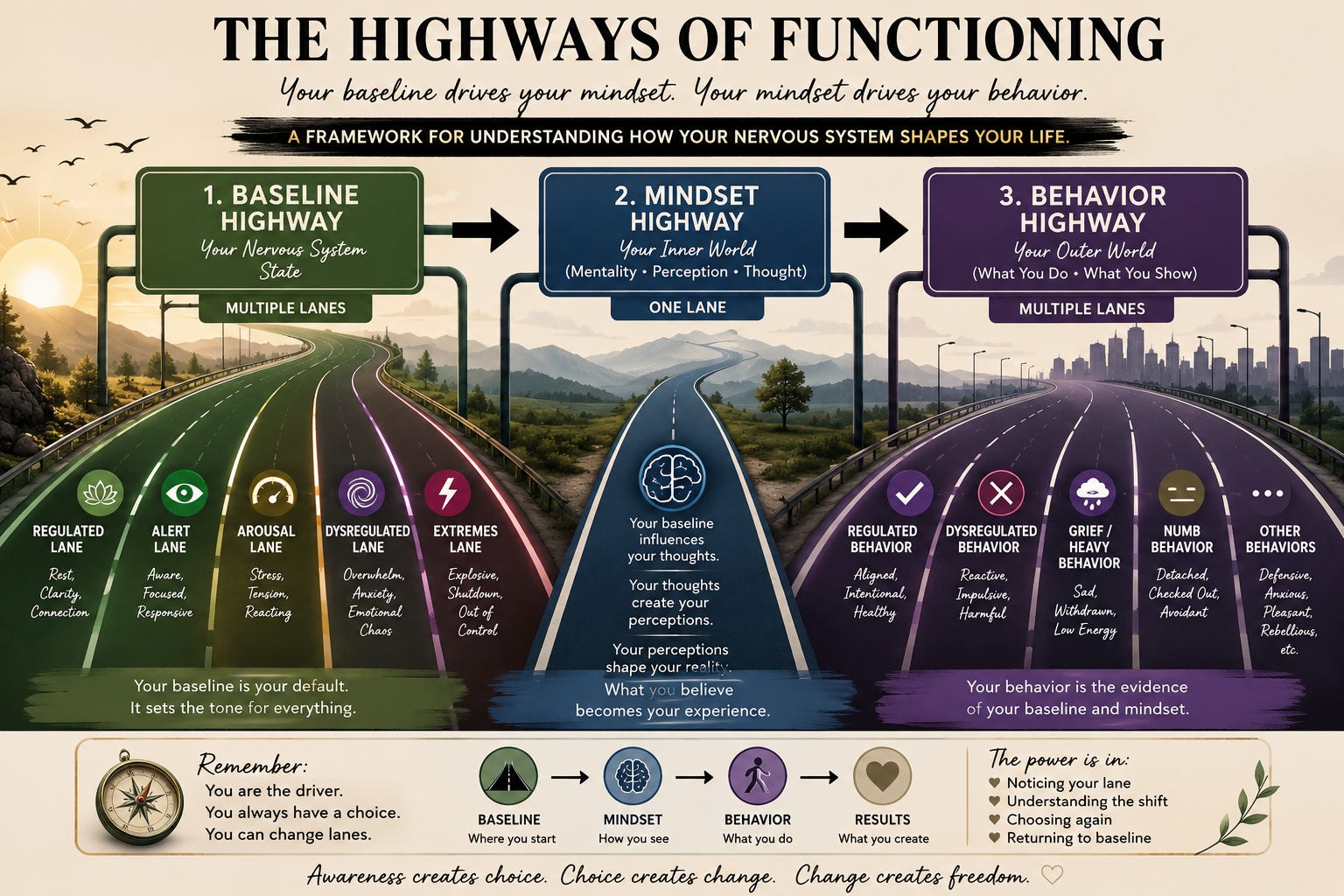
Once you snap, you’re no longer in the Regulation Lane. You’re no longer in the green zone. You’re in the orange or red zone. The red zone represents the extreme end of reactivity. The Activation Lane can house anger, frustration, sadness, grief—anything that keeps you out of the Regulation Lane.
Remember, this is the Highways of Functioning.
The first highway is the Baseline Highway. This is where your nervous system lives. It has multiple lanes, and the lane you’re traveling in determines your baseline for functioning. The Baseline Highway then influences the next highway, which is the Mindset Highway, or what I also think of as the Highway of Perception. This is where your thoughts, feelings, beliefs, interpretations, and perceptions are constantly interacting with one another. Your feelings generate thoughts, and over time those thoughts begin shaping your perception of reality. That Highway of Perception then feeds directly into the Highway of Behavior, which is the part everyone else sees. This is our actions. Our words. Our tone. Our body language. Our habits. Everything observable. Remember, behavior never exists in isolation. What we see with the eye has already been filtered through perception, and perception has already been influenced by baseline. We have to remember that.
So now behavior has multiple lanes because there are many different ways behavior can present itself. There’s regulated behavior, dysregulated behavior, grief behavior, numb behavior, defensive behavior, dissociative behavior, anxious behavior, pleasant behavior and even resentful behavior. There are all different types of behavioral expressions, and each one tells us something about what may be happening further upstream. That means we can’t just look at behavior by itself. We have to consider the baseline lane we frequent and behavior. We have to consider habits because habits become one of the primary lanes within the Highway of Behavior.
One of those lanes aligns with the Regulation Lane of the Baseline Highway. I think of that as the Healthy Habits Lane. These are the daily behaviors that support regulation rather than pull us away from it.
Now, the problem takes us all the way back to where we started... disorder.
Back to sequence.
The order of those habits is different for every single person because we are all unique. The same recipe will not regulate everyone in the same way. We spend so much time watching other people and being influenced by what works for them that we forget to learn the sequence of habits that keeps our own nervous system regulated. That’s where we have to be very careful. Very cautious. Very mindful. Otherwise, we end up trying to mimic the sequence in which other people stack their habits, and when that sequence does not work for us, we develop side effects. Anxiety. Depression. ADHD symptoms. Whatever it is. Not necessarily because the habit itself is wrong, but typically it is due to operating from the poison of comparison. We have to learn what works for us in order to stay balanced within our own nervous system. I think part of the Mindset Highway—the Highway of Perception—is heavily influenced by symbols. Symbols infiltrate our behavior because they first infiltrate our perception. Our brains turn things into symbols as a form of survival. If I can assign meaning to something, I can begin predicting what might happen next. That prediction is a survival process, even though you cannot see it with your eyes because it is happening internally within the mind.
Once I turn something into a symbol, I can create a meaning around it. That meaning can then produce an action or behavior in me. So instead of waiting to find out whether you might become a threat, my mind assigns meaning to you, predicts a behavior from you, and prepares me to protect myself. That is the danger of symbols. They can help us survive, but they can also cause us to respond to an assumed meaning rather than what is actually happening in front of us.
Now that I’ve guided you through this framework, I want you to take a deep breath because we’re about to place something under the magnifying glass. From this point forward, I don’t want you thinking about politics. I don’t want you thinking about religion. I don’t want you thinking about whether you agree or disagree. I want you to think like an observer. Like a researcher. Imagine we’re in a laboratory together studying human behavior. Our job isn’t to decide who’s right. Our job is to notice what happens inside of us while we observe.
The examples I’m about to use are modern-day examples because they contain symbols that many of us already have strong neurological associations with. That means your brain may immediately assign meaning before we’ve even finished collecting the evidence. That’s exactly what I want you to notice. I want you to pay attention to your own nervous system. What emotion shows up first? What assumption does your mind immediately make? Where does your Highway of Perception begin taking you before we’ve even looked at all of the information?
This has nothing to do with how I personally believe or where I stand on any of these topics. That’s not what we’re studying. We’re studying the human mind and perception. We’re studying how quickly the brain creates meaning purely from symbols and how that meaning begins shaping behavior before we’ve even realized we’ve assigned it.
So let’s begin.
Case Study One
A woman is standing in front of a California state monument made of stone in a beautiful natural setting. She is fully covered, with only her face visible, and she is waving a Palestinian flag. As she stands there, you hear people driving past yelling at her. Notice my wording. I said you hear people yelling. We never actually see the people yelling. We simply hear what sounds like a male voice shouting from a passing vehicle. The woman later gets into her car and begins reflecting on what just happened while recording herself on camera for social media. Based on that interaction, she makes the statement that California is “a dangerous place.”
Before we go any further, I don’t want you deciding whether she’s right or wrong. I don’t want you deciding whether the people yelling were justified or not. I want us to stay where we have stayed this entire essay—with observation.
What are the objective facts?
What did we actually witness?
What meanings has your mind already started assigning that we haven’t actually observed? That’s the hook that pulls you and conditions your nervous system into having an automatically response and skipping the key lane. Pause.
Now we’re going to take everything we just laid out and place this scene under the magnifying glass. We’re going to slow it down and examine it piece by piece. I don’t actually want to focus on the symbols themselves. I want to focus on the mechanisms underneath the symbols. This is where I think we miss each other as a human species. We get so caught up arguing about what the symbol means to us that we never stop to ask what our nervous system is actually doing while it’s assigning meaning to that symbol. So let’s start with the woman. Is she actually from Palestine? We don’t know. She’s dressed in what appears to be traditional clothing for her culture or religion, but that doesn’t actually tell us anything. Again, we cannot take what we see at face value. This is discernment training. Observation comes before interpretation. Just because my brain immediately wants to connect dots doesn’t mean those dots belong together.
So she’s standing there waving this flag, and afterward she reports feeling afraid. That immediately makes me curious. Where did she learn what danger feels like? How does she even know what “danger” is? Because if danger had been the only thing she had ever experienced, would she even recognize it as danger? Or would it simply feel normal? She entered California. She waved a flag. She received a response she apparently wasn’t expecting. That’s all we objectively know. Everything else is an unknown variable. What is her history? Unknown. What is her trauma history? Unknown. What experiences shaped her nervous system before this interaction? Unknown. We don’t know what those shoes have walked through before arriving at this moment.
Now I’m going to show you where my curiosity naturally goes, because this is what it looks like to explore instead of conclude. Let’s assume, for the sake of the exercise, that she is from Palestine. Notice what I just did. I made an assumption, and I’m telling you it’s an assumption. If that assumption happened to be true, my first question isn’t political. My first question is psychological. Why did she leave? Was she seeking safety? Opportunity? Family? Education? A different life? I don’t know. I’m not answering the question. I’m simply asking it. That’s a very different thing. I can already feel some of you wanting to answer that question. Notice that. Your Highway of Perception is already activating. I’m asking you to stay with the question a little longer. If she truly left her country to build a life somewhere else, I’m curious about the nervous system that arrived here. What experiences shaped it? What meanings has it already assigned to the world before this interaction even happened? Her waving that flag may represent many different things: pride, grief, home, family, loss. It may simply be the only flag she owns. I don’t know. That’s the point. We don’t know. I mean let’s be real, she may not even know.
Now let’s shift our attention to the person driving by. Imagine it’s the Fourth of July. They have an American flag flying from the back of their truck because they’re proud to be American. They see her waving a Palestinian flag. Instantly, their brain turns that flag into a symbol. That symbol becomes a meaning for them, about her. That meaning produces an emotion as a result that emotion produces a behavior. They yell at her. Notice where the behavior actually began. It didn’t begin with yelling. It began with perceiving. Then she gets into her car and records a video saying she feels scared. Again, my curiosity doesn’t stop with the feeling. Where did she learn to associate a man yelling with being scared? Has she experienced war? Abuse? Oppression? Violence? I don’t know. Those are questions, not conclusions. Remember The Body Keeps the Score. When she hears a man yelling, where does her nervous system go? Where does her perception go? What roads has she already traveled? What have those shoes walked through? What have those shoes fled?
Now let’s pause for a moment.
Now let’s pretend that guy uploaded a TikTok, just like she did, and now I’m watching his video. He’s some white, patriotic American bro (I know... stereotype, but stereotypes exist). He’s angry. He’s cussing. He’s got a Bud Light for the roadie. They’re headed to the beach or somewhere. Who knows. But he feels completely justified. Completely righteous in the anger he’s experiencing because, “How dare they bring XYZ, XYZ, XYZ over here. We’re in America. Go back to your country.” Maybe that’s what he’s saying. Again, he has made a meaning in his mind about her behavior of waving that flag. But where is that anger actually coming from? You really can’t sit here and tell me that a woman you’ve never met, standing in a park, waving a flag from a country she isn’t currently in, is enough by itself to make you that angry. Something else is happening. A symbol has been created, and a meaning has been assigned to that symbol.
The exact same thing happens when someone sees a white person waving an American flag and immediately makes a meaning about them. See how we’ve already left the present moment that I was talking about earlier? We’re not actually responding to what is physically happening in front of us anymore. We’re responding to the story our nervous system has attached to the symbol. We’ve drifted out of the present moment and into a specific lane within the Baseline Highway. Once we’re in that lane, we begin looping. That loop influences the Highway of Perception, and the Highway of Perception begins shaping the story we’re telling ourselves. Eventually, that story produces a behavior. In her case, maybe that behavior is getting on TikTok and sharing how unsafe she felt. In his case, maybe it’s getting on TikTok explaining why he was so angry. Different behaviors. Same mechanism.
Remember, at this point it isn’t even about the flags anymore. It isn’t about what she’s wearing, what she looks like. It isn’t even about that one interaction. We’re looking underneath all of it. We’re looking at the psychological landscape each person brought into that moment long before they ever crossed paths. Her story is different. His story is different. Both stories are valid because both belong to human beings who have lived different lives and developed different nervous systems. Does that automatically make either story accurate? No. And that’s exactly why this work matters, and why nuance is important. The moment we drift out of regulation, we lose access to curiosity and discernment. Once that happens we stop observing, and we start jumping to conclusions— taking a trip to distortion island. That’s the shift. We stop asking questions, and we start defending the meaning we’ve already made.
Now think back to the Highways of Communication. If we can’t access regulation, we can’t access those highways either. Instead, we begin looping. We defend. We criticize. We withdraw. We justify. We overexplain. We intellectualize. We attack. We shut down. Whatever lane our nervous system frequents becomes the lane we continue driving in.
Do you see the connection now?
We cannot communicate effectively because we cannot access regulation. And when we cannot access regulation, we cannot access the parts of ourselves capable of curiosity, discernment, and repair.
So we loop.
Looping is a form of avoidance. We all avoid differently because we all have a different flavor of what we loop in. Some of us loop in substances. Some of us loop in scrolling. Some of us loop in work. Some of us loop in relationships, or in hypervigilance, overthinking. We loop in our poison of choice.
So what is your poison?
How do you eat? What do you smoke? What do you drink? What do you scroll? What do you consistently reach for when your nervous system begins drifting out of regulation? More importantly, how repetitive is that behavior? Because repetition is what creates the baseline. The more consistently you engage in a behavior, the more it becomes the lane your nervous system habitually travels down. And over time, that lane begins influencing how you feel, how you think, how you process information, how you communicate, how you listen, and ultimately how you experience the world around you. Which is why it impacts your perception. We throw words around all the time like effectively. “Communicate effectively.” “Process effectively.” “Listen effectively.”But what does effectively actually mean? It means something different depending on the person because every one of us has a different Highway of Perception. We all assign different meanings to the same words based on the life we’ve lived, the experiences we’ve had, and the baseline we’ve developed into. Words are simply tools that help us translate what is happening inside of us.
Think about the technology we have today. I can speak English, and within seconds technology can translate my words into another language so someone else can understand me. That’s essentially what I’m trying to do throughout this essay. I’m translating information that many of us have carried for years but haven’t known how to organize. We’ve collected all this information. We’ve read the books. We’ve listened to the podcasts. We’ve highlighted the quote or talk about healing until we’re blue in the face. But so much of it stays intellectual. We keep holding it. We keep repeating it. We keep regurgitating it. We don’t embody it.
What does embodiment actually look like for you?
Because it’s going to look different for everybody. That’s the sequence. That’s the order. That’s what I’ve been trying to build throughout this entire essay. Your sequence is not my sequence, is not the next person’s sequence. My sequence is not yours. The goal isn’t to copy someone else’s recipe. The goal is to discover the sequence of habits that keeps your soul in alignment. Being in alignment becomes incredibly important because the longer we stay out of alignment with ourselves, the more we abandon the younger parts of ourselves that were already abandoned during development. Our developmental experiences shape the Baseline Highway. The lane we repeatedly travel within that highway begins influencing the Mindset (perception) Highway—our perceptions, beliefs, interpretations, and stories. Those perceptions then shape the Highway of Behavior, what everyone else can actually see. Over time, those highways become well-traveled roads. They become habits. They become loops, which then become personalities when stuck in them long enough. They become the routes we automatically take without even realizing we’re driving them.
Now, here’s what concerns me.
In today’s world, those chronic loops are increasingly being treated as identities. Mainstream culture often takes the lane you’ve been stuck in and turns it into a prediction about your future with disordered language. As if the loop you’ve been driving somehow determines who you are or what your life will become.
I don’t believe that.
I believe it tells us where you’ve been driving and how that route has caused you to loop. Not where you’re destined to stay.
Poverty. Homelessness. Chronic abuse cycles. Not feeling at home in your own body. Maybe you have what everyone else would call the “perfect life.” You have the money. The beautiful home. The successful career. The family. The vacations. All the things people spend their lives chasing. But internally, you still don’t feel good. Your relationships are suffering, so is your nervous system. It actually doesn’t matter what the circumstance is because everyone is navigating something. Every single one of us. The question isn’t whether you’re struggling. The question becomes where your struggle lives, what lane it keeps pulling you into, and whether you’ve mistaken that lane for who you are because pathology has become identity. Which robs us of the neuroplasticity our brains were designed to do.
Throughout this essay, I’ve used the word poison a lot, but maybe this is where I want to soften that idea. Maybe the goal isn’t to spend our lives trying to find the poison that hurts the least. Maybe the goal is to become so familiar with our own nervous system that we begin choosing what nourishes it instead. What restores it. What keeps it balanced. I don’t actually love the word healing because, for me, it almost signals perfection. Like one day we’ll finally arrive and declare ourselves “healed.” I don’t think that’s what this is. I think this is balance and an embodied form of awareness. I think this is learning how to recognize when we’ve drifted into another lane and having enough self-awareness to gently bring ourselves back.
That’s why we spent so much time talking about the Highways of Communication, and now we’re beginning to build the Highways of Functioning. Communication was never the whole story. Communication is simply what becomes visible, but underneath communication is perception. Underneath perception is nervous system baseline. Underneath baseline are the habits we repeatedly practice until they become the roads our nervous system naturally prefers to travel (our personality.) That’s why we started with the word disorder. We broke it apart. We looked at order. Then we looked at sequence. Because maybe the conversation isn’t actually about disorder at all. Maybe it’s about the sequence we’ve been stacking our habits in, because of outside influences, and we are doing that for years without ever realizing it. As we continue exploring this framework together, we’re going to place modern life under the magnifying glass. That means exploring the symbols being made behind: politics, family systems, marriage, social media, parenting, religion, culture, trauma, and addiction. We’re going to slow everything down so we can understand the mechanisms underneath human behavior. Once we develop the curiosity in mechanisms than conclusions, something shifts. Curiosity begins replacing certainty, which allows us to access critical thinking in order to make proper judgments from a discerned place and not a reactive state. That’s where I think growth actually starts.
It will probably make you uncomfortable. Good. I think discomfort is often the invitation into awareness. We’ve been conditioned to judge before we’ve been taught to observe. The same way we react before we’ve been taught to regulate. We’ve been conditioned to mistake our perception for reality. My work has always been exposure therapy, but check your baggage. This isn’t about trying to persuade you how to think or to even like me or believe what I believe. I’m trying to expand your capacity. The more capacity your nervous system has, the more difference it can tolerate without immediately translating that difference into danger.
The world is nothing but difference. So developing capacity provides you the skills necessary to be bilingual in the language of connection. Your partner will be different from you. Your children will be different from you. Your family will be different from you. Your clients will be different from you. Even the version of yourself ten years from now will be different from who you are today. If we don’t learn how to expand our capacity to tolerate difference, we’ll keep looping. We’ll keep assigning meanings that were never there. We’ll keep normalizing dysfunction simply because we’ve driven that road so many times it feels familiar. And familiar doesn’t always mean healthy or have a meaning at all. Sometimes familiar is just familiar.
Maybe that’s what disordered language has unintentionally done. Maybe we’ve become so focused on naming the outcome that we’ve stopped becoming curious about the sequence that produced that very outcome. We’ve become experts at labeling the destination while remaining strangers to the road that got us there. That’s the work I want to do with you. Once we learn to ask better questions we develop the ability to create better regulated observations which lead to greater awareness. Greater awareness creates different choices, and different choices create different habits. Over time those different habits create a different baseline for functioning in this world. And over time, that changes the direction of the entire highway (trajectory of our life.)
I’m excited to build this framework with you because that’s all these essays really are. They’re me thinking out loud. They’re me sharing the way my brain organizes the world. Some of it will resonate. Some of it won’t. Some of it will evolve because I’m still learning too.
So take what serves you. Leave what doesn’t.
Tell me where your mind went while reading this. Tell me where you noticed yourself making assumptions. Tell me where your Highway of Perception took over. Because if this framework does anything, I hope it helps you become a little less certain, a little more curious, and a little more compassionate toward the highways that both you and everyone else have been driving for far longer than either of us probably realize.
Till next time data collectors
👍 good