Every family system has a plate of meat somewhere.
That meat represents everything that happened but never got fully acknowledged. The grief nobody knew how to hold. The addiction everybody worked around or even tiptoed around. The betrayal that became “old news.” The abuse that got renamed as discipline, personality, stress, culture, loyalty, or “that is just how we are.” The shame, the secrecy, the abandonment, the resentment, the things people survived but never actually metabolized, processed, or even named. Instead of dealing with the meat, the family puts the plate in the closet, closes the door, and keeps functioning.
At first, everybody can smell it. The rot of it.
The children know something is wrong even when nobody explains what is happening. They notice the tension. They watch the adults change the subject. They feel the room shift when certain names are mentioned. They learn which questions make people uncomfortable, which emotions create consequences, and which truths are not allowed to breathe in the house. Family systems research has long shown that families organize themselves around patterns, roles, rules, and unspoken agreements that help the system maintain stability, even when that stability is unhealthy. Murray Bowen described how anxiety moves through family systems and becomes managed through emotional distance, triangulation, overfunctioning, underfunctioning, and other predictable patterns. Salvador Minuchin also showed how family structures can preserve dysfunction by teaching each member where they are allowed to stand and what they are permitted to acknowledge.
Eventually, everybody becomes nose-blind.
The meat is still rotting, but the nervous system adapts to the smell. Avoidance becomes normal, so does silence, while emotional shutdown becomes maturity, strength, or resilience. Hypervigilance becomes responsibility. Any of this feel or sound familiar for you? “We do not talk about that” becomes a family rule without anybody ever having to say it directly. This is part of how emotional learning works. Repeated exposure changes what the nervous system recognizes as familiar, and familiar can start to feel normal even when it is deeply uncomfortable. Trauma research has shown that the body learns patterns of threat, protection, and anticipation through repeated experience, which is why people can become highly adapted to environments that are emotionally unsafe while struggling to recognize that anything is wrong (van der Kolk, 2014; Siegel, 2010).
Then those children grow up.
They leave the house carrying the smell with them, but remember— they cannot smell it because their nervous system developed inside of it. They enter friendships, workplaces, marriages, parenthood, and community spaces with patterns that feel completely reasonable to them. They may not recognize their defensiveness, control, emotional distance, reactivity, avoidance, people-pleasing, or inability to repair as part of the old system. To them, it may just feel like personality. It may feel like, “This is who I am.” It may feel like, “This is how relationships work.” It may feel like, “I am just being honest,” “I need space,” “I do everything for everybody,” or “People always disappoint me.”
Then they meet another person who also came from a house with a closet that holds the rotten meat.
Their partner has their own plate of meat tucked away somewhere. Their own grief. Their own fear. Their own secrets. Their own emotional rules. Their own things they were taught not to smell. This is where relationships become interesting, because we are often completely nose-blind to our own rot while being able to smell every unhealed thing in the person across from us.
Healing isn’t about pretending the mold was never there.
It’s about scrubbing the pot, lighting the stove again,
and deciding that this time —
you’ll feed people something that doesn’t make them sick.
Stone Soup, but Make It Rotten
The original lesson behind Stone Soup is that a community can create something nourishing when everyone contributes what they have. One person brings the pot. Somebody else brings the carrots. Another person brings the potatoes, the seasoning, the broth. What begins as almost nothing becomes enough to feed everybody because each person adds something useful to the shared meal.
But in a rotten emotional system, we are still all contributing to the pot. We are just not always honest about what we are putting in it.
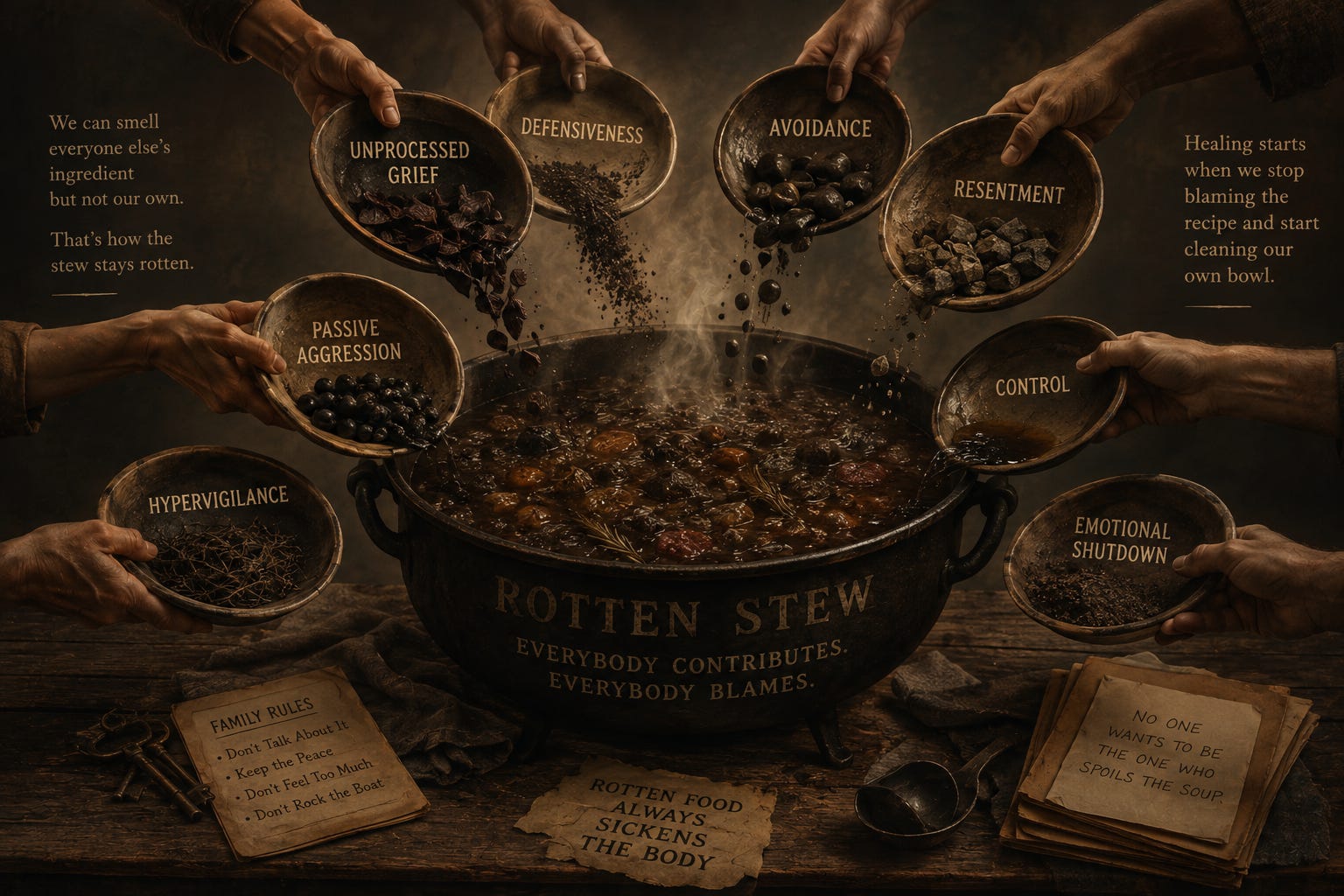
One person adds unprocessed grief. Another adds defensiveness. Somebody else brings avoidance, passive aggression, control, resentment, emotional shutdown, hypervigilance, or the inability to apologize. Everybody is dropping their displaced and unhealed behavior into the same soup, and then standing around the pot pointing at everybody else, asking, “Who ruined this?” That is how relational systems work. We are rarely responding only to what is happening in front of us. We are also responding through what we have carried in, what we have been conditioned to normalize, and what we have refused to process. One person’s withdrawal activates another person’s fear of abandonment. That fear comes out as criticism. The criticism activates defensiveness. The defensiveness creates more withdrawal. Now everybody can taste that something is wrong, but each person is convinced the rotten flavor came from the other person’s ingredient, not something that was a co-created.
This is how blame keeps the stew cooking.
We become experts at identifying what everybody else added while remaining nose-blind to our own contribution. I can smell your avoidance, but not my control. You can smell my resentment, but not your emotional absence. I can identify your defensiveness, but not the way I approached you with contempt already in my voice. We keep tasting the final product as though it was created by one person, when the truth is that the entire system has been feeding the pot. This does not mean every contribution is equal. Some people bring far more harm into a system than others. Abuse, coercion, betrayal, intimidation, and chronic emotional irresponsibility should never be flattened into “everybody played a part.” Accountability still matters, but in many resentment cycles, both people are adding protective behaviors that make the relationship increasingly difficult to digest.
Rewiring out of resentment requires us to stop hovering over the pot only to inspect what everybody else dropped into it. At some point, each person has to ask, “What have I been adding?” Have I been seasoning every conversation with old fear? This is where even I have to check myself with this work. Have I been adding silence and then blaming the other person for the lack of intimacy? Have I been adding suspicion, criticism, or defensiveness while demanding that the relationship taste different?
Stone Soup becomes nourishing because people contribute with intention. Rotten stew keeps spreading because people contribute unconsciously and then refuse ownership of the flavor.
The shift in this work begins when somebody becomes willing to bring a clean ingredient into the room: honesty that can exist without cruelty, accountability that can occur without collapse, grief without projection, boundaries without punishment, expression without explosion. One clean ingredient will not repair the entire pot overnight, but it can interrupt the assumption that the only thing left to do is keep adding more of the same.
Now with our stew it is easy to always look outwardly. I notice this since going public and receiving rotten strew responses from people perceiving my work and the intention behind it from their own lens.
You can see how their family taught them to shut down, but you may not see how your family taught you to become louder, sharper, or more controlling when you do not feel heard. You can identify their fear of vulnerability while remaining unaware of how your own criticism makes vulnerability harder. They can identify your emotional intensity while remaining unaware of how their withdrawal keeps increasing it. This is how two nervous systems can become locked in a dance where each person believes they are reacting to the other person, while both are also reacting to years of emotional material that entered the room long before the current relationship began.
This is how the stew becomes rotten.
Your nervous system is the pot. Everything you bring into the present gets cooked inside of it. New love gets placed in the same pot as old betrayal. A simple disagreement gets mixed with every time you were ignored. Your partner’s tone gets seasoned with your mother’s criticism. A delayed text gets stirred together with abandonment. A request for space gets mixed with rejection. A question about money gets mixed with shame, control, scarcity, and everything your family taught you about survival. The current moment may be real, but it is no longer the only ingredient in the room. Antonio Damasio’s work helped establish that emotion is not separate from reasoning; bodily states and emotional memory shape how we interpret, decide, and respond. Dan Siegel has also written extensively about how past experience organizes present perception through implicit memory, meaning we can react from emotional learning without consciously realizing what memory has been activated. In other words, the past does not always announce itself before it enters the conversation. Sometimes it just changes the flavor.
We leak what we do not process.
Unprocessed grief can become irritability. While fear can become control, shame can become criticism, helplessness can become contempt, disappointment can become emotional withdrawal. Resentment can become gossip, triangulation, passive aggression, or the need to make somebody else the problem— we see this a lot in the egoic mind. What we refuse to name does not disappear. It often finds another exit, sometimes through the form of displacement or projection. This is where emotional contagion matters. Research by Elaine Hatfield, John Cacioppo, and Richard Rapson showed that people automatically synchronize with the expressions, postures, voices, and emotional states of others. We are constantly reading one another through tone, pacing, facial expression, silence, body tension, and energy in the room. That means you can say, “I am fine,” while your whole nervous system tells everybody to brace. You can insist nothing is wrong while punishing the room with your silence. You can believe you are keeping your feelings to yourself while everyone around you is organizing around emotions you refuse to name. Just think about Thanksgiving and you are at the home of the person who was “okay” with hosting. You can tell in their demeanor and behavior that they clearly are not okay with being the host. They slam cabinets, have an attitude, cooking and washing aggressively. You ask if they are ok, they say “I’m fine.”
That is emotional pollution.
It does not mean you are intentionally trying to harm people. It means emotions move through systems. Stephen Porges’s Polyvagal Theory attempts to explain how nervous systems continually evaluate cues of safety and danger, while social neuroscience more broadly supports the idea that human beings regulate in relationship with one another. When one person is chronically defensive, shut down, volatile, contemptuous, or hypervigilant, the people around them do not remain untouched. The room begins adjusting to the nervous system with the loudest signal, even when that signal is silence.
This is why emotional hygiene matters.
Emotional hygiene is not pretending to be positive or spiritually bypassing grief. It is not forcing forgiveness because somebody told you that anger is low vibration. It also does not look like shaming yourself for being hurt, disappointed, jealous, afraid, or resentful. Emotional hygiene is knowing what you are bringing into the room before you ask everybody else to eat from your pot. Think of commute calibration here.

You do not wash your hands because your hands are evil. You wash them because you are about to feed someone.
The same is true emotionally.
Before we feed a relationship from our internal pot, we have to become curious about what has been sitting inside of it. What have I been stirring into every conversation? What happened long before this person that I keep assigning to them? What emotional leftovers am I reheating and serving as if they were created today? What am I calling intuition that may actually be hypervigilance? What am I calling honesty that may actually be resentment leaking without any form of regulation?
This is one of the stops in rewiring out of resentment.
Resentment does not only grow from what happened. It also grows from what never got cleaned, named, repaired, grieved, or understood. It grows when old pain keeps flavoring new experiences and we keep calling the taste proof that the present is rotten— good ol’ confirmation bias. It grows when we believe the problem is always the newest ingredient, never the pot.
Sometimes the relationship truly has spoiled ingredients. Sometimes there is active betrayal, cruelty, neglect, dishonesty, coercion, emotional irresponsibility, or repeated harm that needs to be addressed honestly. This metaphor is not meant to turn every present-day problem into childhood projection.
But sometimes we are trying to cook something new in a pot we never rinsed, While hoping onto TikTok story time shaming another human for a blindspot within ourselves we do not see.
And if we never become aware of that, we will keep blaming every new ingredient for a flavor that was already there.
Cleaning the pot may look like therapy, prayer, journaling, grief work, honest conversations, somatic movement, accountability, boundaries, repair, or finally naming the thing everybody in the family was trained not to smell or that you may not want to face about yourself. It may mean becoming the first person in the system willing to open the closet and say, “Something has been rotting in here, and pretending we cannot smell it is not the same thing as being healed.”
Healing does not require pretending the meat was never there.
It requires opening the closet.
It requires admitting that the smell has been affecting the whole house.
It requires understanding that becoming nose-blind may have helped you survive your family system, but it may now be keeping you from recognizing what you are carrying into the relationships you are trying to keep. The goal is not to become a perfectly clean person with no emotional residue, no no no. We are not here for that. That does not exist, or I should say it does, but not on this corner of the internet. The goal is to stop serving people from a rotten pot while insisting you cannot smell anything.
So before you ask what everybody else is adding to the stew, ask yourself:
What have I become nose-blind to?
What did my family system teach me to normalize?
What emotions am I processing, and which ones am I leaking?
What old wound keeps seasoning the present?
And what would it look like to finally clean the pot before I feed the people I love?
Till next time Data Collectors!